
सभी किताबें

पेशेवर

1 Markets I: The Ecosystem and Exchange-Traded Marketsबाज़ार ऑनलाइन 2 Markets II: Rates, FX and Creditबाज़ार ऑनलाइन 3 Markets III: Commodities, Energy and Cryptoबाज़ार ऑनलाइन 4 Quantitative Methodsविधियाँ ऑनलाइन 5 Derivatives and Volatilityडेरिवेटिव्स ऑनलाइन 6 Rates, Credit, XVA and Riskब्याज दरें, क्रेडिट और जोखिम ऑनलाइन 7 Research Craft: Predictors, Backtests, Measurement, Portfoliosअनुसंधान ऑनलाइन 8 Strategies I: Equities and Futuresरणनीतियाँ ऑनलाइन 9 Strategies II: Volatility, Relative Value, Macro and the Bank Desksरणनीतियाँ ऑनलाइन 10 Microstructure and Executionनिष्पादन ऑनलाइन 11 Market Making and High-Frequency Tradingमार्केट मेकिंग ऑनलाइन 12 Machine Learning for Marketsमशीन लर्निंग ऑनलाइन 13 Low-Latency Softwareतकनीक ऑनलाइन 14 Networks, Hardware and Trading Infrastructureतकनीक ऑनलाइन 15 Research, Data and Risk Platformsतकनीक ऑनलाइन 16 The Desk and the Firmफ़र्म ऑनलाइन 17 The Industry: Firms, Roles and Careersकरियर ऑनलाइन 18 Interviews I: Maths, Probability and Speedकरियर ऑनलाइन 19 Interviews II: Markets, Trading Games and the Final Roundकरियर ऑनलाइन 20 Interviews III: Codeकरियर ऑनलाइन
ऐप्स परिचय Coach लॉग इन पढ़ना शुरू करें

Quantitative Finance · शब्दावली

Scenario fan-out, task granularity क्या है?

अन्य नाम: scenario fan-out · task granularity

Definition 20.2 Research, Data and Risk Platforms · अध्याय 20 — The Risk Grid

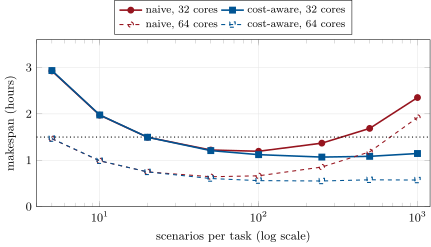
Scenario fan-out is the splitting of the scenarios into batches so that one trade batch’s revaluation runs as several tasks in parallel. Task granularity is the size of the resulting tasks — here the number of scenarios in a batch, the trades being grouped into batches of about half a second of pricing per scenario — which trades scheduling freedom against the fixed cost of each task.
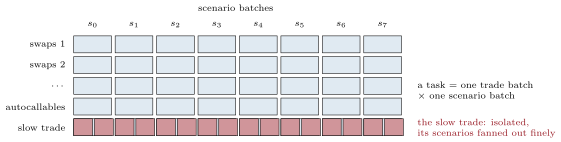
The grid as tasks: rows are trade batches grouped by estimated cost, columns scenario batches; every cell is a task. A cost-aware plan gives a trade measured slow its own row, with finer columns, so that no single task holds the window.
Figure 20.1. The grid as tasks: rows are trade batches grouped by estimated cost, columns scenario batches; every cell is a task. A cost-aware plan gives a trade measured slow its own row, with finer columns, so that no single task holds the window.
Makespan of the nightly grid on 32 cores (solid) and 64 (dashed) against the number of scenarios per task, for a plan that trusts the cost estimates (naive) and one that isolates the trade measured slow last night (cost-aware); the dotted line is the 90-minute window. Coarse tasks cannot be balanced; fine tasks drown in their fixed costs. Data: fig_riskgrid.py, with costs from bench_riskgrid.py.
Figure 20.2. Makespan of the nightly grid on 32 cores (solid) and 64 (dashed) against the number of scenarios per task, for a plan that trusts the cost estimates (naive) and one that isolates the trade measured slow last night (cost-aware); the dotted line is the 90-minute window. Coarse tasks cannot be balanced; fine tasks drown in their fixed costs. Data: fig_riskgrid.py, with costs from bench_riskgrid.py.
अध्याय में पढ़ें →