
Semua buku

Profesional

Aplikasi Tentang Pelatih Masuk Mulai membaca

Quantitative Finance · Glosarium

Apa itu Scenario fan-out, task granularity?

Dikenal juga sebagai: scenario fan-out · task granularity

Definition 20.2 Research, Data and Risk Platforms · Bab 20 — The Risk Grid

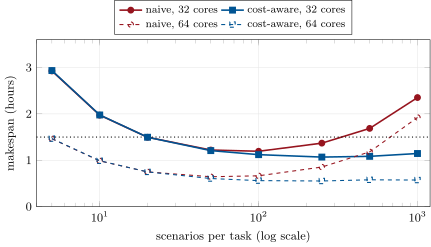
Scenario fan-out is the splitting of the scenarios into batches so that one trade batch’s revaluation runs as several tasks in parallel. Task granularity is the size of the resulting tasks — here the number of scenarios in a batch, the trades being grouped into batches of about half a second of pricing per scenario — which trades scheduling freedom against the fixed cost of each task.
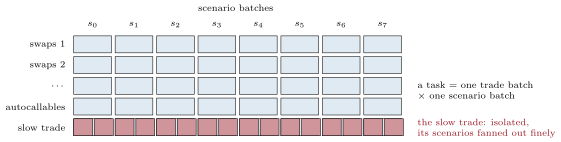
The grid as tasks: rows are trade batches grouped by estimated cost, columns scenario batches; every cell is a task. A cost-aware plan gives a trade measured slow its own row, with finer columns, so that no single task holds the window.
Figure 20.1. The grid as tasks: rows are trade batches grouped by estimated cost, columns scenario batches; every cell is a task. A cost-aware plan gives a trade measured slow its own row, with finer columns, so that no single task holds the window.
Makespan of the nightly grid on 32 cores (solid) and 64 (dashed) against the number of scenarios per task, for a plan that trusts the cost estimates (naive) and one that isolates the trade measured slow last night (cost-aware); the dotted line is the 90-minute window. Coarse tasks cannot be balanced; fine tasks drown in their fixed costs. Data: fig_riskgrid.py, with costs from bench_riskgrid.py.
Figure 20.2. Makespan of the nightly grid on 32 cores (solid) and 64 (dashed) against the number of scenarios per task, for a plan that trusts the cost estimates (naive) and one that isolates the trade measured slow last night (cost-aware); the dotted line is the 90-minute window. Coarse tasks cannot be balanced; fine tasks drown in their fixed costs. Data: fig_riskgrid.py, with costs from bench_riskgrid.py.
Baca dalam konteks →