
Todos los libros

Profesional

Apps Acerca de Coach Iniciar sesión Empezar a leer

Quantitative Finance · Glosario

¿Qué es Sequential-trade model, Glosten–Milgrom model?

También llamado: sequential-trade model · Glosten--Milgrom model

Definition 4.5 Microstructure and Execution · Capítulo 4 — Why There Is a Spread

A sequential-trade model lets traders arrive one at a time to a competitive, risk-neutral liquidity provider who quotes before each arrival and learns from each trade. The Glosten–Milgrom model is the sequential-trade model in which each arrival is informed with probability μ\mu and trades in the direction of the value, or is a noise trader who buys or sells with equal probability, and the provider sets the ask and bid to the expected value conditional on a buy and on a sale.
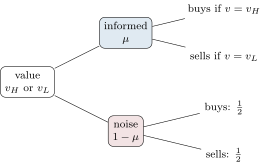
One arrival of the Glosten–Milgrom model. The provider sees only the direction of the trade; a buy is more likely when the value is high, by , and the ask is the value’s expectation given a buy.
Figure 4.1. One arrival of the Glosten–Milgrom model. The provider sees only the direction of the trade; a buy is more likely when the value is high, by μ\mu, and the ask is the value’s expectation given a buy.
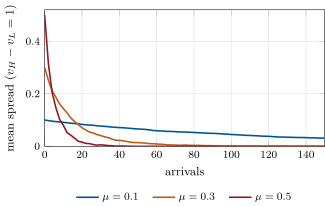
The Glosten–Milgrom spread along a sequence of arrivals, averaged over 400 paths (half with a high value): it starts at  and falls as trades reveal the value, faster when more arrivals are informed. Data: mx_spread.gm_learning.
Figure 4.2. The Glosten–Milgrom spread along a sequence of arrivals, averaged over 400 paths (half with a high value): it starts at μ\mu and falls as trades reveal the value, faster when more arrivals are informed. Data: mx_spread.gm_learning.
Leer en el capítulo →