
جميع الكتب

مهني

1 Markets I: The Ecosystem and Exchange-Traded Marketsالأسواق عبر الإنترنت 2 Markets II: Rates, FX and Creditالأسواق عبر الإنترنت 3 Markets III: Commodities, Energy and Cryptoالأسواق عبر الإنترنت 4 Quantitative Methodsالأساليب عبر الإنترنت 5 Derivatives and Volatilityالمشتقات عبر الإنترنت 6 Rates, Credit, XVA and Riskالفائدة والائتمان والمخاطر عبر الإنترنت 7 Research Craft: Predictors, Backtests, Measurement, Portfoliosالبحث عبر الإنترنت 8 Strategies I: Equities and Futuresالاستراتيجيات عبر الإنترنت 9 Strategies II: Volatility, Relative Value, Macro and the Bank Desksالاستراتيجيات عبر الإنترنت 10 Microstructure and Executionالتنفيذ عبر الإنترنت 11 Market Making and High-Frequency Tradingصناعة السوق عبر الإنترنت 12 Machine Learning for Marketsتعلم الآلة عبر الإنترنت 13 Low-Latency Softwareالتكنولوجيا عبر الإنترنت 14 Networks, Hardware and Trading Infrastructureالتكنولوجيا عبر الإنترنت 15 Research, Data and Risk Platformsالتكنولوجيا عبر الإنترنت 16 The Desk and the Firmالشركة عبر الإنترنت 17 The Industry: Firms, Roles and Careersالمسارات المهنية عبر الإنترنت 18 The Interview Bookالمسارات المهنية عبر الإنترنت
التطبيقات حول المدرب تسجيل الدخول ابدأ القراءة

Quantitative Finance · المسرد

ما معنى Store-and-forward and cut-through switching؟

يُعرف أيضًا باسم: store-and-forward switching · cut-through switching

Definition 2.1 Networks, Hardware and Trading Infrastructure · الفصل 2 — Switches and Layer-1 Devices

A switch using store-and-forward switching receives a frame completely, checks its frame check sequence, and only then starts to send it on the output port. A switch using cut-through switching starts to send a frame as soon as it has read the header fields it needs to choose the output port, while the rest of the frame is still arriving.
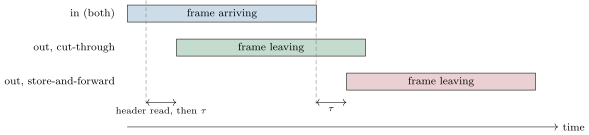
The same frame through a cut-through and a store-and-forward switch. Both wait for the switch’s internal time ; the cut-through switch starts after the header (left dashed line), the store-and-forward switch after the last bit (right dashed line), so it adds one whole serialisation of the frame.
Figure 2.1. The same frame through a cut-through and a store-and-forward switch. Both wait for the switch’s internal time τ\tau; the cut-through switch starts after the header (left dashed line), the store-and-forward switch after the last bit (right dashed line), so it adds one whole serialisation of the frame.

أمثلة

Example 2.3 (One order, three switches)

A 100-byte order frame at 10 Gbit/s10\,\mathrm{G}\mathrm{bit}/\mathrm{s}. A store-and-forward switch with a 500 ns500\,\mathrm{n}\mathrm{s} internal time (a model value, not a data sheet’s) adds 80+500=580 ns80 + 500 = 580\,\mathrm{n}\mathrm{s}; a cut-through switch that reads 64 bytes adds 51.2 ns51.2\,\mathrm{n}\mathrm{s} plus its internal time; a layer-1 device adds only its own few nanoseconds. For a 1 518-byte frame the store-and-forward switch’s toll rises to 1714 ns1714\,\mathrm{n}\mathrm{s}, the others’ do not change (Figure 2.2).

اقرأ في الفصل →