
सभी किताबें

पेशेवर

ऐप्स परिचय Coach लॉग इन पढ़ना शुरू करें

Quantitative Finance · शब्दावली

Store-and-forward and cut-through switching क्या है?

अन्य नाम: store-and-forward switching · cut-through switching

Definition 2.1 Networks, Hardware and Trading Infrastructure · अध्याय 2 — Switches and Layer-1 Devices

A switch using store-and-forward switching receives a frame completely, checks its frame check sequence, and only then starts to send it on the output port. A switch using cut-through switching starts to send a frame as soon as it has read the header fields it needs to choose the output port, while the rest of the frame is still arriving.
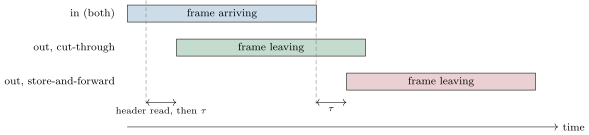
The same frame through a cut-through and a store-and-forward switch. Both wait for the switch’s internal time ; the cut-through switch starts after the header (left dashed line), the store-and-forward switch after the last bit (right dashed line), so it adds one whole serialisation of the frame.
Figure 2.1. The same frame through a cut-through and a store-and-forward switch. Both wait for the switch’s internal time τ\tau; the cut-through switch starts after the header (left dashed line), the store-and-forward switch after the last bit (right dashed line), so it adds one whole serialisation of the frame.

उदाहरण

Example 2.3 (One order, three switches)

A 100-byte order frame at 10 Gbit/s10\,\mathrm{G}\mathrm{bit}/\mathrm{s}. A store-and-forward switch with a 500 ns500\,\mathrm{n}\mathrm{s} internal time (a model value, not a data sheet’s) adds 80+500=580 ns80 + 500 = 580\,\mathrm{n}\mathrm{s}; a cut-through switch that reads 64 bytes adds 51.2 ns51.2\,\mathrm{n}\mathrm{s} plus its internal time; a layer-1 device adds only its own few nanoseconds. For a 1 518-byte frame the store-and-forward switch’s toll rises to 1714 ns1714\,\mathrm{n}\mathrm{s}, the others’ do not change (Figure 2.2).

अध्याय में पढ़ें →