
Tous les livres

Professionnel

Applis À propos Coach Connexion Commencer la lecture

Quantitative Finance · Glossaire

Qu'est-ce que « Stressed expected shortfall » ?

Definition 23.8 Rates, Credit, XVA and Risk · Chapitre 23 — Regulatory Capital for Trading Books

Stressed expected shortfall calibrates the ES to the most severe twelve-month period for the bank’s portfolio, computed on a reduced set of risk factors with a long history and scaled up by the ratio of the current ES with all factors to the current ES with the reduced set (at least one).
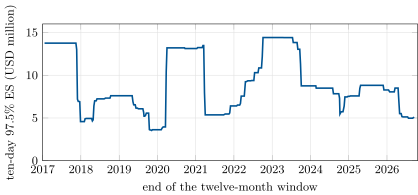
Expected shortfall of today’s book over every twelve-month window of history since 2016, by the window’s end date. The stressed calibration takes the maximum, the year to October 2022. Data: US Treasury par yields, ECB reference rates; the chapter’s tutorial.
Figure 23.2. Expected shortfall of today’s book over every twelve-month window of history since 2016, by the window’s end date. The stressed calibration takes the maximum, the year to October 2022. Data: US Treasury par yields, ECB reference rates; the chapter’s tutorial.

Exemples

Example 23.9 (The internal-model charge)

On overlapping ten-day moves, the book’s 97.5% ES over the last year is USD 5.27 million. Scanning every twelve-month window since 2016, the most severe ends on 3 October 2022 (Figure 23.2): its ES is USD 14.41 million for the whole book, 5.67 million for rates alone and 14.01 million for FX alone. All the factors are major-currency rates and FX pairs with a ten-day liquidity horizon, so no scaling applies. The IMCC is 0.5×14.41+0.5×(5.67+14.01)=USD 17.040.5\times14.41+0.5\times(5.67+14.01) = \text{USD}~17.04 million and, with the multiplier of 1.5, the charge is USD 25.56 million, 37% of the standardised one.

Lire dans le chapitre →