
جميع الكتب

مهني

1 Markets I: The Ecosystem and Exchange-Traded Marketsالأسواق عبر الإنترنت 2 Markets II: Rates, FX and Creditالأسواق عبر الإنترنت 3 Markets III: Commodities, Energy and Cryptoالأسواق عبر الإنترنت 4 Quantitative Methodsالأساليب عبر الإنترنت 5 Derivatives and Volatilityالمشتقات عبر الإنترنت 6 Rates, Credit, XVA and Riskالفائدة والائتمان والمخاطر عبر الإنترنت 7 Research Craft: Predictors, Backtests, Measurement, Portfoliosالبحث عبر الإنترنت 8 Strategies I: Equities and Futuresالاستراتيجيات عبر الإنترنت 9 Strategies II: Volatility, Relative Value, Macro and the Bank Desksالاستراتيجيات عبر الإنترنت 10 Microstructure and Executionالتنفيذ عبر الإنترنت 11 Market Making and High-Frequency Tradingصناعة السوق عبر الإنترنت 12 Machine Learning for Marketsتعلم الآلة عبر الإنترنت 13 Low-Latency Softwareالتكنولوجيا عبر الإنترنت 14 Networks, Hardware and Trading Infrastructureالتكنولوجيا عبر الإنترنت 15 Research, Data and Risk Platformsالتكنولوجيا عبر الإنترنت 16 The Desk and the Firmالشركة عبر الإنترنت 17 The Industry: Firms, Roles and Careersالمسارات المهنية عبر الإنترنت 18 The Interview Bookالمسارات المهنية عبر الإنترنت
التطبيقات حول المدرب تسجيل الدخول ابدأ القراءة

Quantitative Finance · المسرد

ما معنى Strong duality, Slater’s condition, shadow price؟

يُعرف أيضًا باسم: strong duality · Slater's condition · shadow price

Definition 23.5 Quantitative Methods · الفصل 23 — Convex Optimisation

Strong duality holds when the primal and dual optimal values are equal. Slater’s condition is the existence of a strictly feasible point (gi(x)<0g_i(x) < 0 for the nonlinear constraints, Ax=bAx = b). The optimal dual variable of a constraint is its shadow price: the rate at which the optimal value changes when the constraint is relaxed.
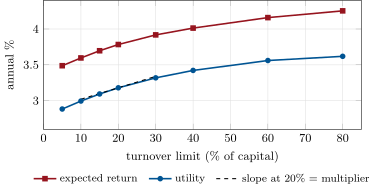
The price of turnover: the optimal long-short portfolio’s utility and expected return as the turnover limit is relaxed from 5% to 80% of capital. The dashed line through the 20% point has the slope of the turnover constraint’s multiplier, 0.0159 (1.6 basis points of utility per 1% of turnover). Data: the chapter’s tutorial, seeded.
Figure 23.1. The price of turnover: the optimal long-short portfolio’s utility and expected return as the turnover limit is relaxed from 5% to 80% of capital. The dashed line through the 20% point has the slope of the turnover constraint’s multiplier, 0.0159 (1.6 basis points of utility per 1% of turnover). Data: the chapter’s tutorial, seeded.
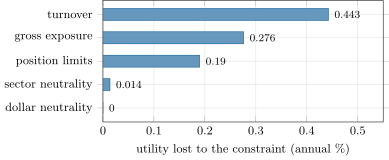
What each constraint group costs the long-short portfolio: the gain in utility when it is removed and the problem re-solved. Dollar neutrality costs nothing because the sector neutralities imply it. Data: the chapter’s tutorial, seeded.
Figure 23.2. What each constraint group costs the long-short portfolio: the gain in utility when it is removed and the problem re-solved. Dollar neutrality costs nothing because the sector neutralities imply it. Data: the chapter’s tutorial, seeded.
اقرأ في الفصل →