All books

Professional

Apps About Coach Log in Start reading

Quantitative Finance · Glossary

What is SVI parametrisation?

Definition 8.1 Derivatives and Volatility · Chapter 8 — Parametrising the Surface

The SVI parametrisation (stochastic volatility inspired) of a smile writes the total implied variance of one expiry as

w(k)=a+b(ρ(k−m)+(k−m)2+ς2),w(k)=a+b\Bigl(\rho(k-m)+\sqrt{(k-m)^2+\varsigma^2}\Bigr),

with b≥0b\ge0, ∣ρ∣<1|\rho|<1, ς>0\varsigma>0 and a+bς1−ρ2≥0a+b\varsigma\sqrt{1-\rho^2}\ge0 (so that the minimum of ww is non-negative). The parameters have a shape each: aa the level, bb the angle between the wings, ρ\rho the rotation (the skew), mm the horizontal position of the minimum, ς\varsigma the smoothness of the vertex.

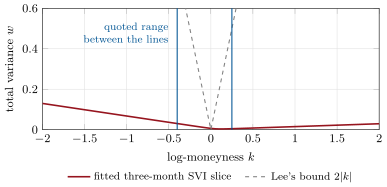
The three-month SVI slice of the tutorial extended far beyond its quoted strikes (between the vertical lines). Its wings are straight, with slopes 0.062 on the left and 0.014 on the right, far inside Lee’s bound 2|k| (dashed): the extrapolation cannot create an arbitrage. Data: the tutorial.
Figure 8.1. The three-month SVI slice of the tutorial extended far beyond its quoted strikes (between the vertical lines). Its wings are straight, with slopes 0.062 on the left and 0.014 on the right, far inside Lee’s bound 2∣k∣2|k| (dashed): the extrapolation cannot create an arbitrage. Data: the tutorial.
Read in context →