Tous les livres

Professionnel

Applis À propos Coach Connexion Commencer la lecture

Quantitative Finance · Glossaire

Qu'est-ce que « Taylor effect » ?

Definition 5.3 Research Craft: Predictors, Backtests, Measurement, Portfolios · Chapitre 5 — Stylised Facts of Returns

The Taylor effect is the finding that the autocorrelations of absolute returns exceed those of their powers ∣r∣θ|r|^\theta for θ≠1\theta \ne 1, in particular those of squared returns (Granger and Ding, 1996, after Taylor, 1986).
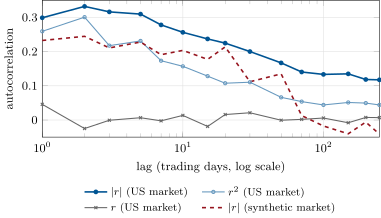
Autocorrelations of daily returns, absolute returns and squared returns of the US market, 1926–2026, and of the absolute returns of the synthetic market factor. Returns are nearly uncorrelated; absolute returns stay correlated beyond a hundred days, and more than squared returns (the Taylor effect). The synthetic factor’s clustering fades after about fifty days. Data: Kenneth R. French data library (derived statistics); firm.synthmkt, seed 1.
Figure 5.3. Autocorrelations of daily returns, absolute returns and squared returns of the US market, 1926–2026, and of the absolute returns of the synthetic market factor. Returns are nearly uncorrelated; absolute returns stay correlated beyond a hundred days, and more than squared returns (the Taylor effect). The synthetic factor’s clustering fades after about fifty days. Data: Kenneth R. French data library (derived statistics); firm.synthmkt, seed 1.
Lire dans le chapitre →
