 Coach
CoachThe volatility roll-down of an option over a horizon is the change in its implied volatility when its time to expiry shortens by the horizon along an unchanged term structure (and, for a sticky-delta surface, an unchanged smile in moneyness); with the time decay, it makes up the option’s carry.
Examples
Example 25.5 (Rolling down an upward-sloping curve)
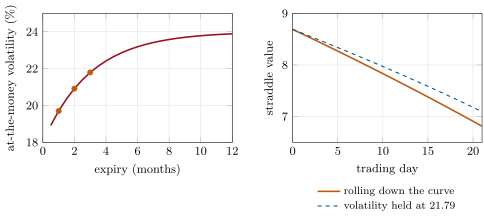
The at-the-money term structure is 19.70 at one month, 20.92 at two, 21.79 at three and 23.89 at one year. A three-month straddle worth 8.69 held for a month, with spot and curve unchanged, is worth 6.81: a carry of . At an unchanged 21.79 it would have lost 1.59 to time decay. The other 0.28 is roll-down, the straddle’s implied volatility falling 0.87 point as it becomes a two-month option. A calendar (long the three-month straddle, short 1.73 one-month straddles, vega-neutral) earns 0.13 a day of carry instead, paid for with a short gamma of (Figure 25.2).