Derivatives and Volatility · Derivatives
25Trading Volatility
A trader buys a one-month at-the-money straddle at 18 volatility because the share has realised 25 for two months, and delta-hedges it every day. A month later the share has again realised exactly 25, and the position has lost money. For three weeks the share drifted up half a percent a day, too quietly to pay the straddle’s time decay while its gamma was large. In the last week it moved almost 3% a day, but by then it was eight percent above the strike, where the straddle had almost no gamma left. The same 25% realised, spread evenly over the month, would have made 3.28 on a premium of 4.15. This chapter is about what a volatility position actually earns: gamma scalping and its dependence on the path, carry and roll-down, skew and term trades, the daily attribution of a volatility book, and the premium that sellers of volatility collect.
25.1 Gamma scalping
Chapter 4 derived the hedging P&L of a delta-hedged option: each day it earns , where is the day’s return. Positive when the day’s move beats the implied variance, negative otherwise, weighted by the cash gamma of that day.
Definition 25.1 (Gamma scalping)
Gamma scalping is holding a long option position and re-hedging its delta at intervals, so that the hedge sells after rises and buys after falls; its P&L is the sum over the intervals of the cash gamma times the difference between the squared realised return and the implied variance of the interval.
Definition 25.2 (Implied–realised spread)
The implied–realised spread of an option position is the difference between the implied volatility at which it was traded and the volatility subsequently realised by the underlying over its life, the quantity a delta-hedged position is a bet on, and only on average.
The sum is weighted, and the weights move with the path. A straddle’s cash gamma is largest near the strike and near expiry, and small far from the strike. Realised variance earned where the gamma is small counts for little.
Example 25.3 (Same volatility, different days)
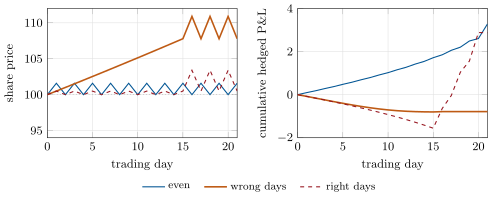
A 21-day at-the-money straddle on a share at 100, bought at 18 volatility (premium 4.15), hedged daily at 18. Three paths all realise exactly 25%:
- even: a move of every day, up and down in turn. The straddle makes 3.28;
- the wrong days: fifteen days of (7.9% realised), which take the share to 107.8, then six days of (45% realised). The quiet weeks lose 0.80 while the gamma is large; the wild week, far from the strike, makes 0.02. The total is ;
- the right days: fifteen days of at the strike, then the same wild week there, with the most gamma of the month. The straddle makes 2.87.
The cash-gamma sum reproduces these within a few tenths (3.05, , 3.03): the rest is the higher-order terms of the large moves (Figure 25.1).
Two consequences follow. A delta-hedged option is a bet on the implied–realised spread only on average over paths. On one path it is a bet on the gamma-weighted realised variance, which is what a variance swap (chapter 14) removes by holding constant cash gamma. And the hedging frequency matters little to the expected P&L, but it matters to its noise and to transaction costs, the trade-off chapter 26 prices.
25.2 Volatility carry and the roll-down
Hold an option with nothing moving and it still earns or loses: time decay, and the change in its implied volatility as its expiry shortens.
Definition 25.4 (Volatility roll-down)
The volatility roll-down of an option over a horizon is the change in its implied volatility when its time to expiry shortens by the horizon along an unchanged term structure (and, for a sticky-delta surface, an unchanged smile in moneyness); with the time decay, it makes up the option’s carry.
Example 25.5 (Rolling down an upward-sloping curve)
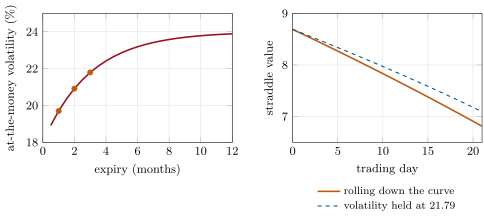
The at-the-money term structure is 19.70 at one month, 20.92 at two, 21.79 at three and 23.89 at one year. A three-month straddle worth 8.69 held for a month, with spot and curve unchanged, is worth 6.81: a carry of . At an unchanged 21.79 it would have lost 1.59 to time decay. The other 0.28 is roll-down, the straddle’s implied volatility falling 0.87 point as it becomes a two-month option. A calendar (long the three-month straddle, short 1.73 one-month straddles, vega-neutral) earns 0.13 a day of carry instead, paid for with a short gamma of (Figure 25.2).
25.3 Skew and term trades
A calendar is a term trade: long one expiry’s volatility, short another’s, vega-neutral in total. It profits if the curve flattens or inverts, and its carry comes from the roll-down. A risk reversal is a skew trade: long a 25-delta call, short a 25-delta put (or the reverse), nearly vega-neutral and long or short the skew. What it earns depends on how the surface moves with the spot, which is the marking rule of chapter 7.
Example 25.6 (One bad day, two marks)
Three months to expiry, at-the-money volatility 20% and a skew that puts the 25-delta put (strike 93.6) at 21.3 and the 25-delta call (106.96) at 18.7. The desk is short the put, long the call, hedged with 0.5 shares. The share falls 5% in a day and the at-the-money level does not move.
| marking | gamma | vega | vanna | unexplained | total |
|---|---|---|---|---|---|
| sticky strike | 0.053 | 0.000 | |||
| sticky delta | 0.053 | 0.112 | 0.081 |
Under sticky strike each option keeps its volatility. Under sticky delta both options’ volatilities fall by a point, because each strike is now higher relative to the spot and the skew lowers volatility as moneyness rises; the position’s vanna turns that into a gain. The mark decides the sign of the day. The Greek explain misses 0.08 either way: a 5% move is too large for second-order terms, and a desk revalues such days in full.
25.4 Attributing a volatility book’s P&L
Every day the desk explains its P&L by Greeks and compares the explanation with a full revaluation. With the change of option ’s own mark,
and the remainder is the unexplained P&L. The build computes both, per option and per day. The marking rule enters twice: through the day’s , which under sticky delta moves with the spot, and through the marks themselves.
Example 25.7 (Three months of a volatility book)
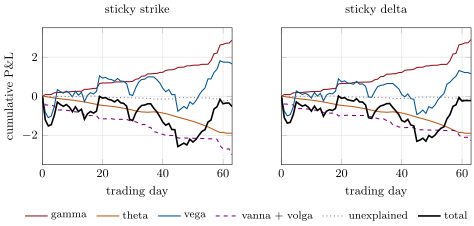
A book long an at-the-money straddle expiring in 0.3 year and short two 90 puts of the same expiry, delta-hedged daily, over 63 days of a stochastic-volatility path (the share goes from 100 to 98.6 by way of 94.3; the volatility from 20 to 19). Totals, marked sticky strike (sticky delta in brackets): gamma 2.87 (2.90), theta (), vega 1.65 (1.15), vanna (), volga (), unexplained (); total (). The largest daily unexplained is 0.08 (Figure 25.3).
The two marks agree on gamma and theta, which depend on the path, and disagree on vega and vanna, which depend on how the surface is assumed to move. They even disagree on the total, because the book is marked differently along the way; the difference disappears only at expiry. A book whose vanna P&L is as large as its vega P&L is a book whose marking rule is a position.
25.5 The variance risk premium in practice
Chapter 14 defined the variance risk premium as the gap between implied and expected realised variance. Bakshi and Kapadia measured it through delta-hedged S&P 500 options: the hedged positions underperform zero, more so when volatility is high, which is the sign of a negative market volatility risk premium for the buyer, and of a positive one for the seller. Israelov and Nielsen split a covered call into its equity, short-volatility and equity-reversal parts. The short-volatility part had a realised Sharpe ratio close to 1.0, though it carried less than a tenth of the strategy’s risk.
As of September 2026 — A published short-volatility benchmark
Cboe’s S&P 500 PutWrite Index (PUT) tracks a collateralised short-put strategy: at-the-money one-month S&P 500 puts sold monthly, usually on the third Friday, over a Treasury-bill account in one- and three-month bills. The strike is the listed strike closest to, but not above, the last index value reported before 11:00 a.m. Eastern time (methodology document, accessed 2026-09).
The premium is paid for bearing crash risk, and the distribution of a seller’s returns shows it: many small gains, a few large losses. On 5 February 2018 the S&P 500 fell 4% while the VIX jumped 20 points, the kind of day that takes months of premium.
Example 25.8 (Ten years of selling straddles)
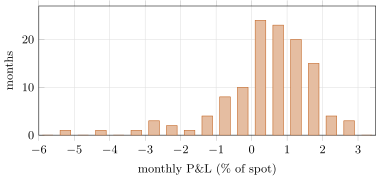
Every month a desk sells a one-month at-the-money straddle at the volatility its model expects plus two points, an assumed premium, and hedges daily at that volatility. The share follows a stochastic-volatility path with crashes (on average one a year, ). Over 120 months the average implied volatility sold is 23.5 against 20.6 realised. The P&L per month averages of the spot, with a standard deviation of 1.33 (a Sharpe ratio of 1.15 a year), 74% of months positive, a best month of and a worst of ; the skewness is (Figure 25.4).
25.6 Tutorial: scalping and explaining
Goal. Run a delta-hedged straddle along constructed paths and compare the P&L with the cash-gamma sum; hold a straddle and a calendar on an unchanged curve; explain a risk reversal’s bad day and a volatility book’s three months under sticky strike and sticky delta; run a short-volatility programme for ten years. End state: the four figures, the risk-reversal table and the numbers of the weekend problem.
The explain of one period, per option at its own mark, against full revaluation:
def explain(book: Sequence[Option], s0: float, s1: float, t0: float, t1: float, surf0: SkewSurface,
            surf1: SkewSurface, hedge: float = 0.0) -> dict[str, float]:
    """One period's P&L of the book plus `hedge` shares: full revaluation against the Greek explain. Each option's
    volatility change is the change of its own mark (surface and spot both move)."""
    ds, dt = s1 - s0, t1 - t0
    parts = dict.fromkeys(("delta", "gamma", "theta", "vega", "vanna", "volga"), 0.0)
    for o in book:
        tau0, tau1 = o.expiry - t0, o.expiry - t1
        if tau0 <= 1e-12:
            continue
        v0 = surf0.vol(o.strike, tau0, s0)
        dv = (surf1.vol(o.strike, tau1, s1) if tau1 > 1e-12 else v0) - v0
        g = greeks(s0, o.strike, tau0, 0.0, 0.0, v0, o.right)
        parts["delta"] += o.qty * g["delta"] * ds
        parts["gamma"] += o.qty * 0.5 * g["gamma"] * ds * ds
        parts["theta"] += o.qty * g["theta"] * dt
        parts["vega"] += o.qty * g["vega"] * dv
        parts["vanna"] += o.qty * g["vanna"] * ds * dv
        parts["volga"] += o.qty * 0.5 * g["volga"] * dv * dv
    parts["delta"] += hedge * ds
    total = value(book, s1, t1, surf1) - value(book, s0, t0, surf0) + hedge * ds
    parts["total"] = total
    parts["unexplained"] = total - sum(parts[k] for k in ("delta", "gamma", "theta", "vega", "vanna", "volga"))
    return parts
Listing 25.1. Greek explain against full revaluation. code/firm/volpnl/firm_volpnl.py The scalp: daily hedges at the implied volatility, and the cash-gamma sum:
def gamma_scalp(returns: Sequence[float], strike: float = 100.0, days: int = 21, vol: float = 0.18,
                s0: float = 100.0) -> dict:
    """A long straddle bought at implied `vol`, marked and delta-hedged daily at that volatility along the
    given daily log returns: P&L by full revaluation and the cash-gamma sum 1/2 Gamma S^2 (r^2 - vol^2 dt)."""
    path = s0 * np.exp(np.concatenate([[0.0], np.cumsum(returns)]))
    book = [Option(strike, days * DT, "C"), Option(strike, days * DT, "P")]
    flat = SkewSurface(lambda tau: vol)
    res = hedged_pnl(path, book, [flat] * len(path))
    cash_gamma = np.array([0.5 * book_greeks(book, path[i], i * DT, flat)["gamma"] * path[i] ** 2
                           for i in range(len(returns))])
    approx = cash_gamma * (np.asarray(returns) ** 2 - vol * vol * DT)
    return {"path": path, "daily": res["total"], "approx": approx, "cash_gamma": cash_gamma,
            "premium": value(book, s0, 0.0, flat),
            "realised": math.sqrt(float(np.sum(np.asarray(returns) ** 2)) / (len(returns) * DT))}
Listing 25.2. A hedged straddle along a path. code/firm/volpnl/firm_volpnl.py - Run
dv_volpnl.scalp(),carry(),risk_reversal(),book_explain(),short_vol()andfig_volpnl.py.
What to change next. Hedge the wrong-days straddle twice a day and at the realised volatility; add a skew move to the book’s surface; sell puts instead of straddles in the programme and compare the tails.
25.7 Build: volatility-book P&L
Purpose. The miniature firm’s volatility-book P&L: hedged positions revalued in full, and the daily explain by Greek against it, under either marking rule.
Interface. Option(strike, expiry, right, qty); SkewSurface(atm, skew, ref) with vol(strike, tau, spot) (ref=None: sticky delta) and shifted; value, book_greeks; explain(book, s0, s1, t0, t1, surf0, surf1, hedge); hedged_pnl(path, book, surfaces); gamma_scalp(returns, strike, days, vol); roll_down(atm, tau, horizon).
Rules. Every option is explained at its own mark; the explain is always shown against full revaluation, never instead of it; the marking rule is an explicit input.
Acceptance tests. code/firm/volpnl/tests/: the unexplained part is small for small moves and grows as the cube of the move; the hedge removes the delta P&L; sticky-strike marks do not move with the spot and sticky-delta marks do; a straddle hedged along a path realising its implied volatility makes almost nothing; roll-down on flat and sloping curves.
Stretch. Theta and roll-down separated in the daily explain; a vega explain by expiry bucket (chapter 26); the explain of chapter 18’s autocallables from their bumped Greeks.
Sources and further reading
- G. Bakshi and N. Kapadia, “Delta-hedged gains and the negative market volatility risk premium”, Review of Financial Studies 16(2) (2003) 527–566.
- R. Israelov and L. N. Nielsen, “Covered calls uncovered”, Financial Analysts Journal 71(6) (2015) 44–57.
- P. Carr and L. Wu, “Variance risk premiums”, Review of Financial Studies 22(3) (2009) 1311–1341.
- Cboe Global Indices, “Cboe S&P 500 PutWrite Indices methodology” (accessed 2026-09).
- Bank for International Settlements, Quarterly Review, March 2018, box on the equity market turbulence of 5 February.
25.8 Exercises
Exercise 25.1 ★
A one-month at-the-money straddle on a share at 100 has a cash gamma of about 770 at inception. What does a day with a 2% move earn at 18 implied volatility? A day with no move?
Solution
Solution of Exercise 25.1.
for the 2% day; for the quiet day. The breakeven daily move is .
Exercise 25.2 ★
Why does a long straddle lose money on the wrong-days path although realised volatility beats implied by seven points?
Solution
Solution of Exercise 25.2.
The realised variance came when the straddle’s cash gamma was small. The quiet weeks (7.9% realised) fell at the strike, where the cash gamma was about 770 and the straddle paid theta for nothing: . The wild week (45%) came with the share at 107.8, where the cash gamma was 39, a twentieth of the starting level: .
Exercise 25.3 ★
Split the three-month straddle’s one-month carry into theta and roll-down, and say what an inverted curve would change.
Solution
Solution of Exercise 25.3.
Carry : time decay at an unchanged 21.79 is and roll-down (the volatility falls 0.87 point to the two-month 20.92). On an inverted curve the shorter expiry has the higher volatility, so a long position rolls up: positive roll-down, which offsets part of the decay.
Exercise 25.4 ★★
Explain why the calendar earns positive carry and what it pays for it.
Solution
Solution of Exercise 25.4.
Short one-month straddles decay faster per unit of vega than the long three-month straddle, and the three-month leg rolls down less per day. With the vega matched (1.73 one-month straddles per three-month straddle) the net theta is positive: 0.13 a day. The price is a short gamma of , so a large move in the next days loses money, and a flattening of the curve does too.
Exercise 25.5 ★★
Show that under sticky delta, with the at-the-money level fixed, every strike’s volatility changes by when spot moves from to (skew ), and compute it for the risk reversal’s day.
Solution
Solution of Exercise 25.5.
. At fixed and , , the same for every strike. With , and : , a fall of about one point.
Exercise 25.6 ★★
Why do gamma and theta agree under the two marking rules in the book’s explain, while vega and vanna do not?
Solution
Solution of Exercise 25.6.
Gamma and theta depend on the path of the spot and on the marks at the start of each day, which are close under the two rules when the spot is near its reference. Vega and vanna depend on , the day’s change in each option’s mark. Under sticky strike it comes from the level only, under sticky delta also from the spot’s move, so the two rules assign the same move to different columns.
Exercise 25.7 ★★★
Coding. Rerun the short-volatility programme with no premium. What are the average P&L and the Sharpe ratio? Is the average distinguishable from zero, and how can the implied volatility sold exceed the average realised one without a premium?
Solution
Solution of Exercise 25.7.
Without a premium the average is of the spot a month, with a standard deviation of 1.33, so a standard error of : indistinguishable from zero. The Sharpe ratio is . The implied volatility sold (21.5 on average) exceeds the average realised (20.6) because it is the square root of the expected variance, and by Jensen’s inequality that exceeds the expected square root. In variance the two match: root-mean-squares of 23.0 and 23.2. The two points of premium are the whole of the .
Exercise 25.8 ★★★
Find the flaw. “Our short-volatility book has a Sharpe ratio above 1 and three winning months out of four; its risk is small.”
Solution
Solution of Exercise 25.8.
The Sharpe ratio and the hit rate describe the body of the distribution, not the tail. In the chapter’s programme the same figures (1.15, 74%) coexist with a worst month of , 4.1 standard deviations below the mean, and a skewness of . Ten years may contain no crash of the size that sets the true risk. Measure the risk by stress (a 5 February 2018) and by tail measures, not by volatility.
25.9 Problem: The Wrong Days
Problem 25.1
Weekend problem — when 25 realised loses to 18 implied
The trader of the opening bought a 21-day at-the-money straddle on a share at 100 at 18 volatility and hedged it daily. The share realised 25%.
Part I — The trade.
- What did the straddle cost, and what was the trader betting on?
- Give the daily move that realises 25% evenly, and the P&L of the even path.
- Give the daily cash gamma at inception, and the breakeven daily move at 18 implied.
- How much does the even path’s P&L differ from the cash-gamma sum, and why?
- What would a variance swap on the same notional have paid on any of the three paths?
Part II — The wrong days.
- Describe the wrong-days path and check that it realises 25%.
- Split its P&L between the quiet weeks and the wild week.
- Where was the spot during the wild week, and what was the straddle’s gamma there compared with inception?
- What does the right-days path make, and why less than the even path?
- What does the comparison say about the implied–realised spread as a trading signal?
Part III — Other ways to be long volatility.
- How would re-striking the straddle when the spot drifted have changed the result?
- What is the carry of holding a three-month straddle for a month on the chapter’s curve, and how much of it is roll-down?
- What does a vega-neutral calendar earn per day, and what risk does it take?
- On a 5% fall, what does a short-put, long-call risk reversal make under sticky strike and under sticky delta?
- Why must a desk revalue such a day in full rather than by Greeks?
Part IV — Judgement.
- Was the trader wrong about volatility?
- What would you report in the P&L attribution for the month?
- How does the short-volatility programme’s distribution explain why sellers are paid?
- State the named result: the gamma P&L of a long straddle when the same realised volatility comes in moves concentrated on low-gamma days, against uniformly spread moves.
- In one sentence: what does a delta-hedged option pay?
Solution
Solution of Problem 25.1.
1. 4.15; that the gamma-weighted realised variance over the month would exceed 18% volatility. 2. a day; . 3. About 770 (); a daily move of breaks even. 4. 3.28 against 3.05: the higher-order terms of daily moves of 1.6%, which the second-order sum leaves out. 5. The same on all three paths: the notional times in variance points, since a variance swap’s cash gamma is constant. 6. Fifteen days of and six of : . 7. in the quiet weeks, in the wild week: . 8. At about 107.8, 7.8% above the strike: a cash gamma of 39 against 770 at inception. 9. 2.87. Its quiet weeks, at the strike, pay theta at full gamma with 7.9% realised; the even path earns on every day. 10. The spread is the expected P&L only on average over paths. On one path the realised variance’s timing relative to the gamma decides; a variance swap isolates the spread. 11. Re-striking at the money (selling the old straddle, buying a new one) would have kept the gamma near its starting level for the wild week, at the cost of the bid–ask spread and a new premium. 12. over the month, of which is roll-down. 13. 0.13 a day, for a short gamma of : a large move or a flattening curve. 14. marked sticky strike, sticky delta. 15. The Greek explain misses 0.08 either way: third-order terms of a 5% move are as large as the day’s P&L. 16. Not about the level: the share did realise 25. The trade was a bet on a path-weighted quantity, and the path went against it. 17. Gamma earned on the quiet weeks below theta, almost no gamma in the wild week, no vega (the implied volatility did not change), and a small unexplained from the large moves. 18. Many small gains and a few large losses (skewness , worst month ): the premium pays for bearing the crashes. 19. With the same 25% realised, the long straddle loses 0.78 when the moves come on the low-gamma days and makes 3.28 when they are spread evenly. 20. The realised variance weighted by the option’s cash gamma, minus the implied variance on the same weights.
25.10 Interview questions
Interview question 25.1 ★ trader
You are long a delta-hedged straddle. Where does your P&L come from?
Solution
Solution of Interview question 25.1.
From the difference between the realised squared moves and the implied variance, weighted each day by the cash gamma : gamma gains when the moves are large, theta losses when they are small; plus vega when the implied volatility moves, and the cross terms.
What the interviewer is looking for: the cash-gamma-weighted spread.
Interview question 25.2 ★★ trader, researcher
Realised volatility came in above implied and your hedged straddle lost money. How?
Solution
Solution of Interview question 25.2.
The realised variance came where the gamma was small: the share drifted away from the strike quietly and moved sharply far from it, or the big moves came when the option had much time left and little gamma per unit of move. Also possible: the implied volatility fell (vega loss), or hedging at discrete times missed intraday moves.
What the interviewer is looking for: path dependence through the gamma, and vega.
Interview question 25.3 ★★ trader
What is the carry of a calendar spread on an upward-sloping term structure?
Solution
Solution of Interview question 25.3.
Long the longer expiry, short the shorter, vega-neutral: the short leg’s faster decay gives positive theta, and the long leg rolls down the curve, which costs a little. Net carry is usually positive; the risk is short gamma and a flattening or inversion of the curve.
What the interviewer is looking for: theta, roll-down, and the short gamma that pays for them.
Interview question 25.4 ★★ risk, developer
How would you build a daily P&L explain for an options book, and what do you do with the unexplained part?
Solution
Solution of Interview question 25.4.
Per option, at its own mark: delta, gamma, theta, vega, vanna, volga from the start-of-day Greeks and the day’s moves in spot and in each mark; full revaluation alongside. The unexplained part is monitored: small and random is fine, while large or persistent means missing risk factors, large moves, a marking change or a booking error, each to be investigated.
What the interviewer is looking for: per-option explain, full revaluation, unexplained as a control.
Interview question 25.5 ★★ trader, risk
The same book shows different vega P&L under sticky strike and sticky delta. Which is right?
Solution
Solution of Interview question 25.5.
Neither is right in general: they are two assumptions about how the surface moves with the spot. The total P&L of the day follows the marks, and the split follows the rule. Choose the rule the market has followed for this underlying (chapter 7), and report the vanna exposure it creates as a risk.
What the interviewer is looking for: marking rule as an assumption, and its effect on the split.
Interview question 25.6 ★★★ researcher
Is the variance risk premium a free lunch? How would you size a short-volatility strategy?
Solution
Solution of Interview question 25.6.
No: it is payment for bearing crash risk and for providing insurance. Returns have a long left tail. Size by stress loss (a 5 February 2018 or worse), not by volatility; cap the short gamma and vega; prefer defined-risk structures; keep capital for the tail.
What the interviewer is looking for: compensation for tail risk, sizing by stress.