
Todos os livros

Profissional

Apps Sobre Coach Entrar Começar a ler

Quantitative Finance · Glossário

O que é Volatility surface, log-moneyness, total implied variance?

Também chamado de: volatility surface · log-moneyness · total implied variance

Definition 7.1 Derivatives and Volatility · Capítulo 7 — Implied Volatility and Its Surface

The volatility surface of an underlying is the function (K,T)↦σimp(K,T)(K,T)\mapsto\sigma_{\mathrm{imp}}(K,T) that gives, for every strike and expiry, the implied volatility of the European option, computed with Black’s formula on the forward F0,TF_{0,T} of that expiry. Its natural coordinates are the log-moneyness k=ln⁡(K/F0,T)k=\ln(K/F_{0,T}), which measures a strike against the forward of its own expiry, and the total implied variance w(k,T)=σimp2Tw(k,T)=\sigma_{\mathrm{imp}}^2T, the variance of the log-return to expiry that the price implies.
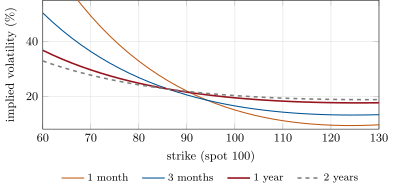
The chapter’s equity-index surface: four smiles of one surface. Short expiries are steep and low at the money; long expiries are flatter and higher. The 90–110 skew is 10.8 volatility points at one month, 6.3 at three months, 3.3 at one year and 2.5 at two. Illustrative parameters, in line with the shapes described in the text.
Figure 7.1. The chapter’s equity-index surface: four smiles of one surface. Short expiries are steep and low at the money; long expiries are flatter and higher. The 90–110 skew is 10.8 volatility points at one month, 6.3 at three months, 3.3 at one year and 2.5 at two. Illustrative parameters, in line with the shapes described in the text.
Ler no capítulo →