
جميع الكتب

مهني

1 Markets I: The Ecosystem and Exchange-Traded Marketsالأسواق عبر الإنترنت 2 Markets II: Rates, FX and Creditالأسواق عبر الإنترنت 3 Markets III: Commodities, Energy and Cryptoالأسواق عبر الإنترنت 4 Quantitative Methodsالأساليب عبر الإنترنت 5 Derivatives and Volatilityالمشتقات عبر الإنترنت 6 Rates, Credit, XVA and Riskالفائدة والائتمان والمخاطر عبر الإنترنت 7 Research Craft: Predictors, Backtests, Measurement, Portfoliosالبحث عبر الإنترنت 8 Strategies I: Equities and Futuresالاستراتيجيات عبر الإنترنت 9 Strategies II: Volatility, Relative Value, Macro and the Bank Desksالاستراتيجيات عبر الإنترنت 10 Microstructure and Executionالتنفيذ عبر الإنترنت 11 Market Making and High-Frequency Tradingصناعة السوق عبر الإنترنت 12 Machine Learning for Marketsتعلم الآلة عبر الإنترنت 13 Low-Latency Softwareالتكنولوجيا عبر الإنترنت 14 Networks, Hardware and Trading Infrastructureالتكنولوجيا عبر الإنترنت 15 Research, Data and Risk Platformsالتكنولوجيا عبر الإنترنت 16 The Desk and the Firmالشركة عبر الإنترنت 17 The Industry: Firms, Roles and Careersالمسارات المهنية عبر الإنترنت 18 The Interview Bookالمسارات المهنية عبر الإنترنت
التطبيقات حول المدرب تسجيل الدخول ابدأ القراءة

Quantitative Finance · المسرد

ما معنى Volatility swap؟

Definition 14.6 Derivatives and Volatility · الفصل 14 — Variance Swaps and Volatility Derivatives

A volatility swap pays N(σR−Kvol)N\bigl(\sigma_R-K_{\mathrm{vol}}\bigr): realised volatility, not variance, against a strike.
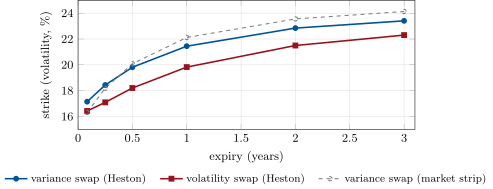
Variance-swap and volatility-swap strikes by expiry under the Heston model calibrated to chapter 9’s surface, and the market strip’s variance-swap strike. The gap between the first two is the convexity adjustment, largest near one year. Data: the tutorial.
Figure 14.2. Variance-swap and volatility-swap strikes by expiry under the Heston model calibrated to chapter 9’s surface, and the market strip’s variance-swap strike. The gap between the first two is the convexity adjustment, largest near one year. Data: the tutorial.

أمثلة

Example 14.7 (Volatility or variance)

Under the Heston model calibrated to chapter 9’s surface in chapter 10, the one-year variance-swap strike is 21.4% and the volatility-swap strike 19.8%: a convexity adjustment of 1.62 volatility points. The adjustment is 0.72 point at one month, 1.34 at three months and 1.61 at six months, then falls to 1.35 at two years and 1.10 at three (Figure 14.2). At short expiries there is little time for variance to vary. At long expiries mean reversion averages its variation away. The market’s own one-year strip gives 22.1%, 0.7 point above Heston’s, because the calibrated model does not reproduce the surface’s wings, which carry weight in the strip.

اقرأ في الفصل →