
Todos los libros

Profesional

Apps Acerca de Coach Iniciar sesión Empezar a leer

Quantitative Finance · Glosario

¿Qué es Volatility swap?

Definition 14.6 Derivatives and Volatility · Capítulo 14 — Variance Swaps and Volatility Derivatives

A volatility swap pays N(σR−Kvol)N\bigl(\sigma_R-K_{\mathrm{vol}}\bigr): realised volatility, not variance, against a strike.
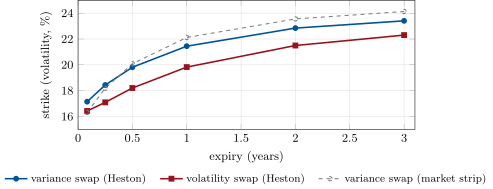
Variance-swap and volatility-swap strikes by expiry under the Heston model calibrated to chapter 9’s surface, and the market strip’s variance-swap strike. The gap between the first two is the convexity adjustment, largest near one year. Data: the tutorial.
Figure 14.2. Variance-swap and volatility-swap strikes by expiry under the Heston model calibrated to chapter 9’s surface, and the market strip’s variance-swap strike. The gap between the first two is the convexity adjustment, largest near one year. Data: the tutorial.

Ejemplos

Example 14.7 (Volatility or variance)

Under the Heston model calibrated to chapter 9’s surface in chapter 10, the one-year variance-swap strike is 21.4% and the volatility-swap strike 19.8%: a convexity adjustment of 1.62 volatility points. The adjustment is 0.72 point at one month, 1.34 at three months and 1.61 at six months, then falls to 1.35 at two years and 1.10 at three (Figure 14.2). At short expiries there is little time for variance to vary. At long expiries mean reversion averages its variation away. The market’s own one-year strip gives 22.1%, 0.7 point above Heston’s, because the calibrated model does not reproduce the surface’s wings, which carry weight in the strip.

Leer en el capítulo →