All books

Professional

Apps About Coach Log in Start reading

Quantitative Finance · Glossary

What is Win-probability model?

Definition 22.3 Market Making and High-Frequency Trading · Chapter 22 — Bond and ETF Request-for-Quote Market Making

A win-probability model estimates the probability that a dealer’s quote wins a request for quote, as a function of the quote’s distance from the dealer’s fair value and of the request’s features (size, side, client, bond, time since the last print, number of dealers asked), fitted on the dealer’s history of wins, losses and covers.
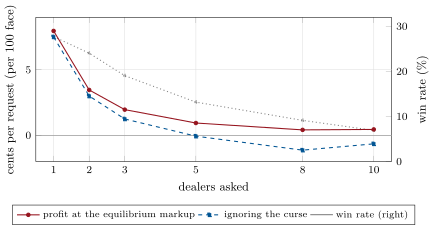
A dealer’s expected profit per request answered, in cents per 100 of face value, at the symmetric equilibrium markup and at the markup a model ignoring the winner’s curse would choose (competitors at the equilibrium), and the equilibrium win rate (right), against the number of dealers asked; estimates off by 25 cents, urgency discounts with a mean of 30 cents, 40 000 requests per point. Data: hf_rfq.equilibria.
Figure 22.2. A dealer’s expected profit per request answered, in cents per 100 of face value, at the symmetric equilibrium markup and at the markup a model ignoring the winner’s curse would choose (competitors at the equilibrium), and the equilibrium win rate (right), against the number of dealers asked; estimates off by 25 cents, urgency discounts with a mean of 30 cents, 40 000 requests per point. Data: hf_rfq.equilibria.
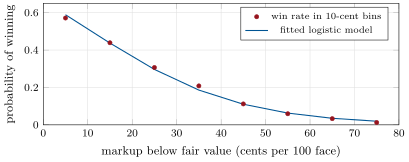
The win-probability model: win rates of 20 000 historical requests grouped by markup, and the logistic curve fitted to them by Newton’s method, against five dealers at the equilibrium markup of 42.5 cents. Data: hf_rfq.win_model.
Figure 22.3. The win-probability model: win rates of 20 000 historical requests grouped by markup, and the logistic curve fitted to them by Newton’s method, against five dealers at the equilibrium markup of 42.5 cents. Data: hf_rfq.win_model.
Read in context →