 Coach
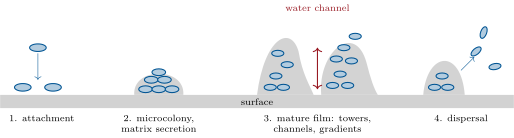
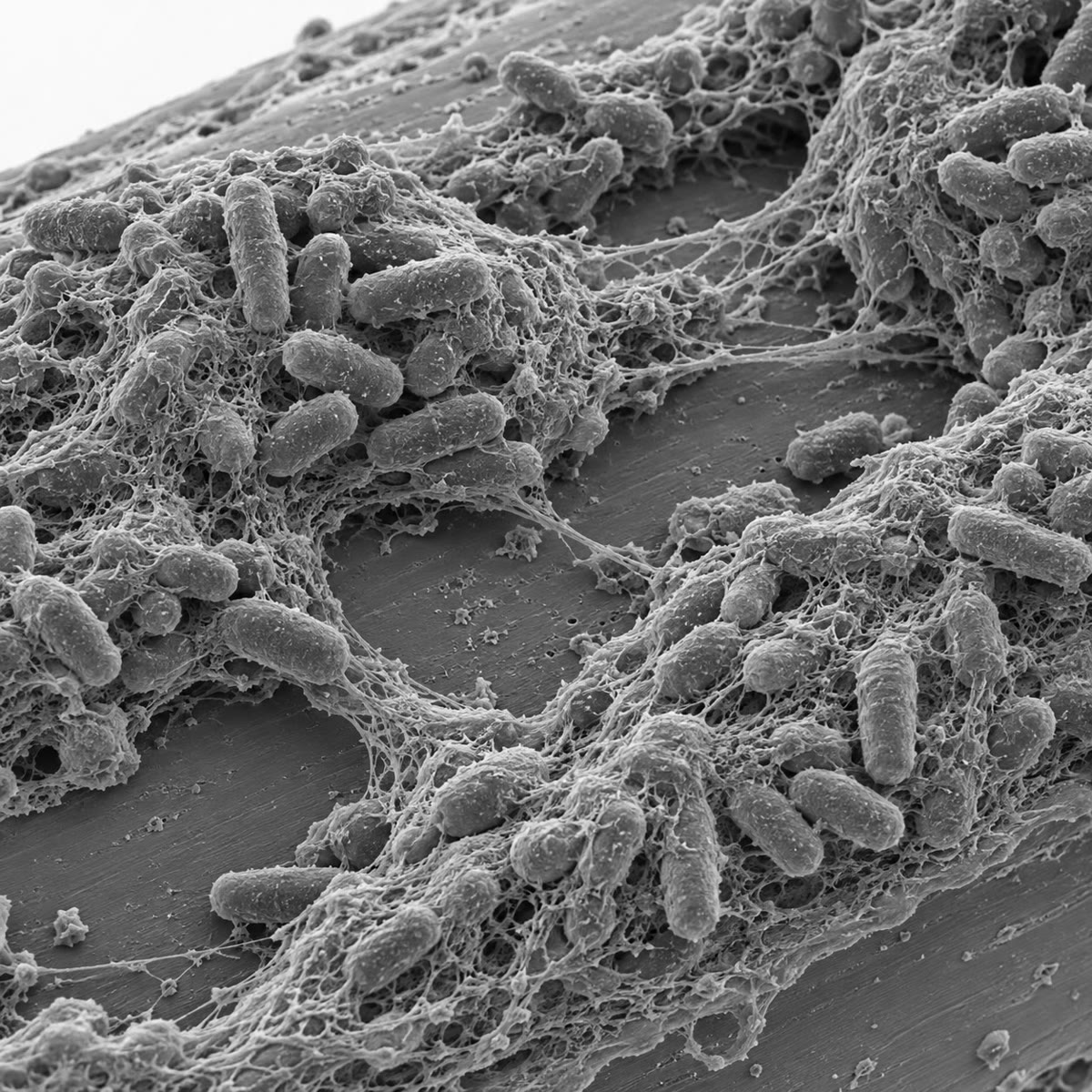
CoachA biofilm is a community of microorganisms attached to a surface and embedded in a self-produced matrix of polysaccharides, proteins and extracellular DNA. It forms in stages: reversible attachment of single cells (flagella, pili), irreversible attachment and microcolony growth, maturation into a structured film with towers and water channels, and dispersal of cells that swim off to seed new surfaces. The matrix holds water and nutrients, protects the cells from desiccation, grazers, antibiotics and immune cells, and sets up chemical gradients that make the film a landscape of niches. Most bacteria on Earth live this way: on rocks in streams, on roots, on teeth (dental plaque), on catheters and implants, in the lungs of cystic fibrosis patients, on ship hulls and in pipes.
Examples
Example 2.15 (Why a biofilm survives antibiotics)
Cells in a biofilm survive concentrations of antibiotic a hundred to a thousand times those that kill the same strain in suspension, without any resistance gene. The matrix slows the drug’s diffusion and binds some of it; the gradients leave the deep cells starved, anoxic and barely growing, and most antibiotics kill only growing cells (penicillins need wall synthesis, aminoglycosides need active transport); a few persister cells are dormant altogether and regrow the film when the treatment stops. A chronic infection on an implant is therefore usually treated by removing the implant.