University Biology — Year 2 · Bachelor Year 2
2Microbial Metabolism and Biofilms
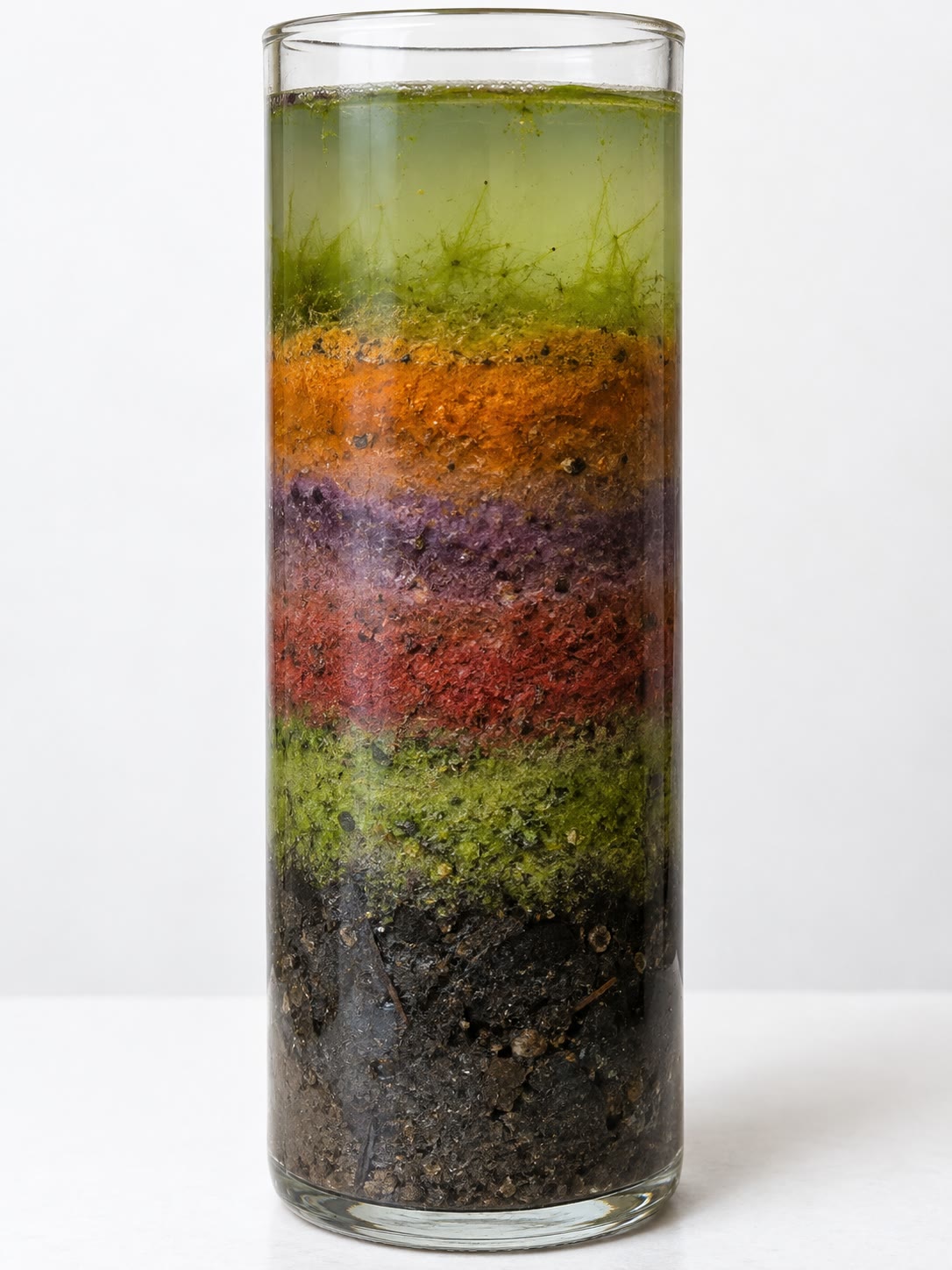
Fill a glass cylinder with pond mud, a little shredded paper, an egg yolk and water, and leave it on a windowsill. Within weeks it stratifies into coloured bands: green algae at the top, a rusty layer, a purple band, a green one lower down, and black sulfide mud at the bottom. Nothing was added but light. Each band is a population that lives on a different chemistry — on oxygen, on nitrate, on sulfate, on sulfide, on hydrogen — and each feeds the next. The column is the microbial world in miniature: cells that earn their energy from almost any pair of substances that can exchange electrons, and that, together, run the chemical cycles of the planet. This chapter sets out the logic of that energetics, the kinetics of microbial growth, and the collective life of microbes on surfaces, which is how most of them actually live.
2.1 Ways of making a living
Definition 2.1 (Trophic types)
An organism is classified by three answers. Its energy source: light (phototroph) or chemical reactions (chemotroph). Its electron source: inorganic substances — , , , , water — (lithotroph) or organic molecules (organotroph). Its carbon source: (autotroph) or organic carbon (heterotroph). Plants and cyanobacteria are photolithoautotrophs; animals, fungi and E. coli are chemoorganoheterotrophs; the nitrifying and sulfur-oxidising bacteria are chemolithoautotrophs, which make their organic matter from with energy drawn from the oxidation of minerals, in the dark. Almost every combination exists somewhere among prokaryotes; eukaryotes occupy only two.
Theorem 2.2 (The energy of a redox pair)
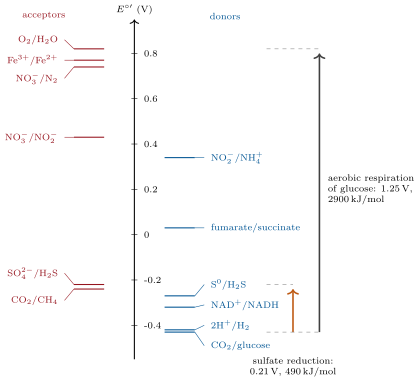
Every energy-yielding metabolism moves electrons from a donor couple to an acceptor couple. Each couple has a standard potential (at pH 7): the more negative, the more readily it gives electrons. Transferring moles of electrons from a donor at to an acceptor at releases a standard free energy
so that the yield is proportional to the vertical distance between the two couples on the electron tower. With at and /glucose at , the 24 electrons of a glucose molecule yield ; handed instead to sulfate (, ), the same electrons yield only .
Proof. For the reaction donor + acceptor donor + acceptor, the free-energy change is the work done by moles of electron charge falling through the potential difference , with the sign convention that a spontaneous transfer (electrons toward the more positive couple) has . This is the Nernst relation of the Year 1 volume applied to two half-reactions. ∎
Proposition 2.3 (Chemolithotrophy)
Some bacteria draw all their energy from inorganic oxidations, using oxygen (or nitrate) as acceptor, and fix with the ATP and reducing power so gained. Nitrifiers: ammonium oxidisers (Nitrosomonas) turn into nitrite (), nitrite oxidisers (Nitrobacter) turn nitrite into nitrate (); together they convert the ammonium of decay into the nitrate that plants take up (Chapter 25). Sulfur oxidisers (Thiobacillus, Beggiatoa) oxidise to sulfur and sulfate; iron oxidisers oxidise to rust; hydrogen oxidisers burn . Because their electron donors sit high on the tower, the yield per molecule is small, and because their donors are poorer reductants than NADH, they must spend energy driving electrons uphill to make the NADH that carbon fixation needs: a nitrifier oxidises some thirty ammonium ions to fix one , and grows slowly.
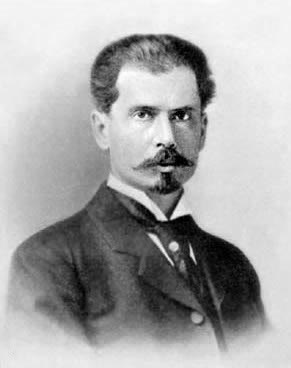
Evidence. Winogradsky (1887–1890) grew filamentous sulfur bacteria in a drop of water into which he let sulfide diffuse from one side and air from the other: they gathered at the boundary, accumulated sulfur globules, and consumed them when the sulfide was cut off. He then isolated nitrifying bacteria on a purely mineral medium containing ammonium and no organic carbon at all, on which they grew and produced nitrate — the first demonstration that life can be built from and the energy of an inorganic reaction, without light. He called it chemosynthesis. ∎
Definition 2.4 (Anoxygenic photosynthesis)
The purple and green bacteria photosynthesise with a single photosystem and a bacteriochlorophyll that absorbs in the near infrared, using , or organic acids as electron donors instead of water: they release sulfur or sulfate, never oxygen, and they need light of wavelengths that pass through the green and cyanobacterial layer above them. Purple sulfur bacteria therefore grow in the purple band of the Winogradsky column, just where sulfide from below meets the light from above; green sulfur bacteria, which tolerate more sulfide and less light, grow beneath them. Oxygenic photosynthesis, with its two photosystems in series, is a later invention of one lineage — the cyanobacteria — that learned to take electrons from water.
2.2 Anaerobic respirations and fermentations
Definition 2.5 (Anaerobic respiration)
Anaerobic respiration is respiration — an electron-transport chain that pumps protons and makes ATP by chemiosmosis — with a terminal acceptor other than oxygen. Denitrifiers (Pseudomonas, Paracoccus) reduce nitrate to nitrite, nitric oxide, nitrous oxide and finally , which escapes to the air; they use their aerobic chain with a few added enzymes and switch to nitrate only when oxygen is gone. Sulfate reducers (Desulfovibrio) reduce sulfate to sulfide, blacken the mud with iron sulfide and give it its smell. Methanogens, which are archaea, reduce with to methane (, ), or split acetate into methane and ; they are killed by oxygen and live in cow rumens, rice paddies, marshes and landfills, from which they release a greenhouse gas that is the subject of Chapter 27. Iron and manganese oxides serve other groups. The Year 1 volume treated oxygen as the acceptor; for most of Earth’s history, and in every sediment today, it is only the first of a series.
Proposition 2.6 (The sequence of acceptors in a sediment)
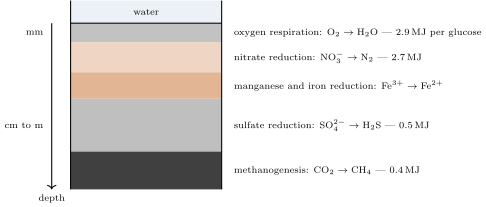
Going down through a water-logged sediment, the electron acceptors are used up in the order of the energy they yield: oxygen in the first millimetres, then nitrate, then manganese and iron oxides, then sulfate, and finally (methanogenesis) in the deepest anoxic layer. The order is the order of the tower: at each depth the organisms using the best remaining acceptor grow fastest, out-compete the rest for the organic donors, and exhaust their acceptor before the next group takes over. In the sea, where sulfate is abundant (), the sulfate zone is thick and methanogenesis begins only metres down; in a freshwater marsh, sulfate-poor, methane forms just below the surface.
Definition 2.7 (Fermentation, revisited)
A fermentation uses no external acceptor: the organic substrate is split into a more oxidised and a more reduced product, ATP is made only by substrate-level phosphorylation, and the NADH of glycolysis is re-oxidised by reducing a metabolite. Yeasts make ethanol and ; lactic bacteria make lactate (yoghurt, sauerkraut, sore muscles); E. coli makes a mixture of acids, ethanol and gases; clostridia make butyrate, butanol and acetone; propionibacteria make the propionate and of Swiss cheese. The yield is two ATP per glucose against about thirty by respiration, so a fermenter must process fifteen times more sugar for the same growth, and its products — acids, alcohol — poison its own medium: fermentations preserve food because the fermenter makes the food uninhabitable, including for itself.
Example 2.8 (Syntrophy: living on the rest)
In an anoxic sediment the fermenters leave behind acetate, propionate, butyrate and . Oxidising propionate to acetate and has a positive standard free energy () and is impossible — unless a methanogen next door consumes the hydrogen as fast as it forms, keeping its partial pressure below , at which the reaction becomes exergonic. Neither partner can grow alone on propionate; together they turn it into methane. This interspecies hydrogen transfer is why anaerobic digestion is always the work of a consortium, and why the archaeon and its bacterial partner are often found pressed against each other.
2.3 Growth on a substrate
Theorem 2.9 (Monod’s law)
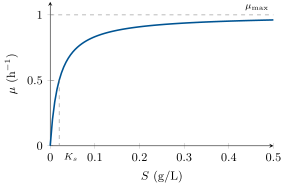
A population growing on a single limiting substrate at concentration has a specific growth rate
where is the biomass concentration, the maximal rate (the reciprocal of the shortest generation time divided by ) and the half-saturation constant, the substrate concentration at which growth runs at half speed — a few milligrams per litre of glucose for E. coli. Substrate is consumed in proportion to growth, , with the yield: grams of biomass per gram of substrate, about for aerobic growth on sugar and for a fermenter.
Evidence. Monod (1942) grew E. coli in batches on a series of glucose concentrations and measured the exponential rate of each: the rates rose with concentration and saturated, as a Michaelis–Menten curve, which is what one expects if the rate is set by a saturable uptake system. The law is empirical — a cell has thousands of enzymes, not one — but it fits nearly every substrate-limited culture, and it is the foundation of fermentation technology and of wastewater engineering. ∎
Theorem 2.10 (The chemostat)
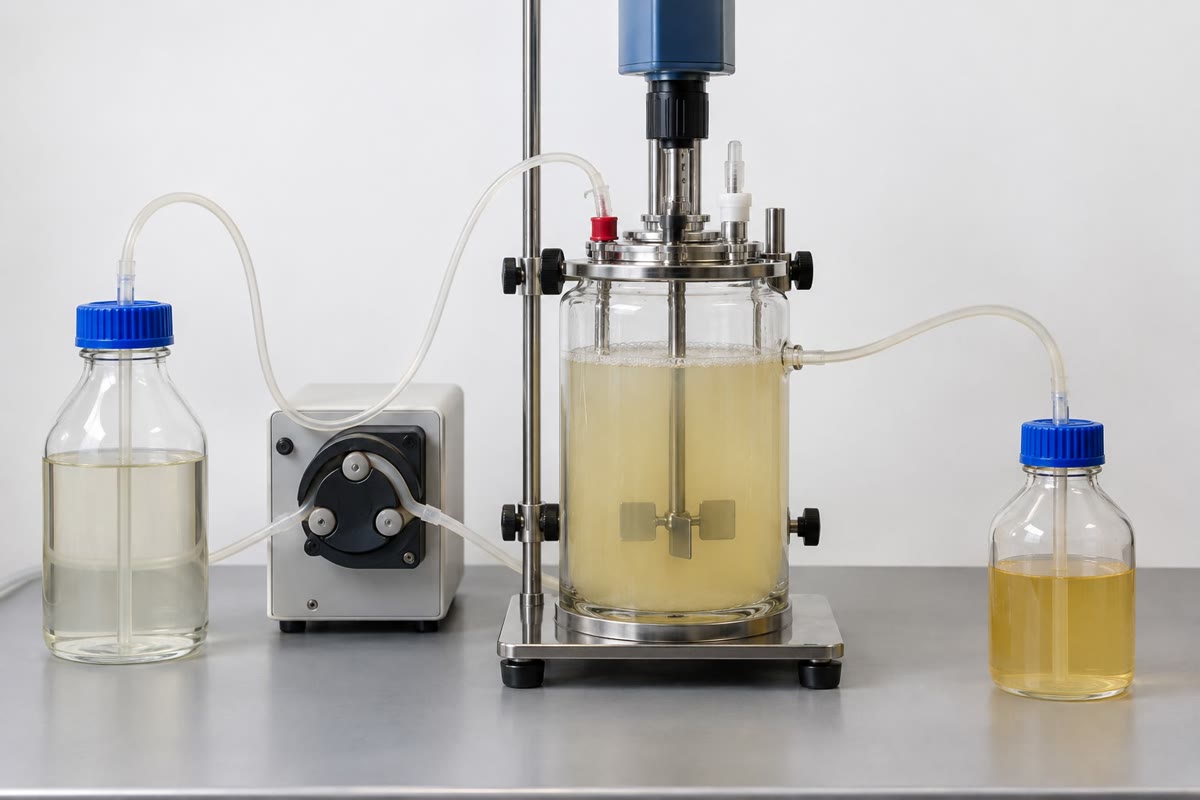
A chemostat is a vessel of volume fed with fresh medium (substrate ) at a flow and drained at the same flow, so that the dilution rate is . Biomass and substrate obey
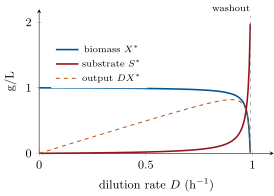
At steady state : the culture grows exactly as fast as it is washed out, whatever below a critical value, and the operator sets the growth rate by turning the pump. The steady-state substrate and biomass are
and above the washout rate no population can hold on.
Proof. Setting with gives ; inverting Monod’s law, , hence . Setting and replacing by : , hence . The solution exists only while , i.e. ; beyond that, for every and decays to zero. The steady state is stable: if rises, falls, drops below and is washed back down. ∎
Example 2.11 (Reading a chemostat)
With , , and , at : and ; the culture leaves of the sugar unused. The washout rate is . A digester or a gut works on the same principle: the human colon, fed three times a day and emptied once, holds its bacteria at a dilution rate near , and any species that cannot double within a day is washed out — unless it holds on to the wall.
2.4 Biofilms
Definition 2.12 (Biofilm)
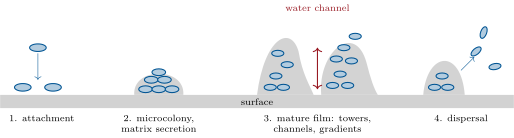
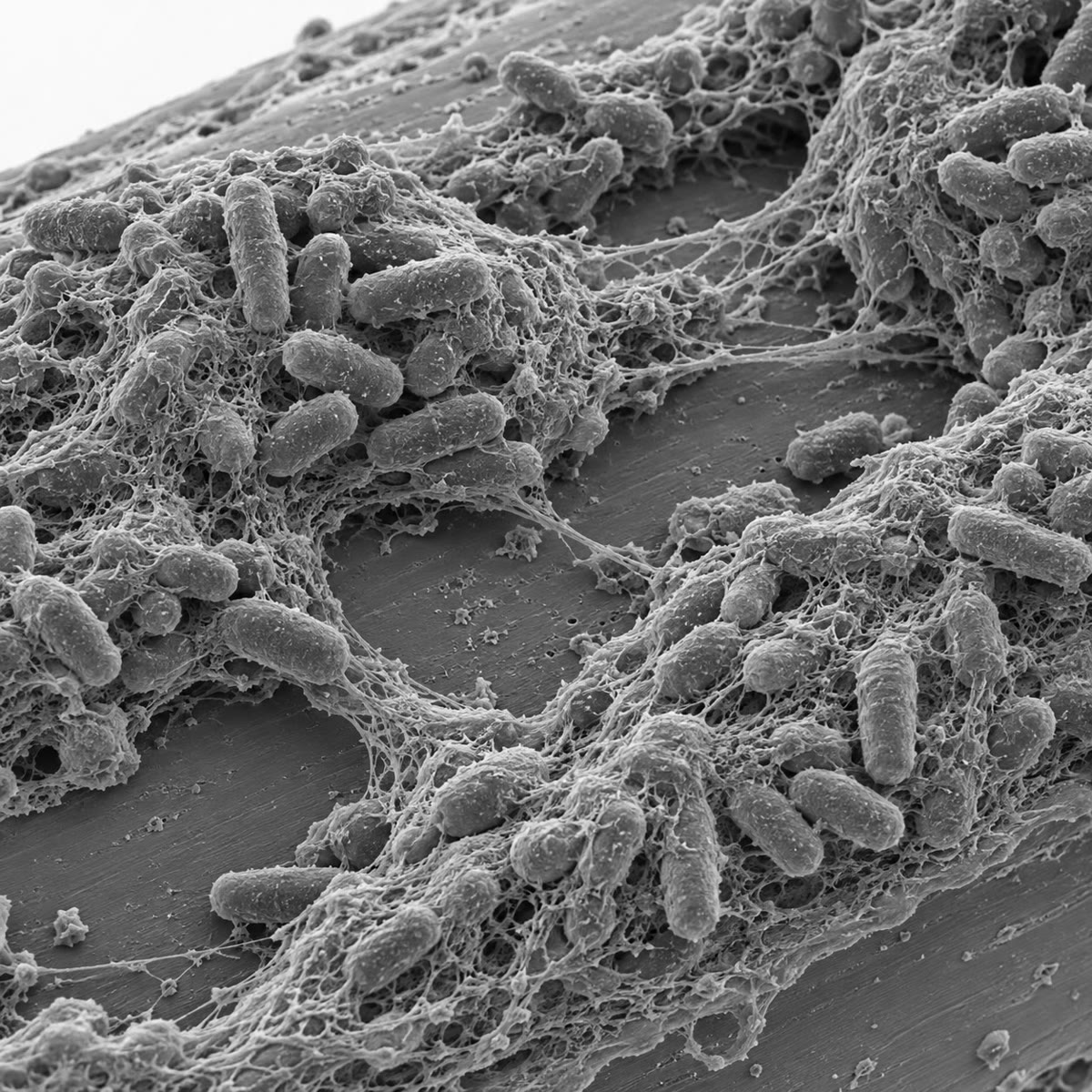
A biofilm is a community of microorganisms attached to a surface and embedded in a self-produced matrix of polysaccharides, proteins and extracellular DNA. It forms in stages: reversible attachment of single cells (flagella, pili), irreversible attachment and microcolony growth, maturation into a structured film with towers and water channels, and dispersal of cells that swim off to seed new surfaces. The matrix holds water and nutrients, protects the cells from desiccation, grazers, antibiotics and immune cells, and sets up chemical gradients that make the film a landscape of niches. Most bacteria on Earth live this way: on rocks in streams, on roots, on teeth (dental plaque), on catheters and implants, in the lungs of cystic fibrosis patients, on ship hulls and in pipes.
Theorem 2.13 (Gradients inside a biofilm)
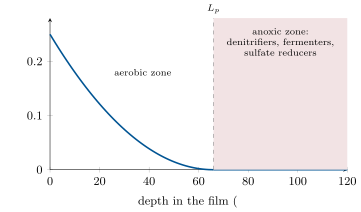
In a film of thickness whose cells consume oxygen at a constant volumetric rate , with the concentration held at at the surface and no flux through the substratum, the steady-state oxygen profile is a parabola, and if the film is thick enough for oxygen to run out, it does so at the penetration depth
where is the effective diffusion coefficient in the matrix. With , and (a dense film of respiring cells), : below a tenth of a millimetre a biofilm is anoxic, and denitrifiers, fermenters and sulfate reducers live under a roof of aerobes.
Proof. Let be the depth below the surface. At steady state the diffusive flux changes with depth only by the consumption: . Integrating twice, . If oxygen vanishes at depth with zero flux there (nothing arrives from below), and : the second gives , and the first then gives , i.e. . The profile is . ∎
Proposition 2.14 (Quorum sensing)
Bacteria count themselves. Each cell secretes a small signal molecule, an autoinducer (acyl-homoserine lactones in Gram-negatives, short peptides in Gram-positives), at a low constant rate. In a dilute suspension the signal diffuses away; in a dense population or a biofilm it accumulates, and above a threshold concentration it binds a receptor that switches on a set of genes — including the gene for the autoinducer itself, hence the name. The genes so controlled are those that pay only when many cells act together: luminescence, the secretion of digestive enzymes and toxins, matrix production, the virulence of pathogens that must overwhelm a host at once rather than alert it one cell at a time.
Evidence. Nealson, Platt and Hastings (1970) found that the marine bacterium Vibrio fischeri, which lights the organ of a squid, is dark in dilute culture and glows only above about cells per millilitre; cell-free medium taken from a dense, glowing culture made a dilute one glow at once. The medium contained the signal; its structure, an acyl-homoserine lactone, was determined in 1981, and mutants unable to make it never glow however dense they become. ∎
Example 2.15 (Why a biofilm survives antibiotics)
Cells in a biofilm survive concentrations of antibiotic a hundred to a thousand times those that kill the same strain in suspension, without any resistance gene. The matrix slows the drug’s diffusion and binds some of it; the gradients leave the deep cells starved, anoxic and barely growing, and most antibiotics kill only growing cells (penicillins need wall synthesis, aminoglycosides need active transport); a few persister cells are dormant altogether and regrow the film when the treatment stops. A chronic infection on an implant is therefore usually treated by removing the implant.
2.5 Microbial communities
Example 2.16 (The Winogradsky column, explained)
Light and air enter from above; organic matter and sulfate from the mud. Cyanobacteria and algae grow at the top and release oxygen. Below, heterotrophs use up the oxygen on the organic matter, then the nitrate; deeper, sulfate reducers turn sulfate into sulfide, which diffuses upward and blackens the mud with iron sulfide. Where the rising sulfide meets the descending light, purple sulfur bacteria oxidise it photosynthetically (the purple band), green sulfur bacteria below them; where sulfide meets oxygen, in the dark, colourless sulfur oxidisers such as Beggiatoa earn a living chemolithotrophically (the white veil); where reduced iron meets oxygen, iron oxidisers leave a rusty band. Sulfur cycles between sulfide and sulfate within the column; carbon cycles between and organic matter; only light enters and only heat leaves. It is a closed ecosystem with an open energy budget, and a scale model of the ocean floor.
Remark 2.17 (Microbial mats and the early Earth)
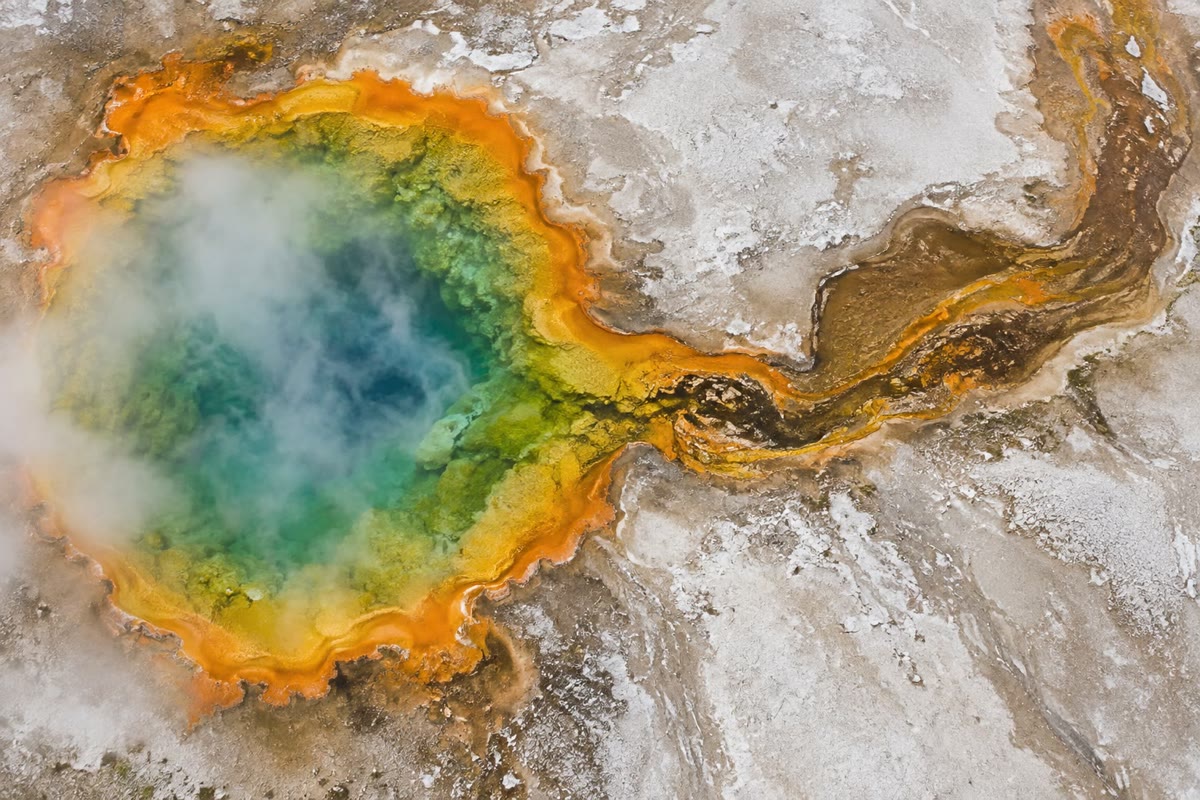
Around hot springs and on tidal flats, layered microbial mats a few millimetres thick pack the whole column into a thickness that light can cross: cyanobacteria on top, purple bacteria beneath, sulfate reducers at the base, each layer consuming what the one above produces, and the mat migrating up through the sediment it traps. Fossil mats — stromatolites — are the oldest evidence of life, billion years old. For two billion years, before plants or animals, the biosphere was these mats and the plankton above them, and it was they that filled the air with oxygen (Chapter 25).
2.6 Exercises
Exercise 2.1 ★
Classify by energy source, electron source and carbon source: a cyanobacterium; Nitrosomonas; E. coli on glucose; a purple non-sulfur bacterium growing in light on succinate; Thiobacillus on in the dark.
Solution
Solution of Exercise 2.1.
Cyanobacterium: photo-litho-autotroph (light, water, ). Nitrosomonas: chemo-litho-autotroph (ammonium oxidation, ). E. coli on glucose: chemo-organo-heterotroph. Purple non-sulfur bacterium on succinate in light: photo-organo-heterotroph. Thiobacillus on sulfide in the dark: chemo-litho-autotroph.
Exercise 2.2 ★
List the electron acceptors of respiration in order of decreasing energy yield, and say where in a sediment each is used.
Solution
Solution of Exercise 2.2.
Oxygen (surface millimetres), nitrate (just below, where oxygen is gone), manganese and iron oxides (the brown-to-grey transition), sulfate (the black sulfidic layer, thick in marine sediments), for methanogenesis (deepest, or just below the surface in sulfate-poor fresh water).
Exercise 2.3 ★
Balance the oxidation of glucose to by nitrate reduced to (in acid solution, water as the other product). How many nitrate ions per glucose?
Solution
Solution of Exercise 2.3.
: 4.8 nitrate ions per glucose (each nitrate accepts 5 electrons, each glucose gives 24).
Exercise 2.4 ★
Define a biofilm and name its four stages. Give three places where biofilms matter to human health or industry.
Solution
Solution of Exercise 2.4.
A surface-attached microbial community embedded in a self-made matrix of polysaccharides, proteins and DNA. Stages: attachment, microcolony and matrix secretion, maturation with towers and channels, dispersal. Dental plaque and caries; infections of catheters and implants (and the lungs in cystic fibrosis); fouling and corrosion of pipes and hulls — or, usefully, the trickling filters of water treatment.
Exercise 2.5 ★★
Compute for from the potentials () and (). How many ATP (at ) can a methanogen make per at most? Comment on its growth rate.
Solution
Solution of Exercise 2.5.
Eight electrons fall from to : of methane (tabulated ), i.e. per : at most 0.7 ATP per hydrogen, in practice about half of one. The energy per substrate molecule is so small that methanogens grow slowly (generation times of hours to days) and convert almost all their substrate into gas rather than cells.
Exercise 2.6 ★★
A bacterium has and of glucose. Compute and the generation time at 1, 5 and . At what concentration does it grow at of its maximum?
Solution
Solution of Exercise 2.6.
: (), (), (). Ninety percent: .
Exercise 2.7 ★★
A chemostat with , , , runs at . Compute , , the biomass output per litre per hour, and the washout rate.
Solution
Solution of Exercise 2.7.
; ; output ; washout .
Exercise 2.8 ★★
Oxidising one to nitrite yields ; a nitrifier captures a quarter of it as ATP (), and fixing one into biomass costs the equivalent of 12 ATP. How many ammonium ions must it oxidise per carbon fixed? Why is a nitrifier’s yield so low compared with a heterotroph’s?
Solution
Solution of Exercise 2.8.
Captured: , i.e. 1.4 ATP per ammonium; , about nine ammonium ions per carbon — and several times more once the cost of making NADH by driving electrons uphill from nitrite is counted. A heterotroph gets its carbon already reduced and organised, and thirty ATP per glucose; a nitrifier must buy both its energy and its reducing power from a poor donor and build every carbon from , so it converts a tiny fraction of the substrate it processes into cells.
Exercise 2.9 ★★
Compute the oxygen penetration depth in a biofilm with , and . What happens to if the bulk oxygen is doubled? If the cells respire four times faster?
Solution
Solution of Exercise 2.9.
. Doubling multiplies by : ; quadrupling halves it: .
Exercise 2.10 ★★★
Predict the bands of a Winogradsky column from top to bottom, naming the metabolism of each, and explain (a) why the purple band forms where it does, (b) why the mud turns black, (c) in what sense the column is a closed system and in what sense an open one.
Solution
Solution of Exercise 2.10.
Top to bottom: water with algae and cyanobacteria (oxygenic photosynthesis); a rusty band of iron oxidisers where meets oxygen; a white veil of colourless sulfur oxidisers (chemolithotrophs) where sulfide meets oxygen; a purple band of purple sulfur bacteria (anoxygenic photosynthesis on sulfide); a green band of green sulfur bacteria (the same, tolerating more sulfide, less light); black mud of fermenters and sulfate reducers. (a) Purple sulfur bacteria need both light from above and sulfide from below, so they sit at the interface where the two gradients cross. (b) Sulfate reducers make , which precipitates iron as black FeS. (c) Closed for matter: sulfur, carbon and nitrogen cycle between oxidised and reduced forms without leaving; open for energy: light enters, heat leaves, and without light every cycle stops.
Exercise 2.11 ★★★
Each cell of a population at density (cells per litre) secretes an autoinducer at molecules per second; the molecule is degraded at a rate . Write the steady-state concentration as a function of . The receptor switches on at : compute the threshold density in cells per millilitre. Compare with a dense culture ( per millilitre) and with seawater ( per millilitre), and explain why a biofilm reaches quorum in a volume where a suspension never would.
Solution
Solution of Exercise 2.11.
Production , loss : . molecules per litre; per litre, per millilitre. The dense culture () is above threshold, seawater () four orders of magnitude below it. In a biofilm the cells sit at per millilitre of matrix, and the matrix slows the signal’s escape (effectively lowering ), so a microcolony of a few thousand cells in a nanolitre reaches quorum while the same cells dispersed in a litre never would.
Exercise 2.12 ★★★
“Prokaryotes run the chemistry of the planet.” Discuss with three processes from this chapter that no eukaryote can carry out, saying for each what would happen to the biosphere if it stopped.
Solution
Solution of Exercise 2.12.
Nitrogen fixation (only prokaryotes have nitrogenase): stopped, the combined nitrogen of the biosphere would drain away by denitrification and production would collapse within decades. Nitrification and denitrification (prokaryotes only): stopped, ammonium would accumulate and nitrate vanish, and nitrogen would never return to the air. Methanogenesis and anaerobic respiration (prokaryotes only): stopped, organic matter in anoxic sediments, rumens and marshes would accumulate unmineralised and carbon would leave the cycle; equally, oxygenic photosynthesis was a bacterial invention, and without it there would be no oxygen to respire. The eukaryotes are a late and chemically narrow addition to a prokaryotic planet.
2.7 Problem: A Wastewater Treatment Plant
Problem 2.1
Weekend problem — a town’s sewage works analysed as a set of microbial reactors, from the energetics of its bacteria to the methane that powers it, ending on the plant’s energy balance
A plant treats of sewage a day carrying of organic matter, measured as the oxygen needed to burn it (its chemical oxygen demand, COD), and of ammonium nitrogen. It has an aerated tank of activated sludge, an anoxic tank for denitrification, and an anaerobic digester for the sludge. Data: aerobic heterotrophs convert organic matter with a yield (kilogram of biomass COD per kilogram of substrate COD, so the rest is oxidised); nitrification needs of per kilogram of nitrogen; denitrification needs of substrate COD per kilogram of nitrate nitrogen; aeration delivers of per kilowatt-hour; the sludge’s COD is converted to methane in the digester at , each kilogram of COD converted giving of methane of energy content , burnt in a generator of electrical efficiency. Nitrifiers: , of ammonium nitrogen.
Part I — The energetics.
- Using the electron tower, compute for the oxidation of one mole of glucose (24 electrons at ) by oxygen ().
- Compute it for nitrate reduced to () and for sulfate reduced to sulfide ().
- Why does denitrification only start in the anoxic tank, and why is sulfate reduction (with its smell) a sign of a badly run plant?
- If cells capture of the free energy as ATP (), how many ATP per glucose does each of the three metabolisms give?
- How much more glucose must a sulfate reducer process than an aerobe for the same growth?
- Fermenters in the digester get 2 ATP per glucose. Explain why the digester nevertheless produces almost no biomass and mostly gas.
Part II — The aerated tank.
- Compute the daily load of organic matter, in kilograms of COD.
- Compute the biomass produced per day (as COD) and the oxygen needed to oxidise the rest.
- Compute the aeration energy for the organic matter, in kilowatt-hours per day.
- Compute the daily nitrogen load and the oxygen needed to nitrify it.
- The sludge is retained in the tank for a mean time (the reciprocal of its dilution rate). Below what are the nitrifiers washed out at any ammonium concentration?
- With , compute the residual ammonium concentration in the effluent.
- Winter lowers to . Recompute the residual ammonium and say what the operator must do.
Part III — Denitrification and the digester. The nitrate made in the aerated tank is recycled to the anoxic tank, where heterotrophs reduce it with the incoming organic matter.
- Compute the organic matter (kilograms of COD per day) consumed by denitrifying all the nitrogen.
- Compute the mass of nitrogen released to the air as per day, and the mass leaving in the effluent as ammonium (question 12), as a fraction of the load.
- That organic matter no longer needs aeration. Compute the oxygen saved, and the total oxygen demand of the plant (remaining organic matter plus nitrification).
- The sludge produced (question 8, kept as COD) goes to the digester. Compute the methane produced per day.
- Compute the energy of that methane and the electricity it yields.
- Compute the aeration electricity for the total oxygen demand of question 16, and compare.
Part IV — The biofilm reactor. A trickling filter grows a biofilm on stones; the bulk water holds of oxygen, , and the film respires at .
- Derive the oxygen profile in a film thick enough to become anoxic.
- Compute the penetration depth.
- The film is thick. What fraction of it is aerobic, and what do the cells below do with the nitrate diffusing down from the aerobic layer?
- Explain why a single biofilm can nitrify and denitrify at once, which the aerated tank cannot.
- Chlorine is added to disinfect the effluent. Give two reasons why the biofilm survives a dose that kills the same bacteria in suspension.
- State the result: the plant’s daily oxygen demand, its methane output, and the fraction of its aeration electricity that the methane supplies.
Solution
Solution of Problem 2.1.
1. . 2. Nitrate: ; sulfate: . 3. Oxygen yields more, so aerobes out-compete denitrifiers for the organic matter while oxygen lasts, and oxygen represses the nitrate reductases; sulfate reduction needs anoxia and the absence of nitrate, so its smell means the tank is under-aerated and the nitrate exhausted — and is toxic and corrodes the concrete. 4. ATP; ; . 5. About six times more (). 6. Two ATP per glucose means a yield of about , so of the substrate’s energy stays in the products (acids, alcohols, ), which the methanogens convert to methane with a similarly small gain; little energy, little biomass, and the carbon leaves as gas. 7. of COD per day. 8. Biomass of COD; the remaining of COD are oxidised and need of . 9. per day. 10. of nitrogen; of . 11. At steady state : washout below . 12. : . 13. , and the washout limit rises to ; the operator must lengthen the sludge age (waste less sludge): at , again. 14. of COD per day. 15. Effluent ammonium , of the load; the rest, of nitrogen, leaves as : . 16. Saved: of . Total demand: of per day. 17. of methane per day. 18. ; electricity per day. 19. Aeration per day: the methane covers of it. 20. , so ; with and : and , with . 21. . 22. aerobic. Below, denitrifiers reduce the nitrate diffusing down from the nitrifying surface layer to , using the organic matter that diffuses in. 23. Within one film the oxygen gradient creates an aerobic layer (nitrification) over an anoxic one (denitrification), a few tens of micrometres apart; the aerated tank is oxic throughout, so denitrification needs a separate anoxic tank. 24. Chlorine reacts with and is consumed by the matrix polymers before it reaches the deep cells; the deep cells are starved, slow-growing or dormant and much less sensitive; only the surface layer dies and the film regrows from below. 25. Oxygen demand per day; methane per day; the methane supplies of the aeration electricity ( of ).