Coach
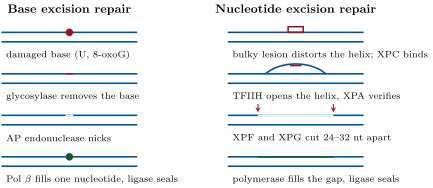
CoachMost lesions affect one strand and are repaired by cutting out the damaged piece and copying the other strand. Base excision repair (BER) handles small, non-distorting lesions: a DNA glycosylase specific for one kind of wrong base (uracil-DNA glycosylase, 8-oxoG glycosylase, and several others) flips the base out of the helix and cuts it off its sugar; an AP endonuclease nicks the backbone at the abasic site; a polymerase (Pol ) removes the sugar and inserts one nucleotide; a ligase seals. Nucleotide excision repair (NER) handles bulky, helix-distorting lesions — pyrimidine dimers, chemical adducts — without recognising the chemistry of the lesion itself: the distortion is detected (by XPC scanning the genome, or by a stalled RNA polymerase in the transcription-coupled branch), the helix is opened by the helicase subunits of TFIIH, the damage is verified (XPA), two endonucleases (XPF, XPG) cut the damaged strand nucleotides apart, the oligonucleotide is released, and polymerase and ligase fill the gap. Loss of any of the seven XP proteins causes xeroderma pigmentosum: extreme sensitivity to sunlight, freckling, and a thousand-fold increased rate of skin cancer.