
Biology · Glossary

What is Nucleosome and chromatin?

Definition 1.1 University Biology — Year 3 · Chapter 1 — Chromatin and Epigenetics

Chromatin is the complex of DNA with proteins in which the genome exists in a eukaryotic nucleus. Its repeating unit is the nucleosome: 147bp147\,\mathrm{bp} of DNA wound in 1.651.65 left-handed turns around a histone octamer — two copies each of the small, very basic proteins H2A, H2B, H3 and H4 — followed by a linker of 20 to 60bp20\text{ to }60\,\mathrm{bp} to the next nucleosome. A fifth histone, H1, binds the linker where it enters and leaves the core and helps the beads pack against one another. Each core histone carries an unstructured amino-terminal tail of some 20 to 4020\text{ to }40 residues that projects out of the particle. Chromatin that stains lightly, is loosely packed and is transcribed is euchromatin; densely packed, late-replicating and largely silent chromatin, at centromeres, telomeres and repeated sequences, is heterochromatin.
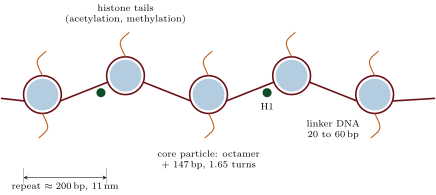
The 10\, nm fibre: nucleosome cores (blue) on a continuous DNA (red), each bead a histone octamer with its tails (orange) projecting out, linker histone H1 (green) at the entry–exit point. About six nucleosomes occupy the length that 1200\, bp of naked DNA would.
The 10nm10\,\mathrm{nm} fibre: nucleosome cores (blue) on a continuous DNA (red), each bead a histone octamer with its tails (orange) projecting out, linker histone H1 (green) at the entry–exit point. About six nucleosomes occupy the length that 1200bp1200\,\mathrm{bp} of naked DNA would.
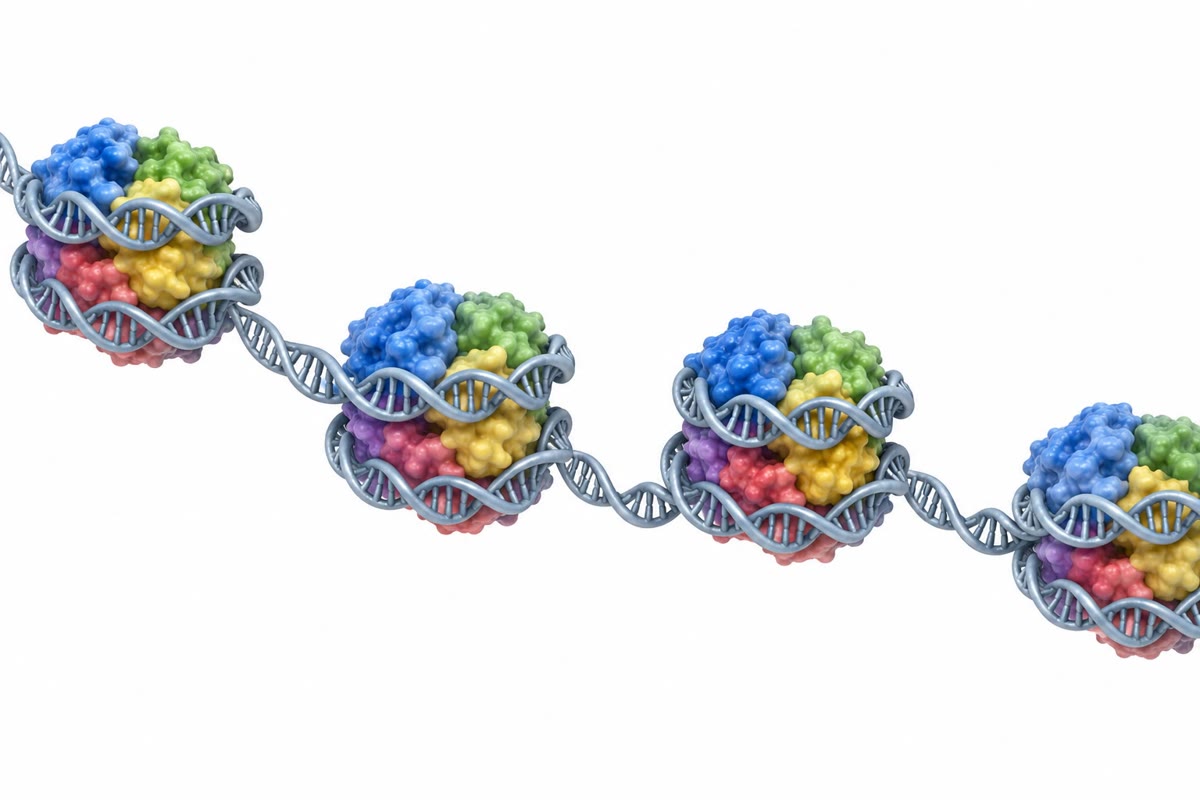
Chromatin at the molecular scale: the double helix wound around successive histone cores, the “beads on a string” that the nuclease ladder revealed.

Examples

Example 1.3 (Two metres in ten micrometres)

A human diploid nucleus holds 6.4×1096.4\times 10^{9} base pairs. At 0.34nm0.34\,\mathrm{nm} per base pair that is 2.2m2.2\,\mathrm{m} of double helix, in a nucleus about 10µm10\,\text{µ}\mathrm{m} across. It is packed into 6.4×10⁹/2003.2×1076.4\times 10^{9}/200 \approx 3.2\times 10^{7} nucleosomes, each carrying about 108kDa108\,\mathrm{kDa} of histone against 96kDa96\,\mathrm{kDa} of DNA (147bp147\,\mathrm{bp} at 650Da650\,\mathrm{Da} per pair): the nucleus contains roughly as much histone as DNA by mass. The DNA itself, treated as a cylinder 2nm2\,\mathrm{nm} across, has a volume of only about 7µm37\,\text{µ}\mathrm{m}^{3}, some 1%1\,\% of a spherical nucleus of radius 5µm5\,\text{µ}\mathrm{m}; the packing problem is one of entanglement and access, not of room.

Read in context →