
All books

Professional

Apps About Coach Log in Start reading

Chemistry · Glossary

What is Bond dipole, dipole moment?

Also known as: bond dipole · dipole moment · polar molecule

Definition 3.22 University Chemistry — Year 1 · Chapter 3 — Lewis Structures, Resonance and VSEPR

In a bond between atoms of different electronegativities the electrons lean towards the more electronegative atom, which bears a partial charge −δe-\delta e while its partner bears +δe+\delta e (0<δ<10 < \delta < 1). The bond dipole is the vector μ⃗=δe d⃗\vec\mu = \delta e\, \vec d, of norm δed\delta e d, pointing from the negative to the positive partial charge, d⃗\vec d being the vector between them. The dipole moment of a molecule is the vector sum of its bond dipoles (and of the contributions of its lone pairs); it is expressed in coulomb metres or in debyes, 1 D=3.336×10⁻³⁰ C m1\,\mathrm{D} = 3.336 \times 10^{-30}\,\mathrm{C}\,\mathrm{m}. A molecule with a non-zero dipole moment is a polar molecule.
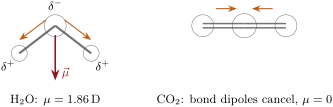
Bond dipoles (orange, from the partial negative to the partial positive charge) and their sum (red). In bent water they add; in linear carbon dioxide they cancel.

Examples

Example 3.25 (Polar and non-polar molecules)

COX2\ce{CO2}, BFX3\ce{BF3}, CHX4\ce{CH4} and CClX4\ce{CCl4} have zero dipole moments. HX2O\ce{H2O} (1.86 D1.86\,\mathrm{D}), NHX3\ce{NH3} (1.48 D1.48\,\mathrm{D}) and SOX2\ce{SO2} (1.63 D1.63\,\mathrm{D}) are polar. Along CHX3Cl\ce{CH3Cl}, CHX2ClX2\ce{CH2Cl2}, CHClX3\ce{CHCl3} the moment falls, 1.87, 1.62, 1.04 D1.04\,\mathrm{D}, to vanish in CClX4\ce{CCl4}: the C−Cl\ce{C-Cl} bond dipoles increasingly cancel. Among the hydrogen halides it follows the electronegativity difference: HF 1.83, HCl 1.09, HBr 0.83, HI 0.45 D0.45\,\mathrm{D}.

Read in context →