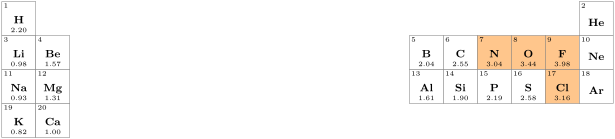
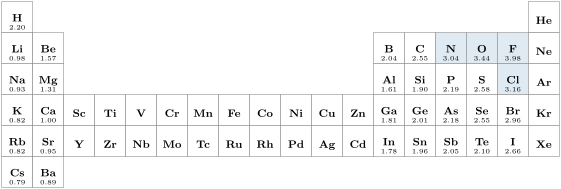
The electronegativity of an element measures how strongly its atoms, in a molecule, attract the electrons of the bonds they share. It is a number without unit; on the usual scale it runs from about 0.8 to about 4.
 Coach
Log in
Start reading
Coach
Log in
Start reading
Chemistry · Glossary
Also known as: Pauling scale · Mulliken scale
The electronegativity of an element measures how strongly its atoms, in a molecule, attract the electrons of the bonds they share. It is a number without unit; on the usual scale it runs from about 0.8 to about 4.
The electronegativity of an element measures the tendency of its atoms, in a molecule, to attract the electrons of the bonds they form. Two scales are in use.
On the Pauling scale, differences are defined from bond energies :
and the scale is anchored by .
Example 2.24 (Lithium in a battery)
Lithium has the lowest electronegativity of period 2 and loses its 2s electron easily, while it is the lightest metal: it carries the most transferable charge per gram of any element, the reason it powers rechargeable batteries. Its first ionisation energy, , is larger than that of sodium (5.14) or potassium (4.34), yet in water it is the most reducing alkali metal, a paradox resolved by the strong hydration of the small ion (Chapter 13).