University Chemistry — Year 1 · Bachelor Year 1
3Lewis Structures, Resonance and VSEPR
The ozone molecule, , is three oxygen atoms in a bent chain. Draw it with the rules of Book 1 and one bond comes out double, the other single: one bond should be short, the other long. Yet microwave spectroscopy finds the two bonds of ozone exactly equal, at , between the double bond of () and the single bond of hydrogen peroxide (). No single drawing is right; two drawings together are. This chapter makes the Lewis model precise — formal charges, octets that are incomplete or exceeded, resonance between several structures — and then uses it to predict the shapes of molecules and the dipole moments that follow from them.
You already know
Book 1 (grade 10) described the covalent bond as a shared pair of electrons, drew Lewis structures with bonding and lone pairs, and predicted four shapes (linear, bent, trigonal, tetrahedral). Electronegativity and its differences were made quantitative in Chapter 2; the valence electrons of an atom are read from its configuration (Definition 1.11).
3.1 Lewis structures and formal charges
Definition 3.1 (Covalent bond, Lewis structure)
A covalent bond is a pair of electrons shared by two atoms, the bonding pair; two or three pairs make a double or a triple bond. A pair of valence electrons that belongs to a single atom is a lone pair. A Lewis structure shows every valence electron of a molecule or ion, as bonds (lines between atoms) and lone pairs (lines or pairs of dots on an atom). By the octet rule, the atoms of period 2 (C, N, O, F) are surrounded in a stable structure by four pairs, eight electrons; by the duet rule, hydrogen by one pair.
Definition 3.2 (Formal charge)
The formal charge of an atom in a Lewis structure is
where is the number of valence electrons of the free atom, the number of electrons in its lone pairs and the number of electrons in the bonds it forms. It is written or next to the atom when it is not zero.
Proposition 3.3 (Formal charges add up to the charge)
The sum of the formal charges of the atoms of a Lewis structure equals the total charge of the molecule or ion.
Proof. Summing over the atoms gives , because each bond’s electrons are counted half on each of its two atoms. The bracket is the total number of valence electrons drawn in the structure, which equals minus the charge of the species. Hence . ∎
Method 3.4 (Drawing a Lewis structure)
To draw the Lewis structure of a molecule or ion:
- count the valence electrons and the pairs ;
- draw the skeleton: the least electronegative atom (not H) is usually central; hydrogen and fluorine are always terminal;
- complete the octets of the terminal atoms with lone pairs, then place the remaining pairs on the central atom;
- if the central atom lacks an octet, turn lone pairs of its neighbours into multiple bonds;
- compute the formal charges; among possible structures prefer the one with the fewest formal charges, and with negative charges on the most electronegative atoms.
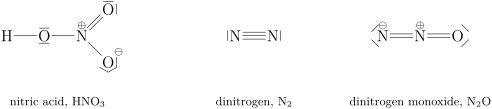
Example 3.5 (Nitric acid)
: electrons, 12 pairs. Skeleton: nitrogen central, bonded to three oxygens, one of which carries the hydrogen. Completing octets with single bonds leaves nitrogen with six electrons; one oxygen lone pair becomes an bond. Formal charges: nitrogen ; the singly bonded oxygen without hydrogen ; the others 0. The total is 0, as Proposition 3.3 requires.
3.2 Beyond the octet
Definition 3.6 (Electron-deficient and hypervalent molecules)
A molecule in which an atom has fewer than eight valence electrons is electron-deficient: in boron has six. A molecule in which an atom of period 3 or beyond is surrounded by more than four pairs is hypervalent: in phosphorus forms five bonds, in sulfur six. Molecules with an odd number of electrons, such as and , cannot satisfy the octet rule on every atom: one electron is unpaired.
Remark 3.7 (Why period 3 and not period 2)
Nitrogen forms but never , while phosphorus forms both and . A period-2 atom is too small to bond to more than four neighbours; a period-3 atom is large enough to hold five or six. Drawings of or with sulfur double bonds (12 electrons around S) or with single bonds and formal charges (an octet) are both found; the second reflects better the charge distribution, and both give the right geometry.
Definition 3.8 (Lewis acid, Lewis base, dative bond)
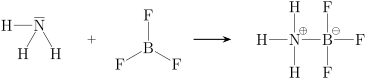
A Lewis acid is a species able to accept a pair of electrons into a vacant place of its valence shell (, , , metal cations); a Lewis base is a species with a lone pair it can share (, , ). When the base gives the pair to the acid, the bond formed is a dative bond: a covalent bond whose two electrons both came from one partner.
Example 3.9 (Ammonia and boron trifluoride)
. In the adduct, boron completes its octet; nitrogen, which now shares its lone pair, carries the formal charge and boron . Once formed, the bond is an ordinary covalent bond.
3.3 Resonance
Definition 3.10 (Resonance structures, resonance hybrid)
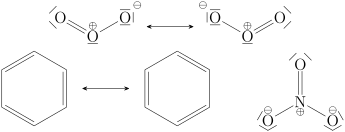
When the electrons of a molecule can be placed in several Lewis structures that differ only by the position of bonds and lone pairs — the nuclei staying in place — each is a resonance structure (or mesomeric form), linked to the others by a double-headed arrow . The real molecule is none of them: it is the resonance hybrid, a single structure whose electron distribution is a weighted average of theirs.
Remark 3.11 (An arrow, not an equilibrium)
The arrow does not describe a reaction: ozone does not switch from one structure to the other. The hybrid is one molecule, described by several drawings because one drawing is not enough. Never use between resonance structures.
Method 3.12 (Writing and weighting resonance structures)
To find the resonance structures of a species:
- start from one Lewis structure; look for a lone pair or a bond next to a bond, a vacant place or a positive charge;
- move pairs with curly arrows (a lone pair becomes a bond, a bond becomes a lone pair), never moving a nucleus and never exceeding the octet of a period-2 atom;
- recompute the formal charges;
- weight the structures: the most important ones obey the octet rule, have the fewest formal charges, and put negative charges on the most electronegative atoms; equivalent structures weigh the same.
Example 3.13 (Ozone, nitrate, benzene)
Ozone has two equivalent structures: each bond is double in one and single in the other, so both have a bond order and the same length, , between and . The nitrate ion has three equivalent structures; each bond has order . Benzene, , has two Kekulé structures; its six bonds are equal, , between the single bond of ethane () and the double bond of ethene ().
Definition 3.14 ( bond, bond)
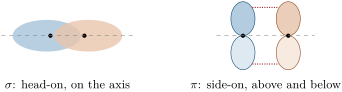
A single bond is a bond: its electron pair lies along the axis joining the two nuclei, from the head-on overlap of two orbitals. The second and third bonds of a multiple bond are bonds: their pairs lie on either side of the axis, from the side-on overlap of two p orbitals perpendicular to it. A double bond is one and one bond; a triple bond one and two .
3.4 The VSEPR model
Definition 3.15 (VSEPR model, steric number)
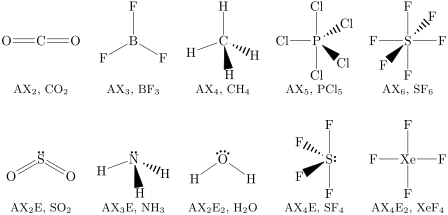
In the VSEPR model (valence-shell electron-pair repulsion), the pairs around a central atom A repel one another and take the arrangement that keeps them farthest apart. A molecule is written , where is the number of atoms bonded to A (a multiple bond counts once) and the number of lone pairs of A. The steric number fixes the arrangement of the pairs: 2 linear, 3 trigonal planar, 4 tetrahedral, 5 trigonal bipyramidal, 6 octahedral. The shape of the molecule is the arrangement of its atoms only.
Proposition 3.16 (VSEPR geometries)
The VSEPR model predicts the shapes and ideal angles of the table below; measured angles are close.
| type | arrangement of pairs | shape | example | measured angle |
|---|---|---|---|---|
| linear | linear | |||
| trigonal planar | trigonal planar | |||
| trigonal planar | bent | |||
| tetrahedral | tetrahedral | |||
| tetrahedral | trigonal pyramidal | |||
| tetrahedral | bent | |||
| trigonal bipyramidal | trigonal bipyramidal | , | ||
| trigonal bipyramidal | seesaw | , | ||
| trigonal bipyramidal | T-shaped | |||
| trigonal bipyramidal | linear | |||
| octahedral | octahedral | |||
| octahedral | square pyramidal | — | ||
| octahedral | square planar | — |
Proof. Admitted at this level. ∎
Proposition 3.17 (Lone pairs close the angles)
A lone pair, held by one nucleus only, spreads more than a bonding pair and repels more strongly: repulsions decrease in the order lone pair/lone pair lone pair/bonding pair bonding pair/bonding pair. Hence the angles between bonds shrink as lone pairs are added ( in , in , in ), and in a trigonal bipyramid lone pairs take the equatorial positions, where they have only two neighbours at .
Proof. Admitted at this level. ∎
Method 3.18 (Predicting a shape)
To predict the shape around a central atom:
- draw the Lewis structure (Method 3.4);
- count the atoms bonded to the central atom () and its lone pairs (); write ;
- read the arrangement from and the shape from the positions of the atoms;
- correct the ideal angles: lone pairs and multiple bonds take more room than single bonds.
Definition 3.19 (Hybridisation)
The hybridisation of an atom is a description of its bonds by orbitals pointing along the directions predicted by VSEPR: an atom of steric number 4 is said to be sp (four equivalent orbitals at ), of steric number 3 sp (three orbitals at in a plane, one p orbital left perpendicular to it), of steric number 2 sp (two orbitals at , two p orbitals left). The p orbitals left over form the bonds.
Example 3.20 (The carbons of organic chemistry)
In ethane each carbon is sp, tetrahedral; in ethene sp, the six atoms in one plane with angles near (measured ); in ethyne sp, the four atoms on one line. The bond lengths shrink from 153.6 to 133.9 to as bonds are added.
Remark 3.21 (A description, not a cause)
Hybridisation describes a geometry already known; it does not explain it, and it fails for the energies of electrons, which molecular orbital theory, in the Year 2 volume, accounts for. It remains the everyday language of organic chemistry: an “sp carbon” means a planar carbon with a p orbital free for a bond.
3.5 Polar molecules: dipole moments
Definition 3.22 (Bond dipole, dipole moment)
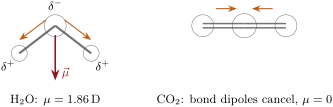
In a bond between atoms of different electronegativities the electrons lean towards the more electronegative atom, which bears a partial charge while its partner bears (). The bond dipole is the vector , of norm , pointing from the negative to the positive partial charge, being the vector between them. The dipole moment of a molecule is the vector sum of its bond dipoles (and of the contributions of its lone pairs); it is expressed in coulomb metres or in debyes, . A molecule with a non-zero dipole moment is a polar molecule.
Remark 3.23 (Direction convention)
Physics draws the dipole vector from the negative to the positive charge, the convention used here. Older chemistry books draw an arrow with a crossed tail pointing towards the negative end; only the direction differs.
Proposition 3.24 (Dipole of a symmetric molecule)
A molecule without lone pairs on A (linear , trigonal , tetrahedral , …) has a zero dipole moment, whatever the polarity of its bonds. A bent molecule of angle whose bonds have the dipole has the dipole moment
Proof. In the symmetric shapes the bond vectors are equal in norm and their directions are arranged symmetrically around A, so they add up to zero (for linear they are opposite; for at three vectors of the same norm sum to zero; for the sum is invariant under the rotations of the tetrahedron, so it is zero). For the bent molecule, each bond vector makes the angle with the bisector; the components perpendicular to the bisector cancel and those along it add: . ∎
Example 3.25 (Polar and non-polar molecules)
, , and have zero dipole moments. (), () and () are polar. Along , , the moment falls, 1.87, 1.62, , to vanish in : the bond dipoles increasingly cancel. Among the hydrogen halides it follows the electronegativity difference: HF 1.83, HCl 1.09, HBr 0.83, HI .
3.6 Exercises
Exercise 3.1 ★
Draw the Lewis structures of , , , , (methanal) and , and give the formal charges.
Solution
Solution of Exercise 3.1.
: two bonds, two lone pairs on O. : three bonds, one lone pair on N. : , two lone pairs on each O. : , one lone pair on N. : carbon bonded to two H and double-bonded to O, two lone pairs on O. All formal charges are zero in these five. : four bonds, no lone pair; nitrogen , the charge of the ion.
Exercise 3.2 ★
Give the type , the shape and the approximate angle of , , , and (central atom first in each formula).
Solution
Solution of Exercise 3.2.
: , bent, below (measured ). : , trigonal pyramidal, about . : , trigonal planar, . : , tetrahedral, . : (the double bond counts once), trigonal planar, .
Exercise 3.3 ★
Which of these molecules are polar: , , , , , ? Justify from the shapes.
Solution
Solution of Exercise 3.3.
Non-polar: (tetrahedral ), (), (linear ): the bond dipoles cancel. Polar: (two different kinds of bonds on a tetrahedron), (pyramidal), (bent).
Exercise 3.4 ★
Identify the Lewis acid and the Lewis base in and in . Which bonds are dative?
Solution
Solution of Exercise 3.4.
is the Lewis acid and the base: the new bond of is dative when formed (afterwards the three bonds are identical). is the acid and each a base: the four bonds are dative.
Exercise 3.5 ★★
Write two resonance structures of the ethanoate ion . What do they predict for the two bond lengths? Compare with methanoic acid , whose two bonds measure 120.2 and .
Solution
Solution of Exercise 3.5.

 . The two structures are equivalent: both bonds have order 1.5 and the same length, between the double and the single bond. In methanoic acid the two oxygens differ (one carries the H), the structures are not equivalent, and the bonds keep distinct lengths, 120.2 () and ().
Exercise 3.6 ★★
Draw the Lewis structure of the sulfate ion with four single bonds, compute the formal charges, and predict the shape. How many resonance structures with two bonds and no charge on sulfur can be written?
Solution
Solution of Exercise 3.6.
electrons. With four single bonds and three lone pairs on each oxygen: sulfur , each oxygen ; total . Shape , tetrahedral. With two bonds, choosing which two of the four oxygens are double-bonded gives structures.
Exercise 3.7 ★★
Use VSEPR to predict the shapes of , , and . Explain why the lone pairs of a trigonal bipyramid sit in the equatorial plane.
Solution
Solution of Exercise 3.7.
: , seesaw. : , T-shaped. : , linear. : , square planar. In a trigonal bipyramid an axial position has three neighbours at , an equatorial position only two: the bulky lone pairs go where they meet the fewest repulsions.
Exercise 3.8 ★★
The angles are in and in ; in and in . Propose an explanation in terms of the size and electronegativity of the central atom.
Solution
Solution of Exercise 3.8.
Sulfur and phosphorus are larger and less electronegative than oxygen and nitrogen: the bonding pairs lie farther from the central atom and are pulled towards hydrogen, so they repel one another less, and the lone pairs squeeze the bonds towards .
Exercise 3.9 ★★
Give the hybridisation of each carbon and of the nitrogen in (ethanenitrile) and in , and the number of and bonds in each molecule.
Solution
Solution of Exercise 3.9.
: the carbon is sp, the nitrile carbon sp, the nitrogen sp; 5 bonds (three , , one in ) and 2 bonds. : the two alkene carbons are sp, the methyl carbon sp; 8 bonds (six , two ) and 1 bond.
Exercise 3.10 ★★★
The dipole moment of is only , against for , although the bond is more polar than the bond. Using the bond dipoles and the lone pair of nitrogen, explain the difference.
Solution
Solution of Exercise 3.10.
Both molecules are pyramidal with a lone pair on nitrogen. The lone pair gives a contribution pointing (negative to positive) from the lone pair towards the nucleus. In , nitrogen is the negative end of each bond: the bond dipoles point from N towards the hydrogens, in the same direction as the lone-pair contribution, and they add. In , fluorine is the negative end: the bond dipoles point from the fluorines towards N, against the lone-pair contribution, and the two nearly cancel.
Exercise 3.11 ★★★
The molecule has an angle of and a dipole moment of . Compute the dipole of one bond; with the bond length , deduce the partial charge on each oxygen.
Solution
Solution of Exercise 3.11.
. Then .
Exercise 3.12 ★★★
Draw the most important Lewis structures of dinitrogen monoxide (linear, ) and compute the formal charges. The measured bond lengths are and ; in the triple bond measures . Which structure weighs more?
Solution
Solution of Exercise 3.12.
with formal charges , , ; with , , . The bond () is close to the triple bond of (): the structure weighs more, and it places the negative charge on oxygen, the more electronegative atom. The bond is however shorter than a single bond: the other structure contributes too.
3.7 Problem: The Molecules of a Lightning Strike
Problem 3.1
Weekend problem — the nitrogen and oxygen species made when lightning heats air: Lewis structures, resonance, shapes, and the partial charges of water
A lightning bolt heats air to thousands of degrees: and give , then , , ozone and finally nitric acid in rain. Data: , . Measured values are given where needed.
Part I — Lewis structures.
- Count the valence electrons of , , , , and .
- Draw the Lewis structure of .
- Draw a Lewis structure of . Why can the octet rule not be satisfied on both atoms?
- Draw two Lewis structures of , with and with , and give the formal charges.
- Draw a Lewis structure of ozone and give the formal charges.
- Draw a Lewis structure of and give the formal charges.
- Which of the six species have an unpaired electron?
Part II — Resonance and bond lengths.
- Write the two resonance structures of ozone. What bond order do they predict?
- The bond measures in ozone, in and in . Is the prediction confirmed?
- Write the three resonance structures of and give the order of each bond.
- In the three bonds measure 140.6, 121.1 and . Assign them and explain using resonance.
- Explain why the angle of () is larger than .
- Which of the two structures of question 4 places the negative formal charge on the more electronegative atom?
Part III — Shapes and polarity.
- Give the type of the central atom of , , and the nitrogen of , and their shapes.
- The ozone angle is . Explain why it is below .
- Ozone has a dipole moment of , , none. Explain.
- Why is non-polar while is polar?
- Predict the angle of relative to , then compare with the measured .
- Same question for water ().
Part IV — The partial charges of water. The dipole moment of water is , its angle and its bond length .
- Express the dipole moment of water as a function of the bond dipole and the angle.
- Compute in debyes.
- Convert it into coulomb metres.
- If the bond dipole were made of two full charges at the two nuclei, what would it be?
- Deduce the fractional ionic character of the bond, the ratio of the measured bond dipole to that of full charges.
Solution
Solution of Problem 3.1.
1. 10, 11, 17, 16, 18, 24. 2. with one lone pair on each nitrogen. 3. with two lone pairs on oxygen, one lone pair and one single electron on nitrogen. With 11 electrons, an odd number, one atom always has an odd count: nitrogen has 7 electrons around it. 4. : , , ; : , , . 5. : central oxygen (one lone pair, three bonds), the singly bonded terminal oxygen , the other 0. 6. As in Example 3.5: nitrogen , the oxygen bearing a single bond and no hydrogen , the others 0. 7. and (11 and 17 electrons). 8. Two equivalent structures, the double bond on either side: order 1.5 for each bond. 9. Yes: lies between the double bond () and the single bond (). 10. The double bond on each of the three oxygens in turn; each bond is double in one structure of three: order . 11. The long bond, , is , a single bond. The two oxygens without hydrogen share one bond through two equivalent resonance structures: two bonds of order 1.5, 121.1 and . 12. Nitrogen carries a single electron rather than a lone pair: it repels the bonding pairs less than a pair would, and the bonds open beyond . 13. , with the negative charge on oxygen. 14. : , bent. : (central N), linear. : , trigonal planar. Nitrogen of : , trigonal planar. 15. The lone pair of the central oxygen repels the bonding pairs more than they repel each other. 16. Ozone is bent and its central atom differs from the end atoms (positive formal charge in the middle, negative charge shared by the ends): a small dipole along the bisector. is linear but its two ends are different atoms: a small dipole. is symmetric: none. 17. is linear (): its bond dipoles cancel. is bent (): they add. 18. : the lone pair closes the angles below ; measured . 19. : two lone pairs close it further; . 20. (Proposition 3.24). 21. . 22. . 23. , that is . 24. : the bond of water carries a third of the charge a fully ionic bond would carry.