全部书籍

专业

应用 关于 Coach 登录 开始阅读

书籍暂未推出简体中文版——当前显示英文版。

Chemistry · 术语表

什么是 Calibration curve?

又称: least-squares line · residual

Definition 34.9 University Chemistry — Year 2 · 第 34 章 — Statistics of Chemical Measurement

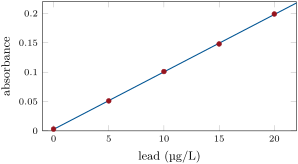
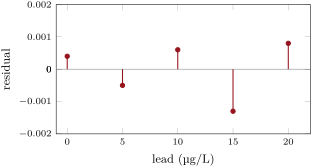
A calibration curve relates the signal yy of an instrument to the concentration xx, from standards of known concentration. The least-squares line y=a+bxy = a + bx is the line that minimises S=∑(yi−a−bxi)2S = \sum (y_i - a - bx_i)^2; each ei=yi−a−bxie_i = y_i - a - bx_i is a residual.

Calibration of lead by graphite-furnace atomic absorption at 283.3\, nm (exercise data, used in the problem). Left: the five standards and the least-squares line. Right: the residuals, small and without pattern: a straight line is adequate. Calibration of lead by graphite-furnace atomic absorption at 283.3\, nm (exercise data, used in the problem). Left: the five standards and the least-squares line. Right: the residuals, small and without pattern: a straight line is adequate.
Calibration of lead by graphite-furnace atomic absorption at 283.3 nm283.3\,\mathrm{nm} (exercise data, used in the problem). Left: the five standards and the least-squares line. Right: the residuals, small and without pattern: a straight line is adequate.
在原文中阅读 →