
All books

Professional

Apps About Coach Log in Start reading

Chemistry · Glossary

What is Carriers?

Also known as: intrinsic semiconductor · charge carrier · hole

Definition 22.6 University Chemistry — Year 3 · Chapter 22 — Solid-State Chemistry: Bands, Defects and Semiconductors

An intrinsic semiconductor is a pure semiconductor, whose carriers all come from electrons excited across the gap. A charge carrier is a mobile particle that carries current: an electron in the conduction band, or a hole, an empty level in the valence band, which moves like a positive charge.
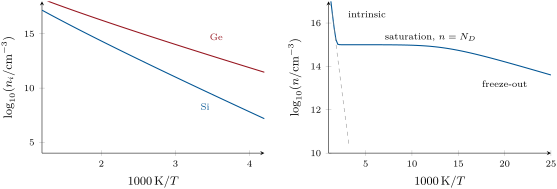
Left: intrinsic carrier concentrations of silicon and germanium against 1/T (model with the measured gaps and effective densities of states); the slopes are close to -E_g/2k. Right: electrons in silicon doped with 1 × 10¹⁵\, cm-3 phosphorus: at low temperature the donors hold their electrons (freeze-out), from about 150 to 500\, K all are ionised (n = N_D), and at high temperature the intrinsic carriers (dashed, n_i) take over.
Left: intrinsic carrier concentrations of silicon and germanium against 1/T1/T (model with the measured gaps and effective densities of states); the slopes are close to −Eg/2k-E_g/2k. Right: electrons in silicon doped with 1×1015 cm−31 \times 10^{15}\,\mathrm{cm}^{-3} phosphorus: at low temperature the donors hold their electrons (freeze-out), from about 150 to 500 K500\,\mathrm{K} all are ionised (n=NDn = N_D), and at high temperature the intrinsic carriers (dashed, nin_i) take over.
Read in context →