University Chemistry — Year 3 · Bachelor Year 3
22Solid-State Chemistry: Bands, Defects and Semiconductors
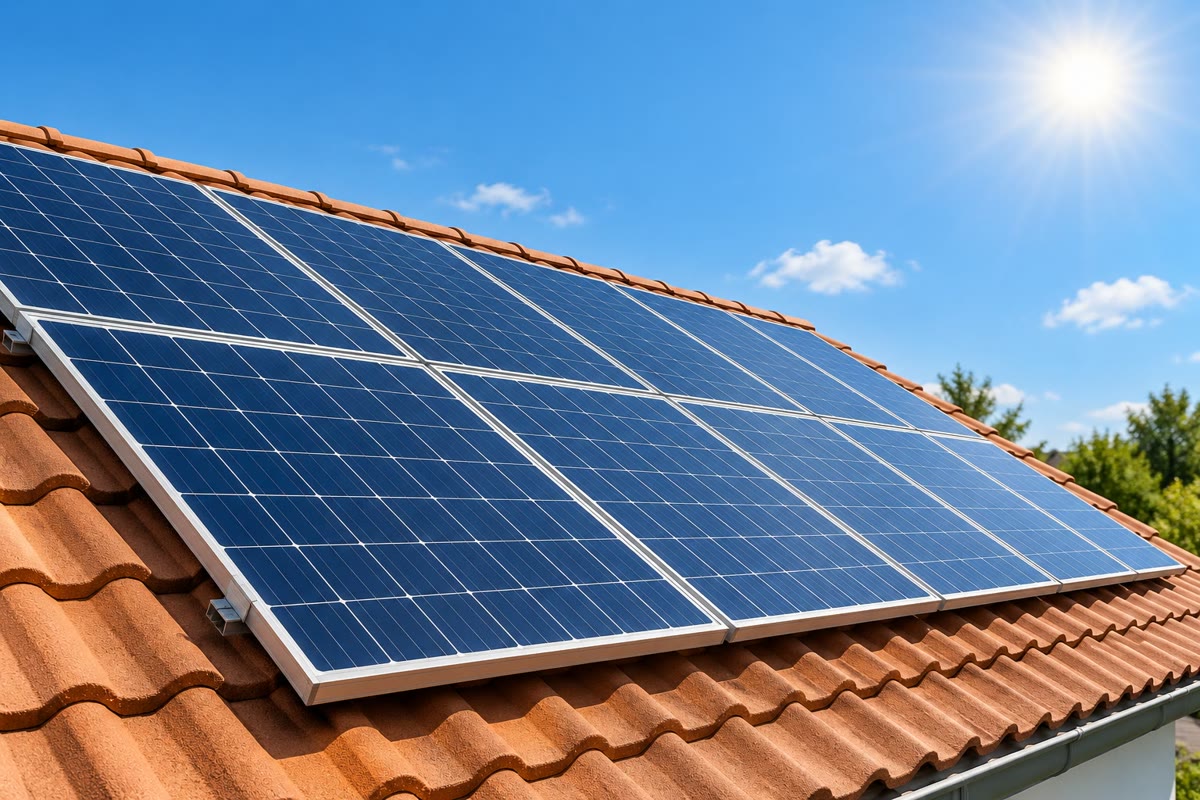
A solar panel on a roof and the light-emitting diode in a lamp are made of the same kind of crystal, silicon or a compound of gallium with nitrogen, arsenic or phosphorus, into which a few impurity atoms per million have been put on purpose. Their working is set by two things a molecule does not have: bands of energy levels, with a gap whose width fixes which light a crystal absorbs or emits, and defects, which carry the charges. This chapter builds the bands from molecular orbitals, counts the carriers of a semiconductor, and treats missing and misplaced atoms as chemical species with their own equilibria, down to the solid electrolyte of the oxygen sensor in a car’s exhaust.
You already know
The Year 1 volume defined crystals, the metallic bond, ionic and covalent crystals, interstitial sites and alloys, and the Nernst equation; the Year 2 volume the Hückel method and the resonance integral . Chapter 9 gave the reciprocal lattice and Chapter 10 the Boltzmann distribution and the statistical entropy .
22.1 From orbitals to bands
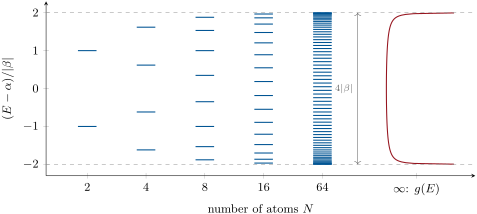
Take a chain of identical atoms, each with one s orbital, in the Hückel approximation: Coulomb integral on each atom, resonance integral between neighbours, zero otherwise.
Theorem 22.1 (Levels of a Hückel chain)
The molecular orbitals of a linear chain of atoms have energies
with coefficients on atom . As the levels fill the interval from to densely: a band of width .
Proof. The secular equations are for , with (no atom there). Try : since , each equation becomes , so . The condition holds for every , and requires ; gives distinct levels (the others repeat them or vanish). The lowest and highest are , which tend to ; the spacing between neighbours is at most , which tends to zero. ∎
For the theorem gives , the orbitals of ethene’s system; for the open-chain hexatriene. In three dimensions the same happens with every kind of atomic orbital: s orbitals give an s band, p orbitals a p band, and each band holds electrons for atoms.
Definition 22.2 (Bands)
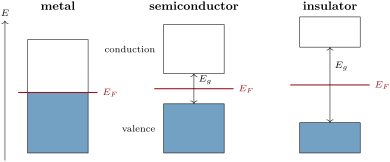
An energy band of a crystal is a continuous range of allowed one-electron energies, formed from the orbitals of all its atoms. A band gap is a range of energies with no levels between two bands. In a semiconductor or an insulator at zero temperature, the highest filled band is the valence band and the lowest empty one the conduction band.
Definition 22.3 (Density of states and Fermi level)
The density of states is the number of levels per unit energy (and per atom or per unit volume) near the energy . The Fermi level is the energy at which a level has probability of being occupied; at zero temperature all levels below it are filled and all above it empty.
Proposition 22.4 (Band filling)
A crystal whose highest occupied band is partly filled conducts electricity like a metal; a crystal whose bands are either full or empty, with a gap between them, does not conduct at zero temperature.
Argued. In an electric field, electrons gain a little energy and momentum: they must move into empty levels just above the ones they occupy. In a partly filled band such levels lie immediately above the Fermi level, at no energy cost. In a full band every level is taken and the next empty one is across the gap; moreover a full band carries no net current, since for each electron moving one way another moves the opposite way. ∎
Sodium, with one 3s electron per atom, half-fills its s band: a metal. Magnesium, with two, would fill its s band exactly, but the s and p bands overlap, so it is a metal too. Diamond and silicon have four valence electrons per atom in orbitals that split into a filled bonding band and an empty antibonding band, separated by a gap.
Definition 22.5 (Semiconductors and insulators)
A semiconductor is a solid with a band gap small enough (up to about ) that a measurable number of electrons cross it at ordinary temperature or after doping; an insulator has a gap so large that it does not conduct.
22.2 Semiconductors
Definition 22.6 (Carriers)
An intrinsic semiconductor is a pure semiconductor, whose carriers all come from electrons excited across the gap. A charge carrier is a mobile particle that carries current: an electron in the conduction band, or a hole, an empty level in the valence band, which moves like a positive charge.
Theorem 22.7 (Intrinsic carrier concentration)
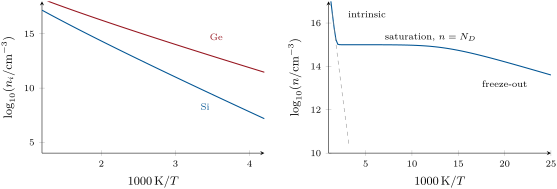
With and the effective densities of states of the conduction and valence bands (admitted), the electron and hole concentrations of a semiconductor whose Fermi level is more than a few from either band edge are
and in an intrinsic semiconductor
Proof. The occupancy of a level of energy is . When , , a Boltzmann tail. Summing it over the levels of the conduction band, , and the last integral is by definition . Holes are empty levels, with probability in the valence band; the same steps give . Then , and in a pure crystal each excited electron leaves one hole: , so . ∎
Proposition 22.8 (Mass-action law)
In any semiconductor at equilibrium, doped or not, .
Proof. The product found in the proof of Theorem 22.7 does not contain : it is the same whatever sets the Fermi level, and equal to its intrinsic value . It is the equilibrium constant of , like the ionic product of water. ∎
Definition 22.9 (Direct and indirect gaps)
A semiconductor has a direct band gap when the top of its valence band and the bottom of its conduction band occur at the same electron momentum, so that a photon alone can carry an electron across, and an indirect band gap when they do not, so that the transition needs a lattice vibration as well.
Silicon () and germanium () have indirect gaps: they absorb light well enough in a thick layer, which suits a solar cell, but emit it very poorly. Gallium arsenide () and gallium nitride (about ) have direct gaps, the basis of infrared and blue light-emitting diodes and lasers; gallium phosphide () is indirect but emits green light when doped. The colour of many pigments is also a band gap: a crystal absorbs all photons with , so cadmium sulfide, with a gap in the blue, is yellow.
Definition 22.10 (Doping)
A dopant is a foreign atom put in a semiconductor on purpose, in small amounts, to provide carriers. In an n-type semiconductor the dopant has one more valence electron than the atom it replaces (phosphorus in silicon) and gives it to the conduction band from a donor level just below that band; in a p-type semiconductor it has one fewer (boron in silicon) and accepts an electron from the valence band into an acceptor level just above it, leaving a hole.
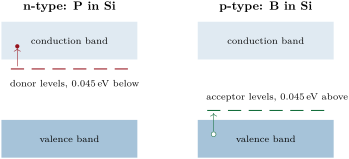
The donor level of phosphorus lies below the conduction band of silicon, less than at room temperature, and boron’s acceptor level as much above the valence band: at nearly every dopant is ionised. That is why one dopant atom per silicon atoms () raises the electron concentration a few hundred thousand times.
Method 22.11 (Carriers of a doped semiconductor)
- Check that the temperature is in the saturation range (dopants fully ionised, ): then the majority carriers are (or ).
- Get the minority carriers from the mass-action law: .
- Place the Fermi level: , or relative to the intrinsic level, .
- If both kinds of dopant are present, use the difference .
Definition 22.12 (p–n junction)
A p–n junction is the boundary, inside one crystal, between a p-type and an n-type region.
At a p–n junction electrons diffuse from the n side into the p side and holes the other way, leaving a thin layer emptied of carriers in which the fixed ionised dopants set up an electric field; at equilibrium the Fermi level is the same on both sides. A voltage applied one way lowers the barrier and current flows; the other way it raises it: a diode. In a light-emitting diode, electrons and holes injected across the junction recombine and emit photons of energy close to ; in a solar cell, photons absorbed near the junction make electron–hole pairs that the field separates, and a current flows in the external circuit.
In the lab — Growing a silicon crystal
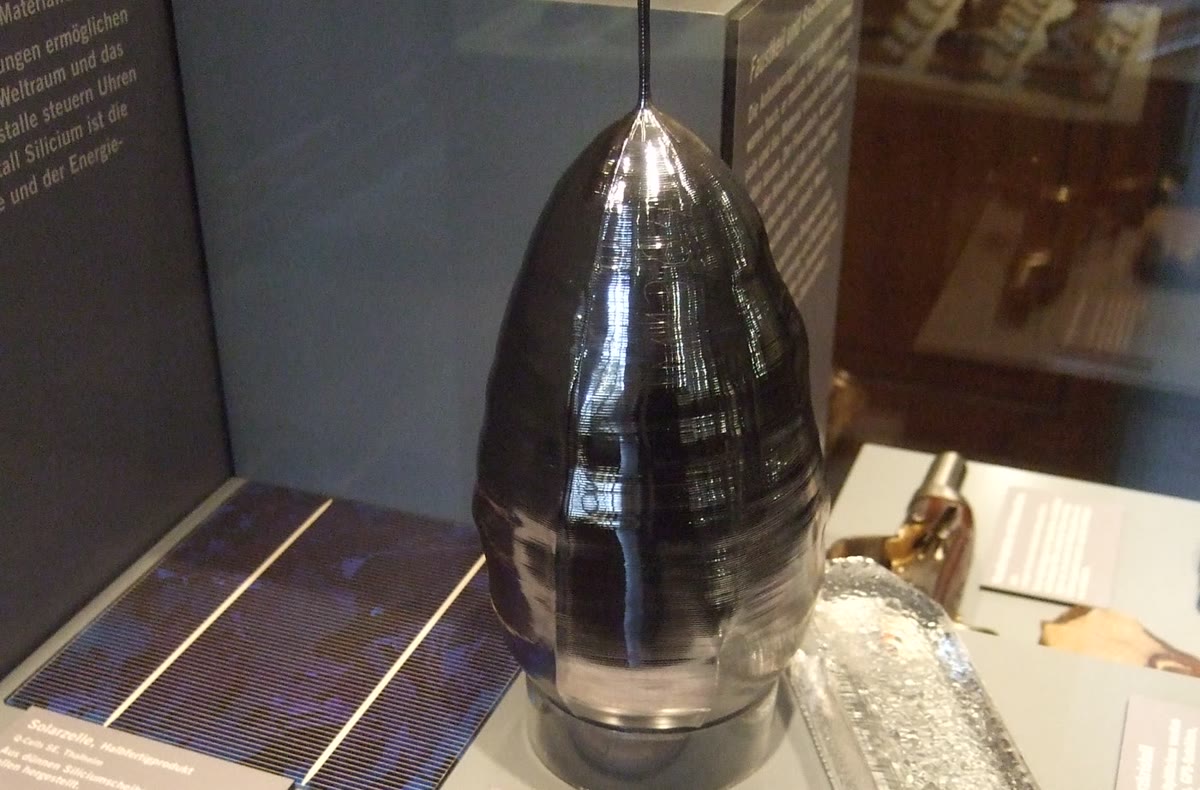
In the Czochralski method, very pure polycrystalline silicon is melted in a silica crucible under argon, at a little above its melting point, with the dopant added to the melt. A small seed crystal on a rotating rod is dipped into the melt and slowly raised: silicon crystallises on it with the seed’s orientation, and the rate of pulling and rotation sets the diameter. The boule is then sawn into wafers less than a millimetre thick. Silane and the doping gases phosphine and arsine used in later steps are pyrophoric or very toxic, and are handled only in sealed industrial systems.
22.3 Point defects
Definition 22.13 (Point defects)
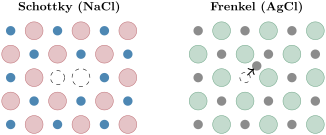
A point defect is a departure from the perfect crystal localised at one site: a vacancy, an interstitial atom, or a foreign atom. In an ionic crystal, a Schottky defect is a pair of vacancies, one cation and one anion, the ions having gone to the surface; a Frenkel defect is a pair made of a vacancy and the ion that left it, sitting on an interstitial site.
Theorem 22.14 (Equilibrium concentration of Schottky defects)
In a crystal MX of formula units, the number of Schottky pairs at equilibrium, with formation enthalpy per pair and , is
Proof. Creating pairs costs and gives a configurational entropy, from the ways of choosing the cation vacancies and as many for the anions: . With Stirling’s formula ,
At equilibrium : , so , and for . The vibrational entropy of the defects, neglected here, multiplies the result by a constant factor. ∎
Proposition 22.15 (Frenkel defects)
With ions of the moving kind, interstitial sites available to them and the formation enthalpy of a pair, the number of Frenkel pairs is (for ).
Proof. The entropy is now , and the same minimisation gives
hence the result. ∎
The square root shows that defects form in pairs: like in a semiconductor, their concentration has half the formation energy in its exponent. Alkali halides form mainly Schottky defects; silver halides, whose small, polarisable fits between the anions, mainly Frenkel defects.
Definition 22.16 (Kröger–Vink notation)
Kröger–Vink notation writes a point defect as : A is the species on the site (V for a vacancy, as the site for an interstitial), S the site it occupies in the perfect crystal, and c its charge relative to that site: for each positive unit, for each negative unit, for none.
Thus is a sodium vacancy (the missing leaves a relative charge ), a chloride vacancy, an interstitial silver ion, a calcium ion on a sodium site, an oxide ion in place. The Schottky equilibrium of NaCl is , the Frenkel equilibrium of AgCl .
Method 22.17 (Writing a defect equation)
- Write what is added to the host and the defects it makes.
- Site balance: the ratio of cation to anion sites of the host is kept (vacancies count as sites).
- Mass balance: the same atoms on both sides (vacancies have no mass; electrons and holes none either).
- Charge balance: the sums of the effective charges are equal.
Example 22.18 (Yttria in zirconia)
Dissolving in puts two on sites, each of relative charge , and three oxide ions on oxygen sites; the host’s ratio of one cation to two oxygen sites requires four oxygen sites for the two cations, so one stays empty:
Sites: 2 cation, 4 oxygen; mass: 2 Y and 3 O; charge: . One oxide vacancy for each two yttrium ions: this is what makes yttria-stabilised zirconia an oxide-ion conductor.
Definition 22.19 (Colour centre)
A colour centre is a point defect that absorbs visible light, such as an electron trapped in an anion vacancy of an alkali halide (an F centre), which colours a crystal that is otherwise transparent.
Heating sodium chloride in sodium vapour or irradiating it makes F centres: the trapped electron behaves like a particle in a box the size of the vacancy, and absorbs in the visible, turning the crystal yellow-brown.
22.4 Non-stoichiometry
Definition 22.20 (Non-stoichiometric compounds)
A non-stoichiometric compound is a solid whose composition varies over a range around a simple ratio of whole numbers, the difference being taken up by point defects.
Iron(II) oxide is never exactly : it is always short of iron, , with set by the temperature and the oxygen pressure at which it was made. Each missing is compensated by two , which in defect language are holes on iron sites.
Proposition 22.21 (Conductivity and oxygen pressure)
For a metal-deficient oxide whose defects are doubly charged metal vacancies compensated by holes, the hole concentration, and the conductivity, vary as . For an oxygen-deficient oxide compensated by electrons, they vary as .
Proof. Taking up oxygen creates metal vacancies:
(the activity of is 1). The charge balance is , so and . For the oxygen-deficient case, , , and the same steps give . The conductivity is proportional to the carrier concentration. ∎
A plot of against thus tells which defects dominate: its slope, or , depends on their charges.
22.5 Ionic conductors
Definition 22.22 (Ionic conductors)
An ionic conductor is a solid in which the current is carried by ions moving through the lattice. A solid electrolyte is an ionic conductor whose electronic conductivity is negligible, so that it can separate the two electrodes of an electrochemical cell.
Proposition 22.23 (Arrhenius law of ionic conduction)
For ions that move by hopping between neighbouring sites over a barrier , .
Partial proof. An ion attempts jumps at a frequency and succeeds with probability , so its diffusion coefficient is for neighbouring sites at distance (random walk). The Nernst–Einstein relation (admitted), for mobile ions of charge per unit volume, gives . The concentration is fixed by doping in an extrinsic conductor; when it is itself thermally created, also contains half the formation enthalpy. ∎
Three solid electrolytes show the range. In yttria-stabilised zirconia the oxide vacancies made by the dopant let ions hop; it conducts usefully only when hot, at several hundred degrees Celsius. In -alumina, sodium ions move in loosely packed planes between spinel blocks, the basis of sodium–sulfur batteries. Silver iodide becomes a superionic conductor above , where its silver ions are spread over many more sites than there are ions, almost like a liquid within a rigid iodide lattice. Lithium-ion conductors (lithium lanthanum zirconate garnets, sulfides) are the electrolytes of the all-solid batteries now under development.
History — The transistor and the pulled crystal
In 1947 John Bardeen and Walter Brattain, in William Shockley’s group at Bell Laboratories, made the first transistor from a crystal of germanium; the three shared the 1956 Nobel Prize in Physics. The crystals came from a method Jan Czochralski had found in 1916 while measuring how fast metals crystallise, pulling a thread of tin out of the melt: adapted to germanium and then silicon, it still makes the wafers of nearly all integrated circuits.
22.6 Exercises
Exercise 22.1 ★
Give the six Hückel levels of a chain of six atoms in units of , and the width of the range they span.
Solution
Solution of Exercise 22.1.
: , , , , , . They span , already 90 % of the band width of the infinite chain.
Exercise 22.2 ★
How many electrons does a band built from the s orbitals of atoms hold? Why are sodium and magnesium both metals?
Solution
Solution of Exercise 22.2.
( orbitals, two electrons each). Sodium, with one 3s electron per atom, half fills its s band: a metal. Magnesium has two and would fill the s band exactly, but the 3s and 3p bands overlap, so the highest occupied levels belong to a partly filled combined band: a metal too.
Exercise 22.3 ★
Estimate the wavelength of the light emitted by diodes of gallium phosphide () and gallium nitride (), using .
Solution
Solution of Exercise 22.3.
: gallium phosphide (green); gallium nitride (near ultraviolet). Blue diodes use gallium nitride alloyed with indium, whose gap is smaller.
Exercise 22.4 ★
Write the Kröger–Vink equations for dissolving in and in , and check each balance.
Solution
Solution of Exercise 22.4.
: two cation and two anion sites, as in NaCl; one Ca and two Cl; charge . : two cation and four oxygen sites; two Y and three O; charge .
Exercise 22.5 ★★
With , (in ) and for silicon at , and , , for germanium, compute for each, and their ratio.
Solution
Solution of Exercise 22.5.
at , . Silicon: , , . Germanium: , , . Ratio : the smaller gap of germanium gives it over two thousand times more carriers.
Exercise 22.6 ★★
Silicon is doped with phosphorus. With at , give the electron and hole concentrations.
Solution
Solution of Exercise 22.6.
; .
Exercise 22.7 ★★
For the crystal of Exercise 22.6, how far above the intrinsic level is the Fermi level?
Solution
Solution of Exercise 22.7.
.
Exercise 22.8 ★★
The formation enthalpy of a Schottky pair in NaCl is about (data of the exercise). Compute the fraction of vacant sites at , and the number of pairs in a mole.
Solution
Solution of Exercise 22.8.
at ; ; in a mole pairs.
Exercise 22.9 ★★
A sample of iron(II) oxide (rock-salt structure, four oxygen sites per cell) has and a density of (data of the exercise). Assuming the oxygen sites full, find in .
Solution
Solution of Exercise 22.9.
The mass of a cell is , that is per mole of cells, or per oxygen. Then gives : , .
Exercise 22.10 ★★★
A lithium-ion conductor has at , at and at (data of the exercise). Find its activation energy.
Solution
Solution of Exercise 22.10.
: , , at , , ; slope between the end points (the middle point lies on the line), so .
Exercise 22.11 ★★★
Show that in an oxide whose dominant defects are singly charged metal vacancies compensated by holes, the conductivity varies as .
Solution
Solution of Exercise 22.11.
, . Charge balance , so and ; the conductivity follows the holes.
Exercise 22.12 ★★★
In AgCl the Frenkel pair has a formation enthalpy of about , and there are two interstitial sites per silver ion (data of the exercise). Compute the fraction of silver ions on interstitial sites at .
Solution
Solution of Exercise 22.12.
.
22.7 Problem: The Oxygen Sensor in an Exhaust Pipe
Problem 22.1
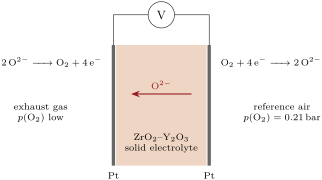
Weekend problem — the oxygen sensor in an exhaust pipe: the defects of yttria-stabilised zirconia, its ionic conductivity and operating temperature, the Nernst voltage of the cell, and the switch between lean and rich exhaust
The sensor’s electrolyte is zirconia with 8.0 mol % , of fluorite structure with four cation and eight oxygen sites per cubic cell, ; a disc thick and in area separates the exhaust from air. Its conductivity follows with and at . Lean exhaust has , rich exhaust (all data of the problem).
Part I — The electrolyte.
- Write the Kröger–Vink equation for dissolving in .
- Check its site, mass and charge balance.
- How many oxide vacancies are created per yttrium ion?
- Write the composition as and compute .
- Compute the fraction of oxygen sites that are vacant.
- Compute the number of vacancies per cell.
- Compute the vacancy concentration in .
Part II — Conductivity and temperature.
- Why does the conductivity rise steeply with temperature?
- Compute .
- Compute at .
- Compute at .
- Compute the resistance of the disc at these two temperatures.
- The electronics need a resistance below : find the lowest working temperature.
- Why are such sensors fitted with a heater?
Part III — The Nernst voltage.
- Write the electrode reaction on the air side, in ordinary and in Kröger–Vink notation.
- Show that the cell voltage is .
- Compute at .
- What is the voltage if the exhaust contained air?
- Compute the change of voltage per factor of ten in .
Part IV — Lean, rich and the switch.
- Compute the voltage in lean exhaust at .
- Compute the voltage in rich exhaust at .
- Why is so small in rich exhaust?
- The engine control switches at : what oxygen pressure does that correspond to?
- Why does the voltage jump at the stoichiometric air-to-fuel ratio, and how does the engine control use it?
- State the result: the sensor voltage in rich exhaust at .
Solution
Solution of Problem 22.1.
1. .
2. Sites: two cation sites and four oxygen sites (three filled, one empty), the 1 : 2 ratio of . Mass: 2 Y and 3 O on each side. Charge: .
3. One vacancy for two yttrium ions: one half per yttrium.
4. Per there are 0.92 Zr and 0.16 Y, 1.08 cations: , .
5. : 3.7 % of the oxygen sites are empty.
6. vacancies per cell.
7. : .
8. Each oxide ion must hop over a barrier of into a neighbouring vacancy; the fraction of attempts that succeed, , grows very fast with .
9. At , : .
10. At : .
11. At : .
12. : at , at .
13. needs ; solving (by trial) gives , about .
14. Exhaust is cold after a start and at low load; the heater brings the electrolyte to its working temperature within seconds, so that the control works from the start, when most pollutants are emitted.
15. ; in Kröger–Vink notation .
16. Oxygen is reduced on the air side and the oxide ions are oxidised back to oxygen on the exhaust side: the cell transfers from air to exhaust, with per mole of and four electrons: .
17. .
18. Zero: the two pressures are equal.
19. per decade.
20. .
21. .
22. Rich exhaust contains carbon monoxide, hydrogen and unburnt hydrocarbons; on the platinum electrode the little oxygen left reacts with them, and is set by the equilibria and , which leave a tiny value at .
23. .
24. Around the stoichiometric ratio, the exhaust passes from a slight excess of oxygen to a slight excess of CO and hydrogen: falls by some eighteen powers of ten for a small change in fuel, and the voltage jumps from below to about . The engine control adds fuel when the voltage is low and removes it when high, holding the mixture at the stoichiometric point where the three-way catalyst converts CO, hydrocarbons and nitrogen oxides at once.
25. In rich exhaust at the sensor gives about .