
All books

Professional

Apps About Coach Log in Start reading

Chemistry · Glossary

What is Character of oxides?

Also known as: basic oxide · acidic oxide · amphoteric oxide

Definition 26.4 University Chemistry — Year 1 · Chapter 26 — Hydrogen and the s-Block

A basic oxide reacts with water to give a hydroxide, or with acids to give salts (NaX2O\ce{Na2O}, CaO\ce{CaO}); an acidic oxide reacts with water to give an acid, or with bases to give salts (COX2\ce{CO2}, SOX3\ce{SO3}, PX4OX10\ce{P4O10}); an amphoteric oxide reacts with both acids and bases (AlX2OX3\ce{Al2O3}, ZnO\ce{ZnO}). Across a period, oxides go from basic (metals, left) to acidic (non-metals, right).
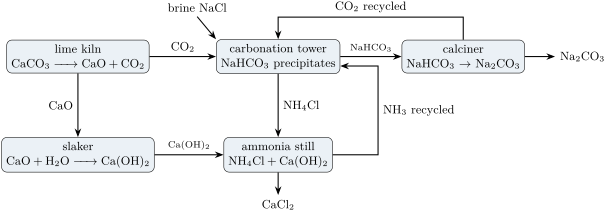
The Solvay process. Carbon dioxide and ammonia go round in loops; salt and limestone enter, soda ash and calcium chloride leave.
Read in context →