University Chemistry — Year 1 · Bachelor Year 1
26Hydrogen and the s-Block
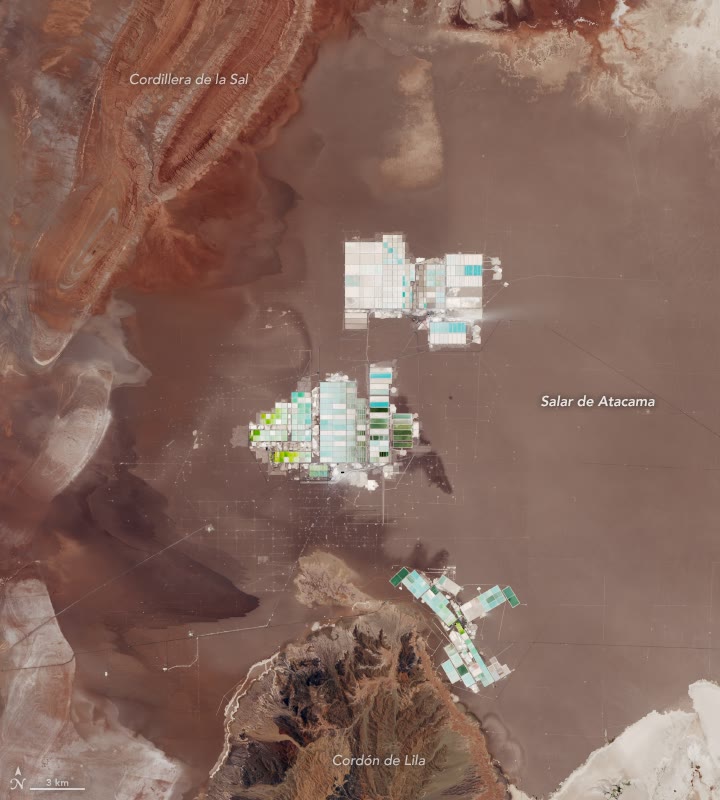
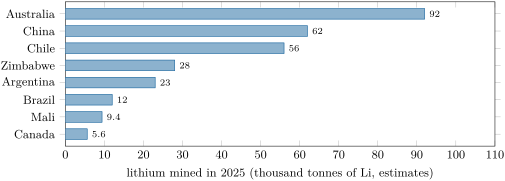
Every phone, laptop and electric car carries a battery whose positive charges are carried by lithium ions. That lithium comes mostly from two places: hard-rock mines in Australia and the salt flats of the Andes, where brine pumped from under the crust is left to evaporate in the sun for months until lithium salts can be precipitated from it. Lithium is the first of the alkali metals, the most reactive metals there are, and its neighbours sodium, potassium, magnesium and calcium supply the bulk chemicals of industry: caustic soda, soda ash, lime. This chapter opens the descriptive chemistry of the elements with hydrogen and the s-block, using the tools of the earlier chapters — ionisation energies, standard potentials, solubility products — to explain what these elements do.
You already know
Ionisation energies and electronegativity (Chapter 2); standard potentials (Chapter 13); solubility products and the precipitation of hydroxides (Chapter 11). The school volume (grade 10) grouped the elements into families: alkali metals, alkaline-earth metals, halogens, noble gases.
26.1 Hydrogen and the hydrides
Hydrogen has one electron: it can lose it (, carried by water as ), share it (covalent bonds), or gain one (, with the electron configuration of helium). Which it does depends on its partner.
Definition 26.1 (Hydrides)
A hydride is a binary compound of hydrogen with another element. Saline hydrides, formed with the alkali and heavier alkaline-earth metals (, , ), are ionic solids containing . Covalent hydrides, formed with the p-block elements (, , , ), are molecular. Metallic hydrides, formed with some transition metals, are solids in which hydrogen occupies interstitial sites of the metal lattice, often with a variable composition.
The hydride ion is a very strong base and reducing agent: saline hydrides react with water, , and serve as drying agents for solvents and as bases in organic synthesis (Chapter 22). The covalent hydrides of the second period show the trend in electronegativity across it: neither acidic nor basic, basic, amphoteric, acidic.
26.2 The alkali metals
Definition 26.2 (Alkali and alkaline-earth metals)
The alkali metals (Li, Na, K, Rb, Cs, Fr) form group 1, with one valence electron ns; the alkaline-earth metals (Be, Mg, Ca, Sr, Ba, Ra) form group 2, with ns. Their elements are the s-block.
Proposition 26.3 (The alkali metals are strong reductants)
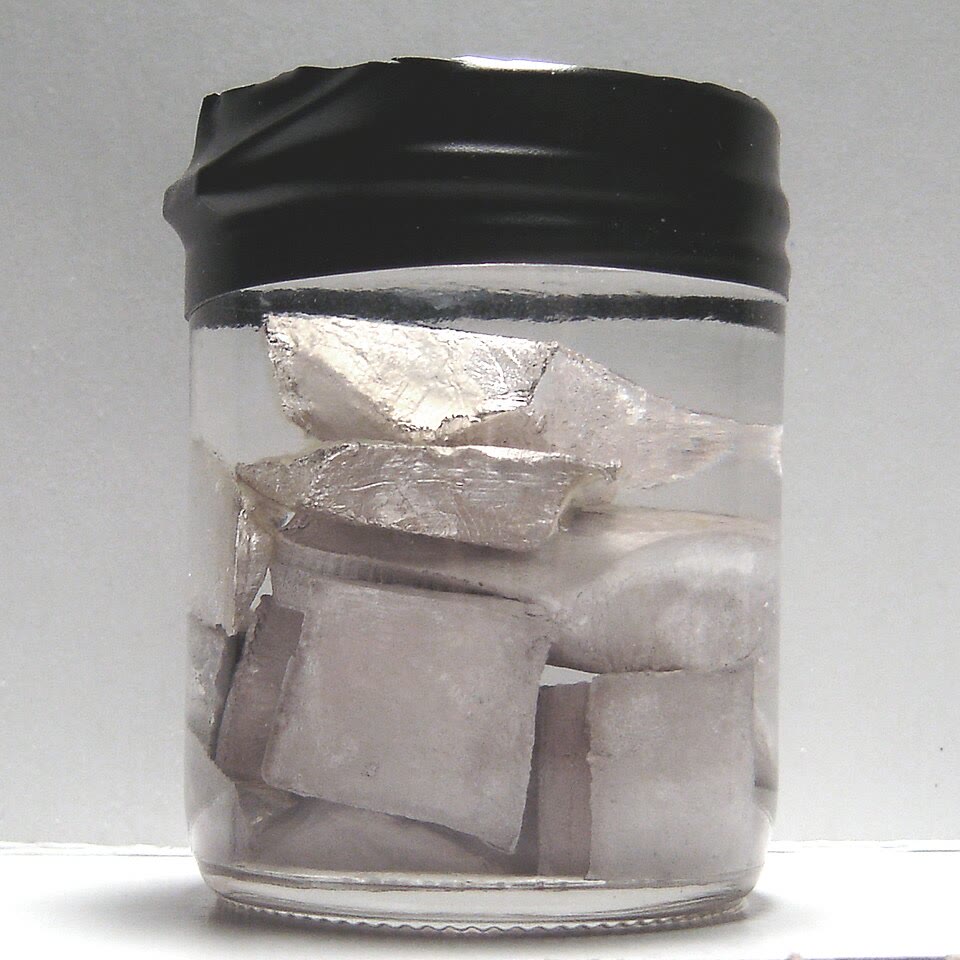
The alkali metals have the lowest first ionisation energies of their periods (Li , Na 5.14, K 4.34) and very negative standard potentials (/ V, / , / ): they reduce water and are found in nature only as ions.
Proof. A single electron outside a noble-gas core, far from the nucleus and screened by the inner shells (Chapter 2), is easily removed. In water the small ion is strongly hydrated, which makes the couple potential even lower. With more than below the line of water at pH 7 ( V), the reaction has an enormous constant (Proposition 13.12). ∎
In the lab — A demonstration, not an experiment
The reaction of sodium with water is shown only by a teacher, behind a safety screen, with a piece the size of a lentil dropped into a large trough of water containing phenolphthalein: the metal melts into a running ball, hydrogen fizzes, and the pink trail shows the hydroxide formed. Potassium ignites the hydrogen. Larger pieces explode. Sodium is cut under oil, handled with tongs, and its residues destroyed with ethanol, never with water.
Lithium is the exception of its group: the smallest ion, the most strongly hydrated, hence the most negative potential, yet the slowest to react with water. Its compounds resemble those of magnesium (lithium carbonate and phosphate are sparingly soluble, as magnesium’s are), a diagonal relationship across the periodic table. The alkali metals are produced by electrolysis of their molten chlorides, since no chemical reductant is strong enough; the electrode reactions of such cells are studied in the Year 2 volume.
26.3 Sodium compounds in industry
Definition 26.4 (Character of oxides)
A basic oxide reacts with water to give a hydroxide, or with acids to give salts (, ); an acidic oxide reacts with water to give an acid, or with bases to give salts (, , ); an amphoteric oxide reacts with both acids and bases (, ). Across a period, oxides go from basic (metals, left) to acidic (non-metals, right).
Sodium hydroxide is made by electrolysis of brine (the chlor-alkali process, which also yields chlorine and hydrogen). Sodium carbonate, soda ash, used for glass, detergents and lithium extraction, is either mined as the mineral trona or made from salt and limestone: in 2025 the world produced about 71 million tonnes, 19 million from natural deposits and 52 million synthetic, most of it by the Solvay process.
Proposition 26.5 (The Solvay process)
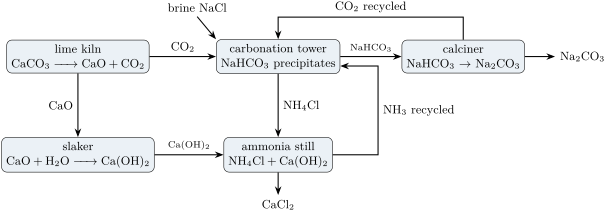
The Solvay process converts sodium chloride and calcium carbonate into sodium carbonate and calcium chloride, , through steps in which ammonia and carbon dioxide are recycled.
Proof. The steps are: (1) (kiln); (2) (carbonation of ammoniacal brine; the hydrogencarbonate, the least soluble salt present, precipitates); (3) (calcination); (4) ; (5) (ammonia recovery). Adding , the , , , , , and water cancel: . ∎
Method 26.6 (Mass balance on a flow sheet)
- Write the overall equation (sum of the steps, recycled species cancelled).
- From the product wanted, compute the amounts of raw materials with the overall equation, then correct for the yield of each step.
- For a recycled species, compute only the make-up needed to replace its losses.
- Check the balance of each element between inputs and outputs.
26.4 The alkaline-earth metals
Magnesium and calcium are less reactive than the alkali metals (higher ionisation energies: Mg , Ca 6.11; two electrons to lose) but still strong reductants ( of / V). Magnesium burns in air with a dazzling white light; its oxide film protects it at room temperature. Magnesium is recovered from sea water by precipitating its hydroxide with lime, (Chapter 11).
Proposition 26.7 (The lime cycle)
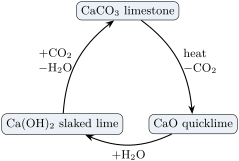
Limestone, quicklime, slaked lime and limestone again form a cycle: (heated in a kiln); (slaking, strongly exothermic); (setting of lime mortar in air). The cycle as a whole changes nothing chemically, but stores and releases energy and carbon dioxide.
Proof. Adding the three equations, every species cancels. The decomposition of the carbonate requires heat, released again in the two other steps; the given off in the kiln is taken up again, slowly, by the mortar. ∎
26.5 Lithium
Brine is concentrated by evaporation, magnesium removed with lime, and lithium carbonate precipitated with soda ash. Lithium carbonate has the unusual property of being less soluble hot than cold: by mass at , at , at . It is therefore precipitated from hot solution, as the weekend problem computes.
26.6 Exercises
Exercise 26.1 ★
Classify as saline, covalent or metallic hydride: , , , , . Write the reaction of with water.
Solution
Solution of Exercise 26.1.
and : saline; and : covalent; : metallic. .
Exercise 26.2 ★
Write the reactions of lithium, sodium and potassium with water, and of magnesium with dilute hydrochloric acid.
Solution
Solution of Exercise 26.2.
, and the same with Na and K; .
Exercise 26.3 ★
Classify as basic, acidic or amphoteric: , , , , , , . Write one reaction for each kind.
Solution
Solution of Exercise 26.3.
Basic: , (). Acidic: , , (). Amphoteric: , ().
Exercise 26.4 ★
Compute the constant of at pH 14 from the standard potentials.
Solution
Solution of Exercise 26.4.
At pH 14 the water couple is , V; .
Exercise 26.5 ★★
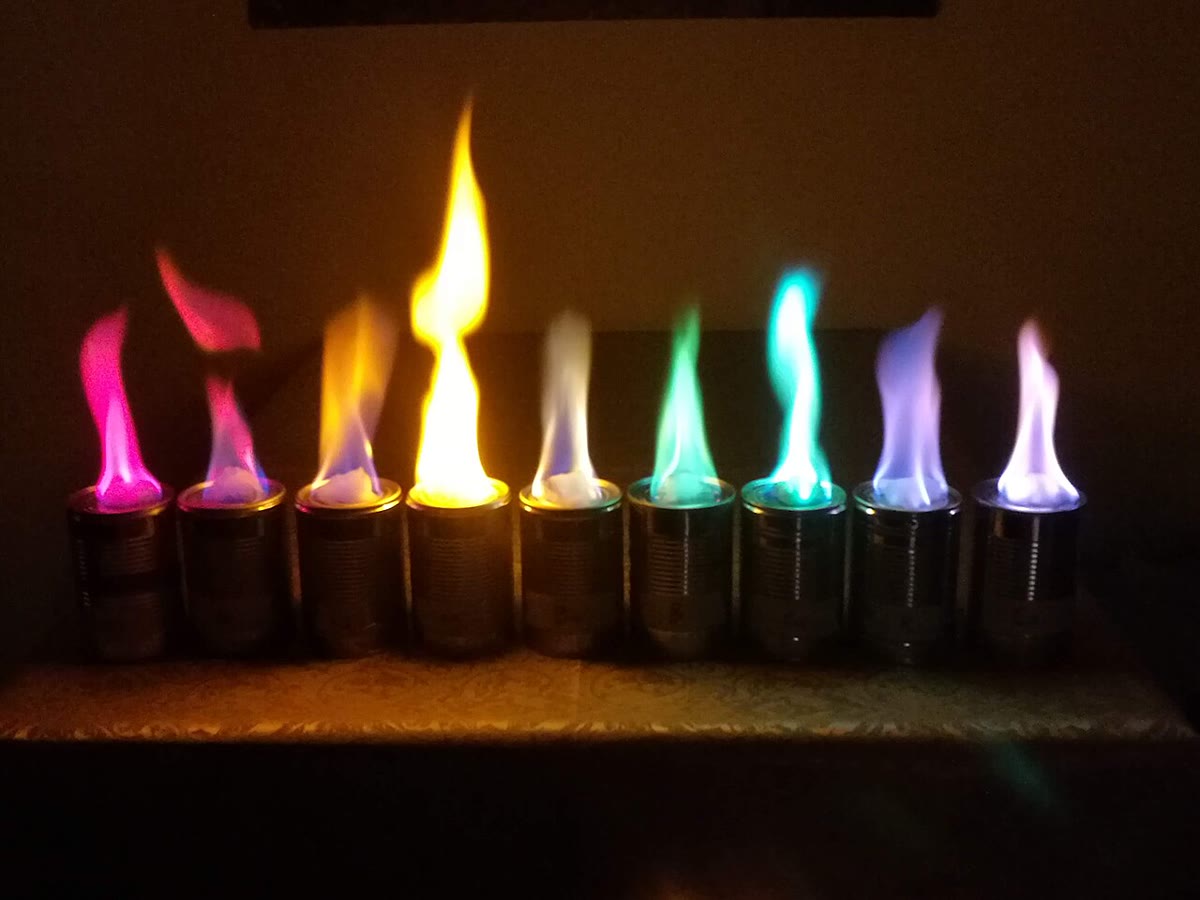
Explain the flame colours of lithium (red) and sodium (yellow) using the energy levels of atoms (Chapter 1). What is the energy of a yellow photon at ?
Solution
Solution of Exercise 26.5.
In the flame, collisions raise an electron to an excited level; returning to the ground state, the atom emits a photon of energy equal to the gap, specific to the element. .
Exercise 26.6 ★★
Compute the mass of limestone (pure ) and of sodium chloride needed for one tonne of soda ash by the Solvay process, with an overall yield of on sodium chloride.
Solution
Solution of Exercise 26.6.
of soda ash: of limestone, , and of salt, .
Exercise 26.7 ★★
Sea water contains about of magnesium (data of the exercise). At what pH does magnesium hydroxide begin to precipitate? What mass of slaked lime precipitates the magnesium of ?
Solution
Solution of Exercise 26.7.
; . of magnesium in need of : .
Exercise 26.8 ★★
Why does lithium react more slowly with water than potassium, although its standard potential is lower? Distinguish thermodynamics and kinetics.
Solution
Solution of Exercise 26.8.
The equilibrium constant (thermodynamics) is enormous for both; the rate (kinetics) is not decided by . Lithium melts at a higher temperature, stays solid and is covered by a less soluble product layer, and loses its electron less easily than potassium (higher ionisation energy): it reacts steadily, potassium violently.
Exercise 26.9 ★★
Compute the mass of quicklime obtained from one tonne of limestone and the volume of released, at and .
Solution
Solution of Exercise 26.9.
: CaO ; , .
Exercise 26.10 ★★★
The world mined about tonnes of lithium in 2025. What mass of lithium carbonate is that? If a car battery holds of lithium (data of the exercise), how many batteries could it supply?
Solution
Solution of Exercise 26.10.
of Li (mass in kg), : about 1.6 million tonnes of lithium carbonate. batteries.
Exercise 26.11 ★★★
Show that the solubility of lithium carbonate falls with temperature from the data of the chapter, and explain why precipitating it hot improves the recovery from a brine.
Solution
Solution of Exercise 26.11.
1.31, 0.84, 0.71 per cent at 20, 80, : the solubility decreases. Hot, less carbonate stays in solution: more is recovered.
Exercise 26.12 ★★★
In step (2) of the Solvay process, the solution contains , , and . Explain why sodium hydrogencarbonate precipitates rather than ammonium chloride, and why the process needs ammonia rather than sodium hydroxide.
Solution
Solution of Exercise 26.12.
is the least soluble of the salts that the ions can form, and the solution is saturated in it first. Ammonia makes the solution basic enough to turn into while being recoverable (as , regenerated by lime); sodium hydroxide would be consumed and cost more than the product.
26.7 Problem: Lithium from Brine
Problem 26.1
Weekend problem — concentrating a lithium brine, removing magnesium with lime, precipitating lithium carbonate with soda ash, and the mass of lithium carbonate recovered from one cubic metre
A brine pumped from under a salt flat contains of lithium and of magnesium (as ions, with much sodium chloride). Evaporation in ponds concentrates it four times. One cubic metre of the concentrated brine is then treated: lime removes the magnesium, soda ash the calcium, and hot soda ash finally precipitates lithium carbonate at . Data: molar masses () Li 6.9, Mg 24.3, 74.1, 106.0, 73.8; 11.25, 8.30; ; solubility of by mass at ; take the final liquor as of density .
Part I — Concentrating.
- Compute the concentrations of lithium and magnesium in the concentrated brine.
- What volume of water evaporates per cubic metre of concentrated brine?
- Why is solar evaporation used rather than heating?
- Which salt crystallises first in the ponds, and why?
- Compute the amounts of lithium and magnesium in one cubic metre.
- Why must magnesium be removed before lithium is precipitated?
Part II — Removing magnesium and calcium.
- Write the reaction of magnesium ions with slaked lime.
- Compute the mass of slaked lime needed (stoichiometric).
- At what pH is of the magnesium precipitated?
- Why is lithium not precipitated as its hydroxide?
- Write the removal of the calcium introduced, with soda ash.
- Compute the mass of soda ash needed for that step.
Part III — Lithium carbonate.
- Write the precipitation of lithium carbonate.
- Compute the mass of soda ash needed for the lithium.
- Compute the theoretical mass of lithium carbonate.
- Why is the precipitation done at ?
- What mass of lithium carbonate stays dissolved in the liquor?
- How is the precipitate washed without losing much of it?
Part IV — Balance.
- Compute the mass of lithium carbonate recovered.
- Compute the recovery of lithium.
- Suggest what is done with the liquor.
- Compare the lithium in one cubic metre with the world production of 2025: how many cubic metres would that production represent?
- State the mass of lithium carbonate recovered per cubic metre of concentrated brine.
Solution
Solution of Problem 26.1.
1. Li , Mg . 2. Four cubic metres of brine give one: three cubic metres of water evaporate. 3. Sunlight and the dry climate supply the energy for free. 4. Sodium chloride, by far the most abundant salt, saturates first. 5. Li ; Mg . 6. Magnesium would precipitate with the carbonate and contaminate the product. 7. . 8. . 9. mol/L left: . 10. Lithium hydroxide is soluble: no solid forms at this pH. 11. . 12. . 13. . 14. . 15. . 16. Lithium carbonate is less soluble hot. 17. . 18. With small volumes of hot water, in which it is least soluble. 19. . 20. . 21. It still holds lithium: it is returned to the ponds. 22. cubic metres. 23. (23.7) of lithium carbonate per cubic metre.