All books

Professional

Apps About Coach Log in Start reading

Chemistry · Glossary

What is Charge-transfer resistance, Tafel slope?

Also known as: charge-transfer resistance · Tafel slope

Definition 15.8 University Chemistry — Year 3 · Chapter 15 — Electrode Kinetics and Electroanalysis

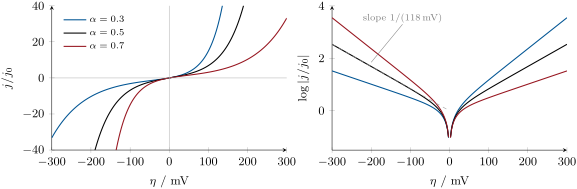
The charge-transfer resistance of an electrode is Rct=(∂η/∂i)η=0R_{\mathrm{ct}} = (\partial\eta/\partial i)_{\eta = 0}. The Tafel slope is the change of overpotential per decade of current in the Tafel region, 2.303 RT/αnF2.303\,RT/\alpha nF.

The Butler–Volmer equation (n = 1, 298\, K) for three transfer coefficients. Left: the current is linear in  near equilibrium (the charge-transfer resistance) and exponential beyond;  makes it asymmetric. Right: the Tafel plot, whose straight branches extrapolate to |j/j_0| = 0 at = 0; the dashed line is the cathodic Tafel line for = 0.5.
The Butler–Volmer equation (n=1n = 1, 298 K298\,\mathrm{K}) for three transfer coefficients. Left: the current is linear in η\eta near equilibrium (the charge-transfer resistance) and exponential beyond; α\alpha makes it asymmetric. Right: the Tafel plot, whose straight branches extrapolate to log⁡∣j/j0∣=0\log|j/j_0| = 0 at η=0\eta = 0; the dashed line is the cathodic Tafel line for α=0.5\alpha = 0.5.
Read in context →