All books

Professional

Apps About Coach Log in Start reading

Chemistry · Glossary

What is Existence domain?

Definition 11.12 University Chemistry — Year 1 · Chapter 11 — Precipitation and Solubility

For a solid and a given total concentration cc of one of its ions, the existence domain of the solid is the range of the variable (pX, pM or pH) over which the solid is present at equilibrium. Its boundary is the value at which the first grain of solid appears, when Qs=KsQ_s = K_s with the ion still at concentration cc.

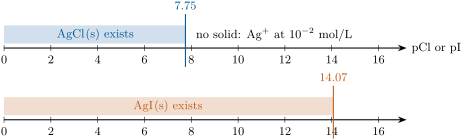
Existence domains of silver chloride (on a pCl axis, top) and silver iodide (on a pI axis, bottom) for a total silver concentration of 1.0 × 10⁻²\, mol/ L. Iodide precipitates silver at concentrations a million times lower than chloride does.
Existence domains of silver chloride (on a pCl axis, top) and silver iodide (on a pI axis, bottom) for a total silver concentration of 1.0×10⁻² mol/L1.0 \times 10^{-2}\,\mathrm{mol}/\mathrm{L}. Iodide precipitates silver at concentrations a million times lower than chloride does.
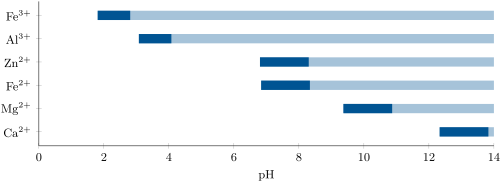
Precipitation of hydroxides from solutions at 0.010\, mol/ L of each ion. The dark bar runs from the first grain of hydroxide to the pH where 99.9\,\% of the ion is precipitated (one pH unit wide for a trivalent ion, one and a half for a divalent one); the light bar is the rest of the existence domain of the hydroxide. The amphoteric redissolution of zinc and aluminium hydroxides at high pH () is not shown.
Precipitation of hydroxides from solutions at 0.010 mol/L0.010\,\mathrm{mol}/\mathrm{L} of each ion. The dark bar runs from the first grain of hydroxide to the pH where 99.9 %99.9\,\% of the ion is precipitated (one pH unit wide for a trivalent ion, one and a half for a divalent one); the light bar is the rest of the existence domain of the hydroxide. The amphoteric redissolution of zinc and aluminium hydroxides at high pH (Section 11.5) is not shown.
Read in context →