A drop of silver nitrate falls into tap water and a white cloud appears: silver chloride, formed from the few milligrams of chloride ions in every litre. Water seeping through limestone carries calcium carbonate away and lays it down again, a fraction of a millimetre a year, as the stalactites of a cave. A kidney stone is a precipitate too. Each of these is an equilibrium between a solid and its ions in solution, and one constant, the solubility product, says whether the solid forms, how much of it dissolves, and how its solubility changes when another ion or the pH is changed. With it a chemist can separate ions one from another by precipitating them in turn — the basis of the treatment of mine waters that closes this chapter.
You already know
The school volume (grades 6 and 12) measured solubility in grams per litre and identified ions by the precipitates they give. The equilibrium constant, the reaction quotientQ and the activities (1 for a pure solid or the solvent, c/c∘ for a solute) were set up in Chapter 7: a reaction goes forward while Q<K. The predominant-reaction method and the scale of pKa come from Chapter 10; c∘=1mol/L is not written in quotients.
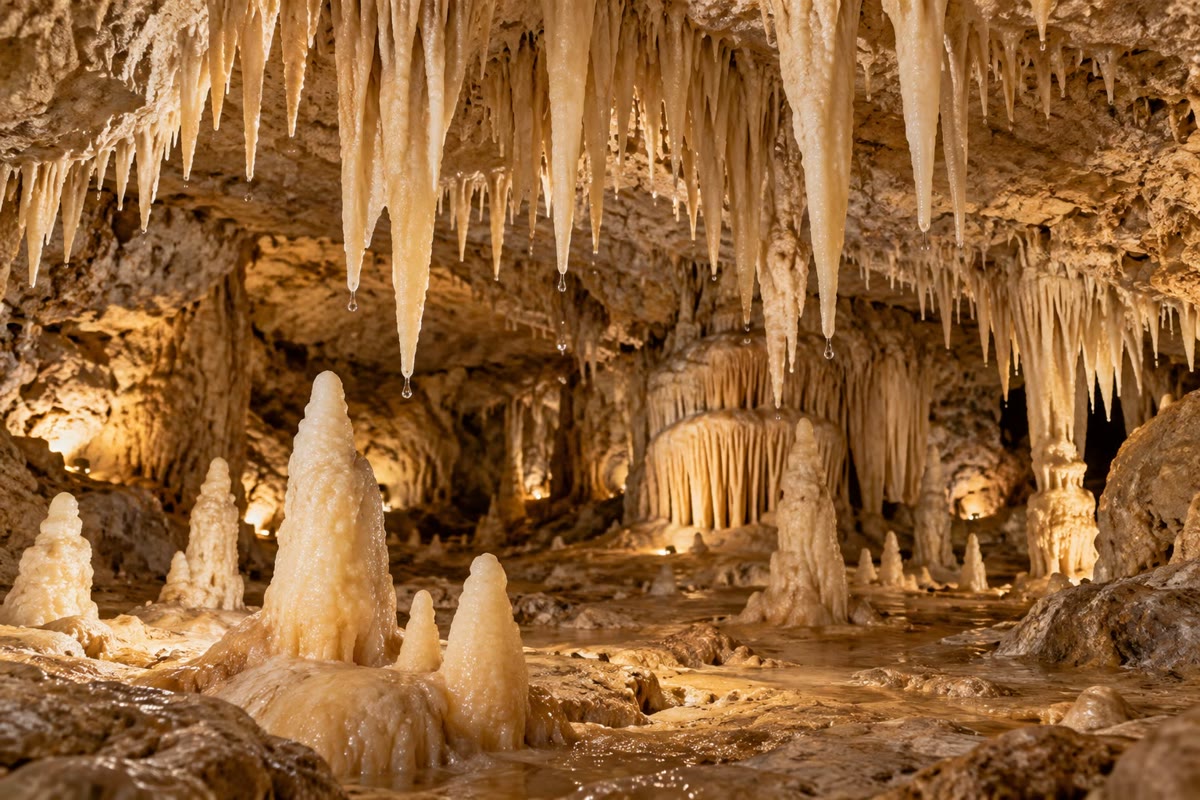
Stalactites and stalagmites in a limestone cave. Water rich in carbon dioxide dissolves calcium carbonate in the soil above; in the cave it loses part of its carbon dioxide and the carbonate precipitates again (Exercise 11.10).
11.1 The solubility product
A crystal of silver chloride dropped into water loses ions to the solution and the solution gives some back to the crystal. When the two rates are equal the solution is saturated: its composition no longer changes, although ions keep passing in both directions (figure below).
Definition 11.1(Solubility product)
The solubility productKs of an ionic solid MaXb is the equilibrium constant of its dissolution into its ions,
the activity of the solid being 1. Like every equilibrium constant it depends on temperature only.
For silver chloride, AgCl(s)AgX++ClX− and Ks=[AgX+][ClX−]=10−9.75; for calcium fluoride, CaFX2(s)CaX2++2FX− and Ks=[CaX2+][FX−]2=10−9.84; for iron(III) hydroxide, Ks=[FeX3+][OHX−]3=10−38.55. The table below lists the values used in this volume. They are computed, like the pKa of Chapter 10, from tabulated standard Gibbs energies of formation: pKs=ΔrG∘/(RTln10), a relation derived in the Year 2 volume.
A crystal of silver chloride in its saturated solution. Ions leave the surface (dissolution) and others are captured (precipitation) at the same rate, so that [AgX+][ClX−] stays equal to Ks. Silver ions are drawn smaller than chloride ions, as they are.
solid
pKs
solid
pKs
AgCl
9.75
Ca(OH)X2
5.33
AgBr
12.27
Mg(OH)X2
11.25
AgI
16.07
Fe(OH)X2
16.31
AgX2CrOX4
11.95
Zn(OH)X2
16.38
BaSOX4
9.97
Fe(OH)X3
38.55
CaCOX3 (calcite)
8.30
Al(OH)X3 (gibbsite)
34.75
CaFX2
9.84
Solubility products at 25∘C, computed from the standard Gibbs energies of formation of the solids and of the aqueous ions. Formation constants used in this chapter (Section 11.5): logβ4=14.45 for Zn(OH)X4X2−, 33.52 for Al(OH)X4X−, and logβ1=11.82 for FeOHX2+.
Proposition 11.2(Condition of precipitation)
Let a solution contain the ions of a solid MaXb, with reaction quotientQs=[Mm+]a[Xx−]b for the dissolution.
If Qs<Ks, the solid cannot be present at equilibrium: the solution is unsaturated and any solid added dissolves, completely if there is not too much of it.
If Qs>Ks, the solid precipitates until Qs=Ks.
The solid and the solution coexist at equilibrium only when Qs=Ks.
Proof. By Chapter 7, the dissolution goes forward as long as Qs<Ks and backward (precipitation) as long as Qs>Ks. While the dissolution goes forward, Qs increases. If the solid is used up before Qs reaches Ks, the evolution stops with no solid left: a reaction with a pure condensed phase can stop before equilibrium because the amount of that phase cannot become negative. If Qs>Ks, precipitation lowers both ion concentrations and Qs decreases until it equals Ks, which it always can, since the ions are there. ∎
The last point is what distinguishes a solid from a dissolved species. An acid–base species is present at every pH, however little; a solid is either present or absent. This is why its diagram will be an existence diagram, not a predominance one (Section 11.4).
Example 11.3(Mixing two solutions)
10.0mL of silver nitrate at 2.0×10⁻⁴mol/L are mixed with 10.0mL of sodium chloride at 2.0×10⁻⁴mol/L. Just after mixing, before any reaction, [AgX+]=[ClX−]=1.0×10⁻⁴mol/L and Qs=10−8.0>Ks=10−9.75: silver chloride precipitates. With both solutions at 2.0×10⁻⁶mol/L, Qs=10−12.0<Ks and the mixture stays clear. Silver nitrate is a sensitive test for chloride ions, but not an infinitely sensitive one.
In the lab— The chloride test
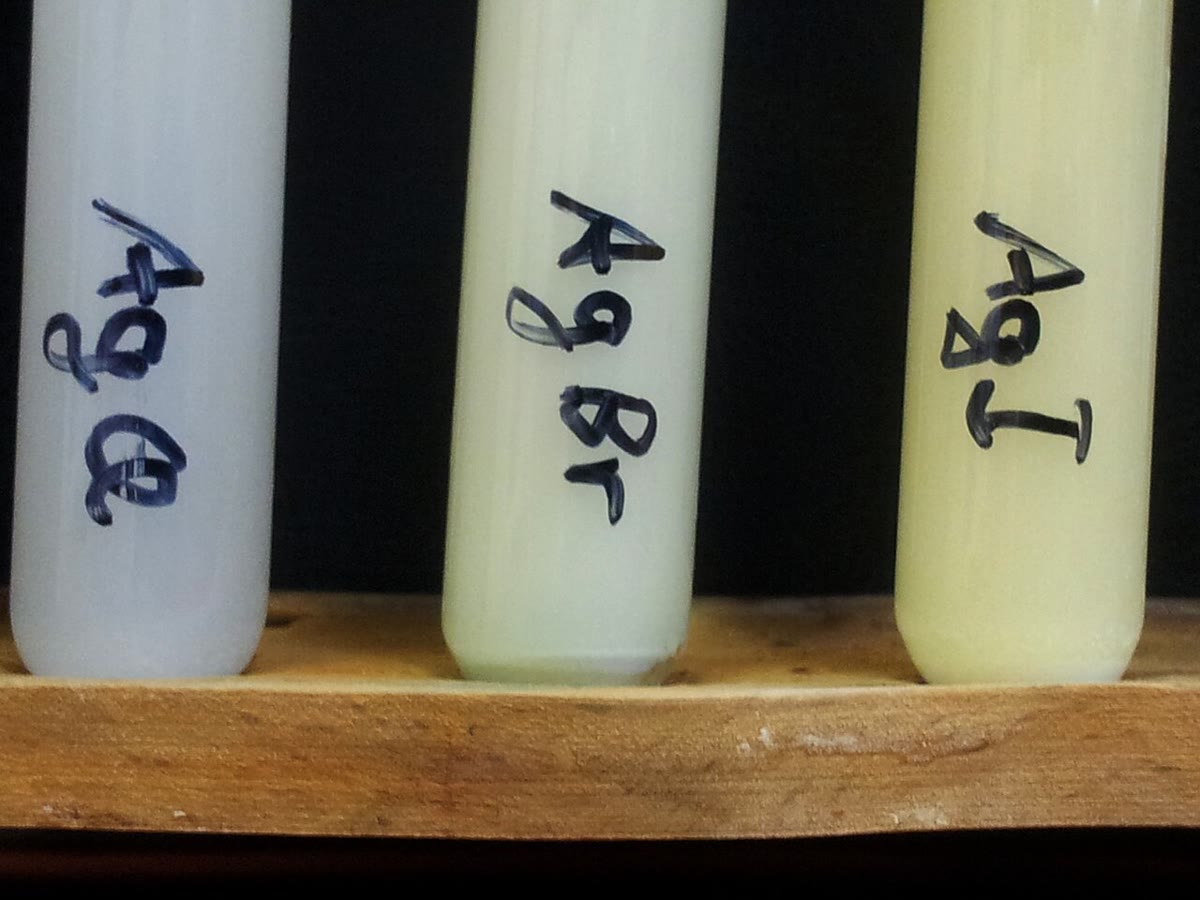
In the teaching laboratory, a few drops of silver nitrate solution are added to the sample, first acidified with dilute nitric acid. The acid turns carbonate and hydroxide ions into carbon dioxide and water, which would otherwise also precipitate with silver ions. A white precipitate that darkens in light is silver chloride; bromide gives a cream precipitate and iodide a yellow one (photograph below). Silver nitrate stains the skin black: gloves and goggles are worn.
Precipitates of silver chloride (white), silver bromide (cream) and silver iodide (pale yellow). Photograph Rrausch1974, CC BY-SA 3.0, Wikimedia Commons.
11.2 Solubility
Definition 11.4(Solubility)
The solubilitys of a solid in a given solution is the amount of solid that dissolves in one litre of that solution until saturation (in mol/L); multiplied by the molar mass, it is the mass solubility, in g/L. It depends on the temperature and on the composition of the solution.
Proposition 11.5(Solubility from the solubility product)
In pure water, if the ions take part in no other reaction,
Proof. When s mol of solid dissolve per litre, [Mm+]=as and [Xx−]=bs, so at saturation Ks=(as)a(bs)b=aabbsa+b. For MX, a=b=1; for MXX2, 1122=4, and the same for MX2X. ∎
Example 11.6(Silver chloride and silver chromate)
Silver chloride: s=10−9.75/2=1.3×10−5mol/L, or 1.9mg/L with M=143.4g/mol. Silver chromate AgX2CrOX4 (pKs=11.95): s=(10−11.95/4)1/3=6.6×10−5mol/L. The chromate has the smaller Ks and yet is five times more soluble. Solubility products can be compared directly only between solids of the same formula type.
Remark 11.7
The formulas assume that the ions are free. In pure water the chromate ion is a weak base and the silver ion is complexed by nothing, so the result for silver chromate is close to correct; for a carbonate, a sulfide or a hydroxide the base properties of the anion matter and the next section is needed. At high ionic strength the activities also drift away from the concentrations, a correction left to the Year 2 volume.
11.3 Common-ion and pH effects
Definition 11.8(Common-ion effect)
The common-ion effect is the decrease of the solubility of a solid in a solution that already contains one of its ions.
Proposition 11.9(Solubility with a common ion)
Let MX dissolve in a solution where [X−]=c already, with c≫Ks. Then s≈Ks/c, much smaller than in pure water. For MXX2 in a solution containing MX2+ at c, s≈21Ks/c.
Proof. At saturation [M+]=s and [X−]=c+s, so s(c+s)=Ks. If s≪c, s=Ks/c; the assumption holds since Ks/c≪c when c2≫Ks. For MXX2, [XX−]=2s and [M2+]=c+s≈c, so c(2s)2=Ks. ∎
Silver chloride in 0.10mol/L sodium chloride: s=10−9.75/0.10=1.8×10−9mol/L, seven thousand times less than in water. This is why a precipitate is washed with a dilute solution of a common ion rather than with pure water: it loses less of itself.
When the anion of the solid is a base, acid pulls it out of the dissolution equilibrium and the solubility rises. For calcium carbonate in acid,
a favoured reaction: vinegar or hydrochloric acid dissolves limestone, and the carbon dioxide formed by the further reaction of HCOX3X− gives the familiar fizz.
Proposition 11.10(Solubility of a hydroxide against pH)
In a solution buffered at a given pH, the concentration of MXn+ in equilibrium with the hydroxide M(OH)Xn obeys
log[Mn+]=−pKs+n(pKe−pH),
a straight line of slope −n against pH. If the ion forms no complex, this is the solubility of the hydroxide.
Proof.Ks=[Mn+][OHX−]n and [OHX−]=Ke/[HX3OX+], so log[Mn+]=logKs−nlog[OHX−]=−pKs−n(pH−pKe). ∎
Each unit of pH divides the solubility of iron(III) hydroxide by a thousand and that of zinc hydroxide by a hundred. Hydroxides are precipitated, and dissolved again, by changing the pH.
Example 11.11(Dissolving calcium carbonate with carbon dioxide)
Water containing dissolved carbon dioxide dissolves calcite:
the constant being obtained by adding the dissolution of the carbonate, the first acidity of carbon dioxide and the reverse of the second. The more carbon dioxide, the more calcium carbonate dissolves. Soil air is usually far richer in carbon dioxide than the air of a cave; water that has crossed the soil and reaches the cave ceiling loses carbon dioxide, and calcite deposits (Exercise 11.10).
11.4 Existence domains and selective precipitation
Definition 11.12(Existence domain)
For a solid and a given total concentration c of one of its ions, the existence domain of the solid is the range of the variable (pX, pM or pH) over which the solid is present at equilibrium. Its boundary is the value at which the first grain of solid appears, when Qs=Ks with the ion still at concentration c.
Method 11.13(Drawing an existence diagram)
Fix the total concentration c of the ion that is not on the axis (for instance [AgX+]tot=c on a pCl axis).
Write Ks at the onset of precipitation, with that ion still at c, and solve for the variable on the axis.
The solid exists on the side where the other ion is concentrated: small pCl (much chloride), small pAg, or high pH for a hydroxide.
Do not mark a domain for the ion itself: it is present everywhere, at c outside the domain of the solid and below c inside it.
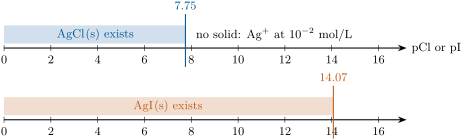
For silver chloride with c=[AgX+]tot=10−2: precipitation starts when [ClX−]=Ks/c=10−7.75, so the solid exists for pCl<7.75. For silver iodide the boundary is at pI=16.07−2=14.07, as drawn below.
Existence domains of silver chloride (on a pCl axis, top) and silver iodide (on a pI axis, bottom) for a total silver concentration of 1.0×10⁻²mol/L. Iodide precipitates silver at concentrations a million times lower than chloride does.
Method 11.14(Selective precipitation)
To separate two ions that precipitate with the same reagent:
compute, for each ion at its concentration, the reagent concentration (or pH) at which its solid starts to form; the lower one precipitates first;
compute the concentration of the first ion left in solution when the second starts to precipitate;
the separation is acceptable if that concentration is a small enough fraction of the initial one — typically 0.1% — and the reagent is then stopped between the two thresholds.
Example 11.15(Iodide and chloride)
A solution contains iodide and chloride ions, both at 1.0×10⁻²mol/L; silver nitrate is added drop by drop, without dilution. Silver iodide starts to form at [AgX+]=10−16.07+2=10−14.07, silver chloride at 10−9.75+2=10−7.75: iodide precipitates first. When silver chloride appears, [IX−]=10−16.07/10−7.75=10−8.32=4.8×10−9mol/L, a fraction 5×10⁻⁷ of the iodide: the separation is complete.
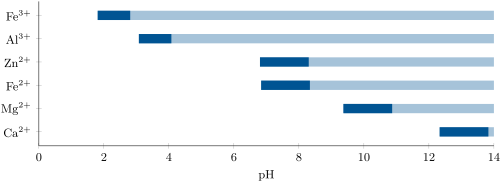
Hydroxides are separated in the same way with the pH as the variable. The chart below shows, for six ions at 0.010mol/L, the pH where the hydroxide appears and the pH where 99.9% of the ion has precipitated. Iron(III) and aluminium are removed in acidic water, zinc and iron(II) near neutrality, magnesium around pH 10 and calcium only in very basic water.
Precipitation of hydroxides from solutions at 0.010mol/L of each ion. The dark bar runs from the first grain of hydroxide to the pH where 99.9% of the ion is precipitated (one pH unit wide for a trivalent ion, one and a half for a divalent one); the light bar is the rest of the existence domain of the hydroxide. The amphoteric redissolution of zinc and aluminium hydroxides at high pH (Section 11.5) is not shown.
11.5 Amphoteric hydroxides
Add sodium hydroxide drop by drop to a solution of zinc sulfate: a white precipitate of zinc hydroxide forms, then, in excess hydroxide, it dissolves again. Aluminium hydroxide does the same; iron(III) and magnesium hydroxides do not.
Definition 11.16(Amphoteric hydroxide)
A hydroxide is an amphoteric hydroxide if it dissolves both in acid, as the cation, and in excess base, as a hydroxo complex anion:
The complex anion Zn(OH)X4X2− (tetrahydroxozincate) is characterised by its formation constant β4=[Zn(OH)X4X2−]/([ZnX2+][OHX−]4)=1014.45; complexes and their constants are the subject of Chapter 12.
Proposition 11.17(Solubility of an amphoteric hydroxide)
If zinc is in solution only as ZnX2+ and Zn(OH)X4X2−, the solubility of zinc hydroxide is
In logs against pH it follows a line of slope −2 at low pH and a line of slope +2 at high pH. It is smallest at [OHX−]4=Ks/K=1/β4, that is at pH=pKe−41logβ4, where smin=2KsK.
Proof. At saturation [ZnX2+]=Ks/[OHX−]2, and [Zn(OH)X4X2−]=β4[ZnX2+][OHX−]4=β4Ks[OHX−]2. With w=[OHX−]2, s(w)=Ks/w+Kw has derivative −Ks/w2+K, zero at w=Ks/K, where s=2KsK. At low pH the first term dominates and logs=logKs−2log[OHX−] (slope −2 in pH); at high pH the second, logs=logK+2log[OHX−] (slope +2). ∎
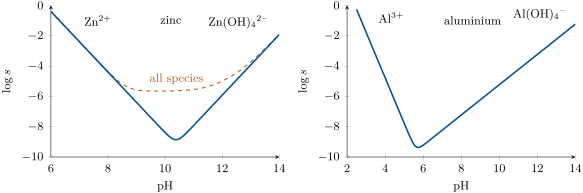
With the values above, the minimum lies at pH=14.00−14.45/4=10.39 and smin=2×10−(16.38+1.93)/2=1.4×10−9mol/L (figure below). The real minimum is far higher: zinc also forms ZnOHX+, Zn(OH)X3X− and, above all, an uncharged dissolved Zn(OH)X2(aq), whose concentration in equilibrium with the solid does not depend on the pH. The full calculation, with the same tables, puts the floor near 10−5.6 mol/L. A two-species model gives the slopes and the order of the thresholds; near the minimum every species counts.
Solubility of zinc hydroxide (left) and of aluminium hydroxide, gibbsite (right), against pH, two-species model (solid lines): slopes −2 and +2 for zinc, −3 and +1 for aluminium. For zinc the dashed curve includes all the hydroxo species, the uncharged Zn(OH)X2(aq) setting a floor.
For aluminium the hydroxide is Al(OH)X3 and the complex Al(OH)X4X−, so Al(OH)X3(s)+OHX−Al(OH)X4X− with K=β4Ks=1033.52−34.75=10−1.23 and slopes −3 and +1. The difference between aluminium and iron(III) — one amphoteric, the other not — is used industrially to separate them: hot sodium hydroxide dissolves the aluminium of bauxite and leaves the iron oxides behind (Exercise 11.12).
11.6 Exercises
Exercise 11.1★
Write the dissolution equation and the expression of Ks for BaSOX4, CaFX2, AgX2CrOX4 and Fe(OH)X3. Give Ks in powers of ten from the table of Section 11.1, and the pKs of a solid of Ks=2.0×10⁻¹³.
Compute the solubility of silver bromide in pure water in mol/L and in mg/L (M=187.8g/mol).
Solution
Solution of Exercise 11.2.
s=Ks=10−12.27/2=7.3×10−7mol/L, that is 7.3×10−7×187.8=1.4×10⁻⁴g/L=0.14mg/L.
Exercise 11.3★
50mL of barium chloride at 2.0×10⁻³mol/L are mixed with 50mL of sodium sulfate at 2.0×10⁻⁴mol/L. Does barium sulfate precipitate? Same question with sodium sulfate at 2.0×10⁻⁷mol/L.
Solution
Solution of Exercise 11.3.
After mixing (volume doubled), [BaX2+]=1.0×10⁻³mol/L and [SOX4X2−]=1.0×10⁻⁴mol/L: Qs=1.0×10⁻⁷>Ks=1.1×10⁻¹⁰, barium sulfate precipitates. In the second case [SOX4X2−]=1.0×10⁻⁷ and Qs=1.0×10⁻¹⁰<Ks: no precipitate, though only just.
Exercise 11.4★
Compute the solubility of barium sulfate in pure water, then in a solution of sodium sulfate at 0.010mol/L. By what factor has it changed?
Solution
Solution of Exercise 11.4.
In water s=10−9.97/2=1.0×10−5mol/L. In 0.010mol/L sulfate (Proposition 11.9), s=10−9.97/0.010=1.1×10−8mol/L, about a thousand times less (factor 970).
Exercise 11.5★★
Compute the solubility of calcium fluoride in pure water (mol/L and mg/L, M=78.1g/mol), then in a solution of calcium chloride at 0.10mol/L. Check the approximation you made.
Solution
Solution of Exercise 11.5.
In water s=(10−9.84/4)1/3=3.3×10−4mol/L, or 26mg/L. In 0.10mol/L calcium chloride, [CaX2+]≈0.10 and [FX−]=2s, so s=2110−9.84/0.10=1.9×10−5mol/L. The approximation s≪0.10 holds by four orders of magnitude.
Exercise 11.6★★
A solution contains magnesium ions at 0.050mol/L. At what pH does magnesium hydroxide start to precipitate? At what pH is 99% of the magnesium precipitated? Draw the existence domain of Mg(OH)X2 on a pH axis.
Solution
Solution of Exercise 11.6.
Onset: pH=14.00−21(11.25+log0.050)=14.00−4.97=9.03. At 99%, [MgX2+]=5.0×10⁻⁴ and pH=14.00−21(11.25−3.30)=10.03. On a pH axis, Mg(OH)X2 exists above 9.03; below it, magnesium is entirely MgX2+ at 0.050mol/L.
Exercise 11.7★★
A solution contains bromide and chloride ions, both at 1.0×10⁻²mol/L. Silver nitrate is added without dilution. Which precipitate appears first? What fraction of the first ion is still in solution when the second solid appears? Is the separation acceptable?
Solution
Solution of Exercise 11.7.
Silver bromide appears first, at [AgX+]=10−12.27+2=10−10.27, silver chloride at 10−7.75. When silver chloride appears, [BrX−]=10−12.27/10−7.75=10−4.52=3.0×10−5mol/L, 0.30% of the bromide. With the usual criterion of 0.1% the separation is not acceptable: the two pKs differ by only 2.5.
Exercise 11.8★★
The Mohr titration of chloride by silver ions uses chromate ions as the indicator: red silver chromate must appear only once nearly all the chloride has precipitated. Chloride is at 0.050mol/L and chromate at 5.0×10⁻³mol/L; dilution is neglected. Compute [AgX+] when silver chromate starts to form, and the fraction of chloride still in solution at that moment.
Solution
Solution of Exercise 11.8.
Silver chromate forms when [AgX+]2×5.0×10−3=10−11.95, [AgX+]=1.5×10⁻⁵mol/L. Then [ClX−]=10−9.75/1.5×10−5=1.2×10−5mol/L, a fraction 2.4×10⁻⁴ (0.024%) of the chloride: the red colour appears when the chloride is practically all precipitated.
Exercise 11.9★★
Calcium carbonate is shaken with a solution kept at pH 8.30 by a buffer, where hydrogencarbonate is by far the main carbonate species. Show that [CaX2+][HCOX3X−]=Ks10pKa2−pH, and compute the solubility, assuming that all the carbonate dissolved stays as HCOX3X− (pKa2=10.33).
Solution
Solution of Exercise 11.9.
[COX3X2−]=[HCOX3X−]Ka2/[HX3OX+]=[HCOX3X−]10pH−pKa2, so Ks=[CaX2+][HCOX3X−]10pH−pKa2, which is the relation asked. With [CaX2+]=[HCOX3X−]=s: s2=10−8.30+10.33−8.30=10−6.27, s=7.3×10⁻⁴mol/L (73mg/L of CaCOX3), against 10−4.15=7.1×10⁻⁵mol/L if the carbonate ion were not a base.
Exercise 11.10★★★
Limestone caves. The solubility of carbon dioxide follows COX2(g)COX2(aq) with logKH=−1.47 (KH=[COX2(aq)]/p(COX2), pressure in bar).
Combine KH with the constant of Example 11.11 to obtain the constant of CaCOX3(s)+COX2(g)+HX2OCaX2++2HCOX3X−.
Show that the solubility of calcite is s=(K′p/4)1/3 and compute it in water that has equilibrated with soil air at p(COX2)=0.010bar, then with outdoor air, 4.26×10⁻⁴bar. Give both in mg/L of CaCOX3 (M=100.1g/mol).
Explain the growth of a stalactite.
Solution
Solution of Exercise 11.10.
1. Adding COX2(g)COX2(aq): K′=KKH=10−4.34−1.47=10−5.81. 2. [CaX2+]=s and [HCOX3X−]=2s, so 4s3=K′p. At 0.010bar: s=(10−5.81×0.010/4)1/3=1.6×10−3mol/L, 157mg/L. Under outdoor air: s=5.5×10⁻⁴mol/L, 55mg/L. (Check: under soil air [COX2(aq)]=10−3.47 and pH=6.37+log(3.14×10⁻³/3.39×10−4)=7.34: hydrogencarbonate does predominate.) 3. Water saturated in calcite under the high carbon dioxide pressure of the soil reaches the cave ceiling, where the pressure is lower: it loses carbon dioxide, Q>K′, and calcite precipitates where the drop hangs, ring after ring.
Exercise 11.11★★★
A solution of zinc at 1.0×10⁻²mol/L is brought to increasing pH, zinc being present only as ZnX2+ and Zn(OH)X4X2−.
Between which pH values is zinc hydroxide present?
1. Onset at pH=14.00−21(16.38−2.00)=6.81. Complete redissolution when [Zn(OH)X4X2−]=10−2=10−1.93[OHX−]2, [OHX−]=10−0.035, pH=13.97. The hydroxide exists between pH 6.81 and 13.97. 2. pH=14.00−14.45/4=10.39, smin=2×10−(16.38+1.93)/2=1.4×10−9mol/L (in this two-species model). 3. Line of slope −2 from (6.81,−2) down to the minimum near (10.39,−8.9), then slope +2 up to (13.97,−2); the real curve is rounded off by the other hydroxo species (figure in Section 11.5).
Exercise 11.12★★★
A solution contains aluminium and iron(III) ions, each at 1.0×10⁻³mol/L. Sodium hydroxide is added in excess.
Above what pH is all the aluminium dissolved as Al(OH)X4X−?
What is then the concentration of FeX3+? Conclude about the separation.
Explain why the separation would fail with magnesium in place of aluminium.
Solution
Solution of Exercise 11.12.
1. Al(OH)X3(s)+OHX−Al(OH)X4X−, K=10−1.23; all the aluminium is dissolved when 10−3⩽K[OHX−], that is [OHX−]⩾10−1.77, pH⩾12.23. 2. [FeX3+]=10−38.55/10−3×1.77=10−33.2: the iron stays entirely as Fe(OH)X3; filtration separates the iron (solid) from the aluminium (filtrate). 3. Magnesium hydroxide is not amphoteric: in excess hydroxide it stays solid, together with iron(III) hydroxide, and nothing separates.
11.7 Problem: Cleaning a Mine Effluent
Problem 11.1
Weekend problem — precipitation thresholds of three hydroxides, the hydroxo complex of iron(III), the recovery of zinc and its amphoteric redissolution, and the pH window for removing iron(III) without losing zinc(II)
Water draining from an old metal mine is acidic (pH 2.0) and contains iron(III) at 1.0×10⁻³mol/L, zinc(II) at 5.0×10⁻³mol/L and magnesium at 2.0×10⁻²mol/L. The plant raises the pH step by step to remove the iron as a waste sludge, then to recover the zinc as its hydroxide, leaving the harmless magnesium in the water. Data at 25∘C: pKs of Fe(OH)X3 38.55, Zn(OH)X2 16.38, Mg(OH)X2 11.25; logβ4(Zn(OH)X4X2−)=14.45; logβ1(FeOHX2+)=11.82; pKe=14.00; molar masses Fe(OH)X3106.8g/mol, Zn(OH)X299.4g/mol.
Part I — Which hydroxide first?
Write the dissolution equilibria of the three hydroxides and their Ks.
Explain why the three pKs alone do not say which hydroxide precipitates first.
Show that M(OH)Xn starts to precipitate from a solution of MXn+ at c at pH=pKe−n1(pKs+logc).
Compute this pH for iron(III).
Compute it for zinc.
Compute it for magnesium.
Give the order of precipitation as the pH rises. Is anything precipitated in the effluent as it leaves the mine?
Part II — Removing iron: first estimate.
The plant wants 99.9% of the iron out of the water. What concentration of dissolved iron does that allow?
Neglecting any complex, at what pH is this reached?
Show that, in the existence domain of Fe(OH)X3, log[FeX3+] decreases by 3 per pH unit.
Up to what pH does the zinc stay entirely in solution?
Give the first estimate of the pH window in which iron is removed while zinc stays.
Part III — The hydroxo complex of iron(III).
Write the formation of FeOHX2+ from FeX3+ and OHX−, and its constant.
At the pH found in question 9, compute [FeOHX2+]/[FeX3+]. Was the first estimate safe?
Express the total dissolved iron [FeX3+]+[FeOHX2+] in equilibrium with Fe(OH)X3 as a function of the pH.
Show that, where FeOHX2+ predominates, its logarithm decreases by 2 per pH unit.
Find the pH at which the total dissolved iron falls to the value of question 8.
Part IV — Recovering zinc.
After the iron sludge is filtered off, the pH is raised again. At what pH is 99% of the zinc precipitated? Does magnesium hydroxide form at that pH?
Write the reaction of zinc hydroxide with excess hydroxide ions and compute its constant.
Above what pH would all the zinc be back in solution? What does this mean for the operator?
Compute the mass of iron(III) hydroxide sludge removed per cubic metre of effluent.
Compute the mass of zinc hydroxide recovered per cubic metre at the pH of question 19.
Why must the iron be removed before the zinc, and not both together?
State the pH window, to two decimals, in which the iron(III) is removed to 99.9% while the zinc(II) stays entirely in solution.
Solution
Solution of Problem 11.1.
1.Fe(OH)X3(s)FeX3++3OHX−, Ks=[FeX3+][OHX−]3; Zn(OH)X2(s)ZnX2++2OHX−, Ks=[ZnX2+][OHX−]2; Mg(OH)X2(s)MgX2++2OHX−, likewise. 2. The constants do not have the same form (power 3 or 2 of [OHX−]) and the three ions are at different concentrations; only the onset pH can be compared. 3. At the onset c[OHX−]n=Ks, so nlog[OHX−]=−pKs−logc and pH=pKe+log[OHX−]=pKe−n1(pKs+logc). 4.14.00−31(38.55−3.00)=2.15. 5.14.00−21(16.38−2.30)=6.96. 6.14.00−21(11.25−1.70)=9.22. 7. Iron(III) (2.15), then zinc (6.96), then magnesium (9.22). At pH 2.0, Qs=10−3×10−36=10−39<10−38.55 for iron, and the others are further from precipitating: nothing is solid. 8.1.0×10−6mol/L. 9.14.00−31(38.55−6.00)=3.15. 10.log[FeX3+]=−38.55+3(14.00−pH)=3.45−3pH: slope −3. 11. Up to the onset of zinc hydroxide, pH 6.96. 12. From 3.15 to 6.96. 13.FeX3++OHX−FeOHX2+, β1=[FeOHX2+]/([FeX3+][OHX−])=1011.82. 14. The two are equal when [OHX−]=10−11.82, at pH 2.18: FeX3+ predominates below, FeOHX2+ above. 15.1011.82+3.15−14.00=100.97=9.3: at pH 3.15 the dissolved iron is 10.3 times the free FeX3+, 1.0×10⁻⁵mol/L: only 99.0% is removed. The first estimate was not safe. 16.[Fe]dissolved=103.45−3pH(1+10pH−2.18). 17.log[FeOHX2+]=11.82+log[FeX3+]+pH−14.00=1.27−2pH: slope −2. 18.1.27−2pH≈−6.00 gives 3.64; with the FeX3+ term included, 103.45−10.92(1+101.46)=1.0×10⁻⁶ at pH=3.64. 19.[ZnX2+]=5.0×10⁻⁵: 14.00−21(16.38−4.30)=7.96. Magnesium hydroxide starts at 9.22: no. 20.Zn(OH)X2(s)+2OHX−Zn(OH)X4X2−, K=β4Ks=1014.45−16.38=10−1.93. 21.[OHX−]2=5.0×10⁻³/10−1.93, pH=13.81. The operator must not overshoot with base: above pH 9.2 the magnesium precipitates with the zinc, and far above, the zinc goes back into solution. 22.1.0×10−3×1000×0.999×106.8=107g per cubic metre. 23.5.0×10−3×1000×0.99×99.4=492g per cubic metre. 24. Raised at once above 6.96, both hydroxides precipitate in one sludge: the zinc is lost in the iron waste, and the waste is contaminated with zinc. Stopping between the thresholds removes the iron alone. 25.From pH 3.64 to pH 6.96: below 3.64 more than 0.1% of the iron is still dissolved, as FeOHX2+ mostly; above 6.96 zinc hydroxide forms. Neglecting FeOHX2+ would have put the lower bound at 3.15.
![A crystal of silver chloride in its saturated solution. Ions leave the surface (dissolution) and others are captured (precipitation) at the same rate, so that [ Ag+][ Cl-] stays equal to K_s. Silver ions are drawn smaller than chloride ions, as they are.](/images/onecourse/chapters/chemistry-2/b1-precipitation/fig-6242ae59d561.svg)