
All books

Professional

Apps About Coach Log in Start reading

Chemistry · Glossary

What is Fast and slow systems?

Also known as: fast system · slow system

Definition 10.6 University Chemistry — Year 2 · Chapter 10 — Current–Potential Curves

A couple is a fast system at a given electrode if a noticeable current flows as soon as the potential departs from its Nernst potential; it is a slow system if an overpotential of some tenths of a volt is needed before the current becomes noticeable, in either direction.
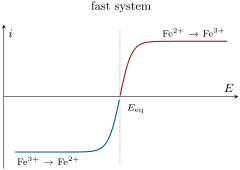
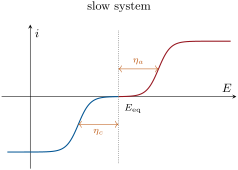
Model current–potential curves of a couple whose two forms are present at equal concentrations (anodic branch red, cathodic blue). Left, a fast system: the current changes sign steeply at the equilibrium potential. Right, a slow system: no current flows over a range of potentials around it; each branch needs an overpotential. Both reach the same limiting plateaus, set by diffusion. (Illustrative values.) Model current–potential curves of a couple whose two forms are present at equal concentrations (anodic branch red, cathodic blue). Left, a fast system: the current changes sign steeply at the equilibrium potential. Right, a slow system: no current flows over a range of potentials around it; each branch needs an overpotential. Both reach the same limiting plateaus, set by diffusion. (Illustrative values.)
Model current–potential curves of a couple whose two forms are present at equal concentrations (anodic branch red, cathodic blue). Left, a fast system: the current changes sign steeply at the equilibrium potential. Right, a slow system: no current flows over a range of potentials around it; each branch needs an overpotential. Both reach the same limiting plateaus, set by diffusion. (Illustrative values.)
Read in context →