
All books

Professional

Apps About Coach Log in Start reading

Chemistry · Glossary

What is Halonium ion, anti and syn addition?

Also known as: halonium ion · anti addition · syn addition

Definition 25.6 University Chemistry — Year 1 · Chapter 25 — Alkenes and Alkynes: Electrophilic Additions

In the addition of BrX2\ce{Br2} or ClX2\ce{Cl2}, the π\pi pair attacks one halogen atom while a lone pair of that atom bonds to the second carbon: a three-membered cyclic halonium ion forms, the other halogen leaving as halide. An addition in which the two new groups end on opposite faces of the former double bond is an anti addition; on the same face, a syn addition.
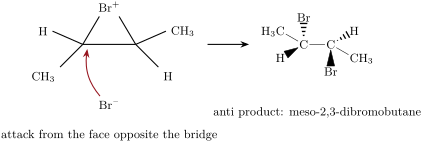
The bromonium ion formed from (E)-but-2-ene, and its opening by bromide from the opposite face (anti addition). The product has two stereocentres of opposite descriptors and an internal mirror plane in a suitable conformation: the meso compound, (2R,3S).
Read in context →