University Chemistry — Year 1 · Bachelor Year 1
25Alkenes and Alkynes: Electrophilic Additions
Shake an alkene with orange bromine water and the colour vanishes in seconds: the oldest test for a carbon–carbon double bond. Behind it is a mechanism. The electrons of the double bond, held less tightly than the electrons and exposed above and below the plane of the molecule, attack an electron-poor reagent; the cation formed then captures a nucleophile. The same two steps add hydrogen halides, water and halogens to alkenes, decide which carbon receives which part of the reagent, and fix the stereochemistry of the product. This chapter develops them, with the rule a nineteenth-century chemist drew from observation and the carbocation that explains it.
You already know
Carbocations, their stability and curly arrows (Chapter 18); the Hammond postulate (Proposition 9.6); / descriptors, (R)/(S), meso compounds and racemic mixtures (Chapter 16). The school volume (grade 12) listed the additions of alkenes without their mechanisms.
25.1 The bond as a nucleophile
Definition 25.1 (Electrophilic addition)
An electrophilic addition to a multiple bond is an addition whose first step is the attack of the electrons on an electrophile E: a cation is formed, which then captures a nucleophile Nu, so that E and Nu end on the two carbons of the former double bond.
The bond is the weaker of the two bonds of C=C (Chapter 3), and its electrons lie away from the nuclei, above and below the plane: alkenes are nucleophiles, and react with acids, halogens and other electrophiles that leave saturated alkanes untouched.
25.2 Adding hydrogen halides: Markovnikov’s rule

Proposition 25.2 (Markovnikov’s rule)
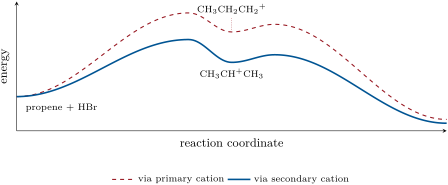
In the addition of HX to an unsymmetrical alkene, the hydrogen goes to the carbon of the double bond that already carries more hydrogens (Markovnikov’s rule). In modern form: the electrophile adds so as to give the more stable carbocation.
Proof. The proton transfer is the rate-determining step, endothermic, ending on a carbocation. By the Hammond postulate (Proposition 9.6) its transition state resembles the carbocation, so the route to the more stable carbocation has the lower barrier and is much faster. Putting the proton on the carbon with more hydrogens leaves the charge on the carbon with more alkyl groups, the more stable cation (Proposition 18.8). ∎
Definition 25.3 (Carbocation rearrangement)
A carbocation rearrangement is the migration, within a carbocation, of a hydrogen atom or an alkyl group with its bonding pair to the neighbouring cationic carbon, giving a more stable carbocation (a 1,2-shift).
Example 25.4 (A methyl shift)
3,3-Dimethylbut-1-ene and hydrogen chloride give a secondary carbocation next to a quaternary carbon; a methyl group moves across with its pair, making a tertiary cation. The main product is 2-chloro-2,3-dimethylbutane, whose skeleton differs from that of the alkene; 3-chloro-2,2-dimethylbutane is minor.

25.3 Adding water
Definition 25.5 (Hydration of an alkene)
The hydration of an alkene is the addition of water, catalysed by a strong acid, giving an alcohol: the reverse of the dehydration of Chapter 22.
The mechanism is that of HX with water as the nucleophile: protonation (Markovnikov), capture of the carbocation by water, loss of a proton from the oxonium ion. Propene gives propan-2-ol, 2-methylpropene gives 2-methylpropan-2-ol. Hydration and dehydration are the same equilibrium, ; dilute aqueous acid and low temperature favour the alcohol, concentrated acid, heat and removal of the alkene favour the alkene (Chapter 7).
25.4 Adding halogens: halonium ions and anti addition
Definition 25.6 (Halonium ion, anti and syn addition)
In the addition of or , the pair attacks one halogen atom while a lone pair of that atom bonds to the second carbon: a three-membered cyclic halonium ion forms, the other halogen leaving as halide. An addition in which the two new groups end on opposite faces of the former double bond is an anti addition; on the same face, a syn addition.
Proposition 25.7 (Halogen addition is anti)
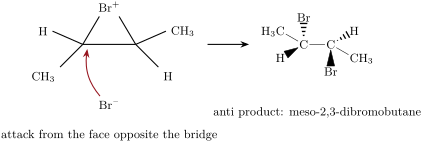
The addition of bromine to an alkene is an anti addition: (E)-but-2-ene gives meso-2,3-dibromobutane, and (Z)-but-2-ene gives the racemic mixture of (2R,3R)- and (2S,3S)-2,3-dibromobutane.
Proof. The bromonium ion bridges one face of the former double bond; the bromide can only attack a carbon from the other face, opening the ring like an SN2 with inversion at that carbon. The two bromines end on opposite faces. For (E)-but-2-ene, attack at either carbon gives the same product, in which the two stereocentres are mirror images of each other: (2R,3S), meso. For (Z)-but-2-ene, attack at one carbon gives (2R,3R), at the other (2S,3S), with equal probability: a racemic mixture. The proof by drawing is Exercise 25.10. ∎
In the lab — Bromine water
Bromine is a dense, volatile, very toxic and corrosive liquid. The test for unsaturation uses dilute bromine water (or a commercial solution of a bromine complex) in a fume cupboard, a few drops at a time; the disappearance of the orange colour signals an addition. In water, the bromonium ion is also captured by water, and a bromohydrin forms beside the dibromide.
25.5 Alkynes: additions and acetylides
Alkynes add HX and twice, each step as for alkenes (Markovnikov for HX). Their hydration, catalysed by acid and a mercury(II) salt, gives not the expected unsaturated alcohol but a ketone: an enol rearranges at once to the carbonyl compound, a process studied in the Year 2 volume.
Definition 25.8 (Terminal alkyne, acetylide)
A terminal alkyne has its triple bond at the end of the chain. A strong base (sodium amide) removes its hydrogen, giving the acetylide ion , a good carbon nucleophile.
Proposition 25.9 (Acidity of terminal alkynes)
The C–H bond of a terminal alkyne is far more acidic than those of alkenes and alkanes, though still much less acidic than water: acetylides are formed with amide ions, not with hydroxide, and are destroyed by water.
Proof. In the acetylide ion the lone pair occupies an orbital with half s character (sp carbon), held closer to the nucleus than the orbitals of sp or sp carbanions: it is more stable, and its conjugate acid stronger. It remains a much stronger base than hydroxide, so water protonates it. ∎
An acetylide attacks a primary halogenoalkane by SN2 (a new C–C bond, + ) or adds to a carbonyl like a Grignard reagent: another way to build carbon skeletons.
Method 25.10 (Predicting an addition)
- Identify the electrophile (, ) and the nucleophile that will follow (, water, the halide).
- For : add it to the carbon that gives the more stable carbocation (Markovnikov); check for a possible 1,2-shift.
- For : bridge the halonium ion and open it from the opposite face (anti); draw both possible attacks and compare the products (meso or racemic).
- With water present, expect the alcohol (or the halohydrin) as well.
History — Vladimir Markovnikov
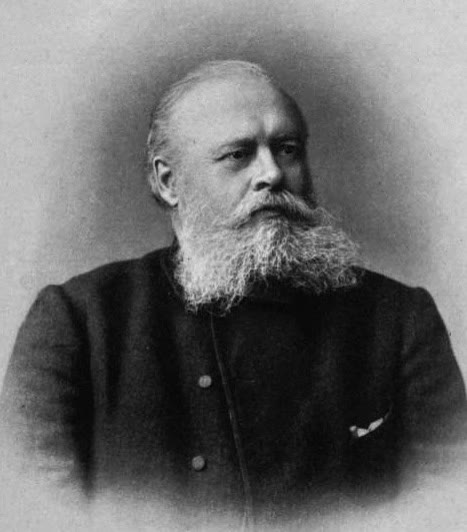
Vladimir Markovnikov stated his rule in the nineteenth century, from the products he and others observed, long before carbocations or curly arrows existed: a regularity of nature, written down before it could be explained. Its modern statement through carbocation stability shows what a mechanism adds to an empirical rule: it says when the rule should fail. (Portrait from an obituary notice published in 1905, public domain, Wikimedia Commons.)
25.6 Exercises
Exercise 25.1 ★
Give the main product of: propene + HCl; 2-methylpropene + HBr; 1-methylcyclohexene + HBr; but-2-yne + one equivalent of HCl.
Solution
Solution of Exercise 25.1.
2-Chloropropane; 2-bromo-2-methylpropane; 1-bromo-1-methylcyclohexane; 2-chlorobut-2-ene.
Exercise 25.2 ★
Write the products of bromine with ethene, cyclohexene and propene. Name them.
Solution
Solution of Exercise 25.2.
1,2-Dibromoethane; trans-1,2-dibromocyclohexane; 1,2-dibromopropane.
Exercise 25.3 ★
Which alcohol does the acid-catalysed hydration of each alkene give: propene, 2-methylpropene, methylenecyclohexane?
Solution
Solution of Exercise 25.3.
Propan-2-ol; 2-methylpropan-2-ol; 1-methylcyclohexan-1-ol (Markovnikov in each case).
Exercise 25.4 ★
Which of these compounds react with sodium amide: propyne, but-2-yne, propene, ethanol? Write the reactions.
Solution
Solution of Exercise 25.4.
Propyne (terminal alkyne): . Ethanol: . But-2-yne and propene have no acidic enough hydrogen.
Exercise 25.5 ★★
Write the full mechanism of the hydration of 2-methylpropene with curly arrows, and explain why the reverse reaction is favoured in hot concentrated acid.
Solution
Solution of Exercise 25.5.
The pair takes on the carbon: tertiary cation ; a water lone pair bonds to it: ; a water molecule takes a proton: . In hot concentrated acid water is scarce and the volatile alkene escapes: the reverse reaction, dehydration, proceeds.
Exercise 25.6 ★★
Explain with the Hammond postulate why 2-methylpropene reacts with HCl much faster than propene.
Solution
Solution of Exercise 25.6.
Protonation of 2-methylpropene gives a tertiary cation, of propene a secondary one. The rate-determining protonation has a transition state resembling the cation (Hammond): the more stable tertiary cation is reached over a lower barrier.
Exercise 25.7 ★★
Bromine reacts with cyclohexene. Show that the product is trans-1,2-dibromocyclohexane, and say whether it is chiral and whether the product is optically active.
Solution
Solution of Exercise 25.7.
The bromonium ion bridges one face of the ring; bromide opens it from the other face: the two bromines end trans. The trans dibromide is chiral (no mirror plane), but bromide attacks the two carbons equally: the two enantiomers form in equal amounts, and the product is racemic, optically inactive.
Exercise 25.8 ★★
Propose a mechanism for the addition of HCl to 3-methylbut-1-ene that gives mainly 2-chloro-2-methylbutane.
Solution
Solution of Exercise 25.8.
Protonation of C1 gives the secondary cation on C2, next to the tertiary C3 bearing a hydrogen; that hydrogen moves with its pair to C2 (a 1,2-hydride shift), leaving a tertiary cation on C3, captured by : 2-chloro-2-methylbutane.
Exercise 25.9 ★★
Propose a synthesis of hex-2-yne from propyne and a halogenoalkane, and of 1-phenylbut-2-yn-1-ol from propyne and benzaldehyde.
Solution
Solution of Exercise 25.9.
Propyne + sodium amide: the propynide ion; with 1-bromopropane (SN2): , hex-2-yne. Propynide with benzaldehyde, then dilute acid: , 1-phenylbut-2-yn-1-ol.
Exercise 25.10 ★★★
Prove the stereochemistry of bromine addition to the two but-2-enes by drawing: bromonium ion, anti attack at each carbon, Cram representation of the products, descriptors. Count the stereoisomers formed in each case.
Solution
Solution of Exercise 25.10.
(E)-but-2-ene: bromonium on one face, bromide from the other at C2 or at C3; both attacks give the same compound, with descriptors (2R,3S): the meso compound, one stereoisomer. (Z)-but-2-ene: attack at C2 gives (2S,3S) (or its mirror image from the other face), attack at C3 (2R,3R); equal amounts: two stereoisomers, a racemic mixture.
Exercise 25.11 ★★★
Bromine water with propene gives 1-bromopropan-2-ol as the main product. Explain the regiochemistry: why does water attack the more substituted carbon of the bromonium ion?
Solution
Solution of Exercise 25.11.
In the unsymmetrical bromonium ion, the more substituted carbon bears more of the positive charge (its C–Br bond is longer and weaker, like a nearly tertiary or secondary cation). Water, in large excess, attacks that carbon from the face opposite the bridge: 1-bromopropan-2-ol.
Exercise 25.12 ★★★
A hydrocarbon decolourises bromine water and adds HBr to give 2-bromo-2-methylbutane; its hydration gives 2-methylbutan-2-ol. Find two possible structures and propose a way to tell them apart.
Solution
Solution of Exercise 25.12.
: an alkene. 2-Methylbut-1-ene and 2-methylbut-2-ene both give the tertiary cation, hence 2-bromo-2-methylbutane and 2-methylbutan-2-ol. Their proton NMR spectra differ: two vinylic protons (, singlets) for the first, one (, a quartet) for the second.
25.7 Problem: Two Butenes and Bromine
Problem 25.1
Weekend problem — the two but-2-enes, the bromonium mechanism, meso and racemic dibromides, their optical rotation and the mass obtained
A laboratory has two bottles of but-2-ene, one pure (Z), one pure (E), and treats of each with bromine in dichloromethane. Molar masses (): 56.0, 159.8, 215.8.
Part I — The two alkenes.
- Draw (Z)- and (E)-but-2-ene and justify the descriptors.
- Are they stereoisomers? Enantiomers or diastereomers?
- Why do they not interconvert at room temperature?
- Which is the more stable, and why?
- Write the overall equation of the addition of bromine.
- How many stereocentres has 2,3-dibromobutane? How many stereoisomers at most, and how many in fact?
Part II — The mechanism.
- Write the formation of the bromonium ion with curly arrows.
- Why is a bridged bromonium ion formed rather than an open carbocation?
- Write the opening of the ion by bromide.
- Why does bromide attack from the face opposite the bridge?
- What kind of addition results?
- Why is the solvent dichloromethane and not water?
Part III — The products.
- From (E)-but-2-ene: draw the product of attack at C2 and give the descriptors of C2 and C3.
- Same for attack at C3. Compare.
- Show that the product is meso.
- From (Z)-but-2-ene: draw the two products and their descriptors.
- In what proportions are they formed? Name the mixture.
- Is the reaction stereospecific? Justify.
Part IV — Rotation and mass.
- What optical rotation does the product of the (Z) alkene show?
- Compute the amount of each alkene.
- Compute the mass of dibromide expected from each at yield.
- State the specific rotation of the dibromide obtained from (E)-but-2-ene, and the mass of it obtained.
Solution
Solution of Problem 25.1.
1. On each carbon outranks H: (Z) has the two methyls on the same side, (E) on opposite sides. 2. Stereoisomers that are not mirror images: diastereomers. 3. Rotation about C=C would break the bond, which costs far more energy than collisions provide at room temperature. 4. (E): its methyl groups do not crowd each other. 5. . 6. Two equivalent stereocentres: at most four, in fact three ((2R,3R), (2S,3S) and the meso (2R,3S)). 7. The pair attacks one Br atom of , the Br–Br pair leaves as , and a lone pair of the attacked bromine bonds to the second carbon: a three-membered bromonium ion. 8. In the bridged ion every atom has an octet; an open secondary carbocation would have a carbon with six electrons. 9. A lone pair of bonds to one ring carbon; the C–Br bond of the bridge breaks, its pair going to the bridging bromine. 10. The bridge occupies one face; as in SN2, the nucleophile enters opposite the bond that breaks. 11. An anti addition. 12. Water would compete with bromide for the bromonium ion and give a bromohydrin. 13. (2R,3S) (or (2S,3R), the same compound). 14. The same compound. 15. In a conformation with the two bromines eclipsed, a mirror plane passes between C2 and C3; the descriptors are opposite. 16. (2R,3R) and (2S,3S). 17. Equal amounts: a racemic mixture. 18. Yes: the two diastereomeric alkenes give different products (meso against racemic). 19. None: the two enantiomers cancel. 20. each. 21. each. 22. (meso compound), .