All books

Professional

Apps About Coach Log in Start reading

Chemistry · Glossary

What is Inverted region?

Definition 19.19 University Chemistry — Year 3 · Chapter 19 — Reaction Mechanisms of Complexes

The inverted region of electron transfer is the range of driving forces −ΔG∘>λ-\Delta G^\circ > \lambda in which the rate decreases as the reaction becomes more exergonic.
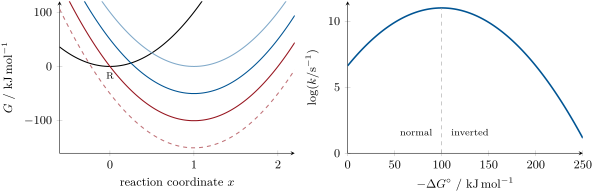
Marcus theory with = 100\, kJ/ mol (model). Left: the reactant parabola (black) and product parabolas for G = 0 and -50 (blue), -100 = - (red) and -150\, kJ/ mol (dashed, inverted region); their crossing point, the transition state, falls to the bottom of the reactant curve at - G = and rises again beyond. Right: the logarithm of the rate constant (model prefactor 1011\, s-1) passes through a maximum at - G =.
Marcus theory with λ=100 kJ/mol\lambda = 100\,\mathrm{kJ}/\mathrm{mol} (model). Left: the reactant parabola (black) and product parabolas for ΔG∘=0\Delta G^\circ = 0 and −50-50 (blue), −100=−λ-100 = -\lambda (red) and −150 kJ/mol-150\,\mathrm{kJ}/\mathrm{mol} (dashed, inverted region); their crossing point, the transition state, falls to the bottom of the reactant curve at −ΔG∘=λ-\Delta G^\circ = \lambda and rises again beyond. Right: the logarithm of the rate constant (model prefactor 1011 s−110^{11}\,\mathrm{s}^{-1}) passes through a maximum at −ΔG∘=λ-\Delta G^\circ = \lambda.
Read in context →
