
All books

Professional

Apps About Coach Log in Start reading

Chemistry · Glossary

What is Isolation method, apparent order?

Also known as: isolation method · apparent order

Definition 8.14 University Chemistry — Year 1 · Chapter 8 — Chemical Kinetics: Rate Laws

In the isolation method, all reactants but one are put in large excess (ten times or more). Their concentrations stay practically constant, and v=k[A]p[B]q≈k′[A]pv = k[\ce{A}]^p[\ce{B}]^q \approx k'[\ce{A}]^p with k′=k[B]0qk' = k[\ce{B}]_0^q: the reaction behaves as if of apparent order pp with the apparent rate constant k′k'. This is also called degeneracy of the order.
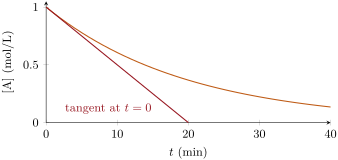
Reading an initial rate: the tangent at the origin (red) of a first-order curve meets the time axis at t_0 = 20\, min, so v_0 = 1.00\, mol/ L/20\, min = 0.050\, mol\, L-1\, min-1.
Reading an initial rate: the tangent at the origin (red) of a first-order curve meets the time axis at t0=20 mint_0 = 20\,\mathrm{min}, so v0=1.00 mol/L/20 min=0.050 mol L−1 min−1v_0 = 1.00\,\mathrm{mol}/\mathrm{L}/20\,\mathrm{min} = 0.050\,\mathrm{mol}\,\mathrm{L}^{-1}\,\mathrm{min}^{-1}.
Read in context →