
All books

Professional

Apps About Coach Log in Start reading

Chemistry · Glossary

What is Longitudinal and transverse relaxation times?

Also known as: longitudinal relaxation time · transverse relaxation time

Definition 8.12 University Chemistry — Year 3 · Chapter 8 — NMR in Depth: Pulses, Relaxation and 2D

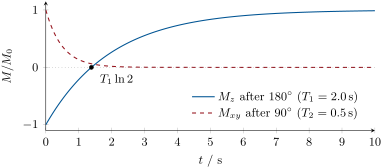
The return of MzM_z to M0M_0 after a perturbation is exponential, with the longitudinal relaxation time T1T_1 (spin–lattice relaxation: energy given to the surroundings). The decay of the transverse magnetisation to zero is exponential with the transverse relaxation time T2≤T1T_2 \le T_1 (spin–spin relaxation: loss of phase coherence between spins).
Relaxation (model values). The inverted longitudinal magnetisation recovers through zero at T_1 2; the transverse magnetisation decays faster, with T_2.
Relaxation (model values). The inverted longitudinal magnetisation recovers through zero at T1ln⁡2T_1\ln2; the transverse magnetisation decays faster, with T2T_2.
Read in context →