
All books

Professional

Apps About Coach Log in Start reading

Chemistry · Glossary

What is Luminescence, fluorescence, phosphorescence, Stokes shift?

Also known as: luminescence · fluorescence · phosphorescence · Stokes shift

Definition 7.13 University Chemistry — Year 3 · Chapter 7 — Electronic Spectroscopy and Photophysics

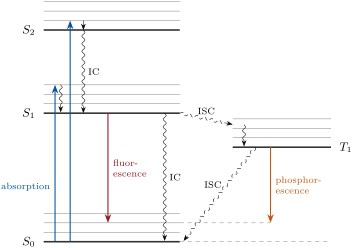
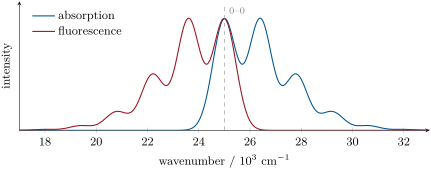
Luminescence is emission of light by an excited molecule. Fluorescence is spin-allowed emission, usually S1→S0S_1 \to S_0, fast (nanoseconds); phosphorescence is spin-forbidden emission, usually T1→S0T_1 \to S_0, slow (milliseconds to seconds). The Stokes shift is the difference between the absorption and emission maxima, in energy.
A Jablonski diagram. Straight arrows: absorption (blue), fluorescence (red), phosphorescence (orange); wavy arrows: vibrational relaxation and internal conversion (IC); dashed wavy arrows: intersystem crossing (ISC). Emission starts from the lowest vibrational level of S_1 or T_1 and may end on any level of S_0.
A Jablonski diagram. Straight arrows: absorption (blue), fluorescence (red), phosphorescence (orange); wavy arrows: vibrational relaxation and internal conversion (IC); dashed wavy arrows: intersystem crossing (ISC). Emission starts from the lowest vibrational level of S1S_1 or T1T_1 and may end on any level of S0S_0.
Absorption and fluorescence of a model molecule (S = 1, vibrational quantum 1400\, cm-1): mirror images about the 0–0 line; the maxima are separated by the Stokes shift.
Absorption and fluorescence of a model molecule (S=1S = 1, vibrational quantum 1400 cm−11400\,\mathrm{cm}^{-1}): mirror images about the 0–0 line; the maxima are separated by the Stokes shift.
Read in context →