
All books

Professional

Apps About Coach Log in Start reading

Chemistry · Glossary

What is π-donor and π-acceptor ligands?

Also known as: pi-donor ligand · pi-acceptor ligand · back-donation

Definition 19.15 University Chemistry — Year 2 · Chapter 19 — Ligand Field Theory and Colour

A π\pi-donor ligand has filled orbitals of π\pi symmetry with respect to the metal–ligand bond (lone pairs of ClX−\ce{Cl-}, OHX−\ce{OH-}); a π\pi-acceptor ligand has empty ones of low energy (the π∗\pi^* orbitals of CO\ce{CO} and CNX−\ce{CN-}). The transfer of electron density from filled metal d orbitals into the empty π∗\pi^* orbitals of a π\pi-acceptor ligand is called back-donation.
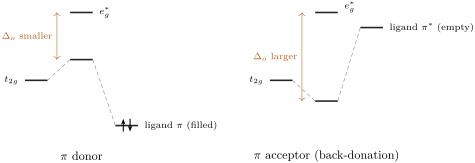
Effect of ligand π orbitals on the t_2g level, schematic. A filled ligand π orbital below pushes t_2g up (smaller splitting); an empty π* orbital above pulls it down (larger splitting).
Effect of ligand π\pi orbitals on the t2gt_{2g} level, schematic. A filled ligand π\pi orbital below pushes t2gt_{2g} up (smaller splitting); an empty π∗\pi^* orbital above pulls it down (larger splitting).
Read in context →