All books

Professional

Apps About Coach Log in Start reading

Chemistry · Glossary

What is Radical clock?

Definition 27.5 University Chemistry — Year 3 · Chapter 27 — Radicals, Carbenes and Rearrangements

A radical clock is a radical that rearranges unimolecularly with a known rate constant, such as the 5-hexenyl radical cyclising; its competition with a bimolecular trap measures the rate constant of the trap, or the reverse.
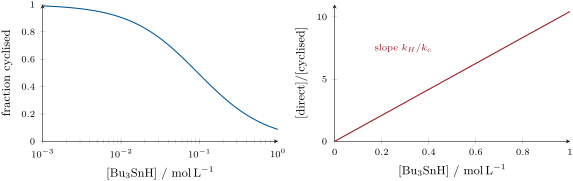

The 5-hexenyl clock with model rate constants k_c = 2.3 × 10⁵\, s-1 and k_H = 2.4 × 10⁶\, L\, mol-1\, s-1. Left: fraction of methylcyclopentane among the products against the hydride concentration: half at k_c/k_H 0.1\, mol/ L. Right: the inverse ratio is a straight line through the origin, of slope k_H/k_c.
The 5-hexenyl clock with model rate constants kc=2.3×10⁵ s−1k_c = 2.3 \times 10^{5}\,\mathrm{s}^{-1} and kH=2.4×10⁶ L mol−1 s−1k_H = 2.4 \times 10^{6}\,\mathrm{L}\,\mathrm{mol}^{-1}\,\mathrm{s}^{-1}. Left: fraction of methylcyclopentane among the products against the hydride concentration: half at kc/kH≈0.1 mol/Lk_c/k_H \approx 0.1\,\mathrm{mol}/\mathrm{L}. Right: the inverse ratio is a straight line through the origin, of slope kH/kck_H/k_c.
Read in context →