University Chemistry — Year 3 · Bachelor Year 3
27Radicals, Carbenes and Rearrangements
The pyrethrum daisy defends itself with esters of chrysanthemic acid, molecules built around a three-membered carbon ring; their synthetic relatives are among the most used household insecticides. Chemists close such rings in one step by adding a carbene to a double bond: a carbon atom with only six electrons around it, two of them unshared. This chapter deals with reactive intermediates that the Year 1 and Year 2 volumes met only in passing (radicals used in synthesis, carbenes and nitrenes) and with the rearrangements in which a group moves to an electron-deficient carbon, nitrogen or oxygen atom, among them two that make the monomers of nylon-6 and of a biodegradable polyester from the same ketone.
You already know
The Year 1 volume introduced radicals, homolysis and half-headed arrows, carbocations and their rearrangements, nucleophiles and leaving groups; the Year 2 volume radical chains (initiation, propagation, termination, radical initiators), peroxy acids, lactones, lactams and imines. Chapter 13 treated chain kinetics, Chapter 20 carbenes as ligands, Chapter 2 singlet and triplet states, and Chapter 12 the Hammond postulate.

27.1 Radical chain reactions in synthesis
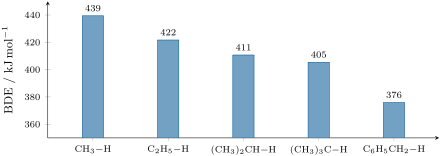
The stability of a carbon radical is measured by the bond dissociation enthalpy of the C–H bond that would form it: the weaker the bond, the more stable the radical.
Proposition 27.1 (Bond dissociation enthalpies)
The bond dissociation enthalpy of R–H at follows from gas-phase enthalpies of formation: .
Proof. The homolysis has, by Hess’s law, the reaction enthalpy of the products’ formation minus that of the reactant; that reaction enthalpy is the bond dissociation enthalpy by definition. ∎
Proposition 27.2 (Selectivity of halogenation)
Hydrogen abstraction by a bromine atom is far more selective between primary, secondary and tertiary C–H bonds than abstraction by a chlorine atom.
Argued. With larger than all the C–H values of the figure and smaller, abstraction by chlorine is exothermic, by bromine endothermic. By the Hammond postulate (Chapter 12) the chlorine transition state is early, reactant-like, and feels little of the difference between the radicals formed; the bromine one is late, product-like, and its activation energy follows most of the difference in BDE, which the Boltzmann factor turns into large rate ratios. ∎
Tributyltin hydride reduces alkyl halides by a chain: a tin radical takes the halogen, the alkyl radical takes a hydrogen atom from the next molecule of hydride, and a new tin radical is made. The same chain removes a hydroxy group once it is turned into a thiocarbonyl ester (the Barton–McCombie deoxygenation), and closes rings. Organotin residues are toxic and hard to remove; tris(trimethylsilyl)silane and other silanes now often replace the tin hydride.
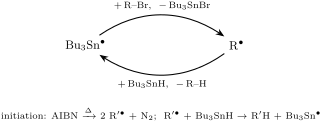
Hydrogen bromide adds to alkenes by the same kind of chain when peroxides are present: a bromine atom adds to the less substituted end, giving the more stable radical, which then takes a hydrogen atom from HBr: anti-Markovnikov addition.
27.2 Radical cyclisations
Definition 27.3 (Exo and endo cyclisations)
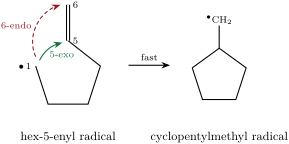
In an exo cyclisation the bond that is broken (or the bond attacked) ends up outside the new ring; in an endo cyclisation, inside it.
Proposition 27.4 (Baldwin’s rules)
For ring closures (established experimentally, with a stereoelectronic rationale): at a tetrahedral carbon (tet), 3- to 7-exo are favoured, 5- and 6-endo disfavoured; at a trigonal carbon (trig), 3- to 7-exo are favoured, 3- to 5-endo disfavoured, 6- and 7-endo favoured; at a digonal carbon (dig), 3- and 4-exo are disfavoured, 5- to 7-exo favoured, 3- to 7-endo favoured.
The rationale is the angle of attack each kind of bond needs: from the back of the bond at a tet carbon, at about 107° to a trigonal system, at a narrower angle to a triple bond; a short chain cannot reach those positions for the disfavoured cases.
Definition 27.5 (Radical clock)
A radical clock is a radical that rearranges unimolecularly with a known rate constant, such as the 5-hexenyl radical cyclising; its competition with a bimolecular trap measures the rate constant of the trap, or the reverse.
Proposition 27.6 (Competition kinetics)
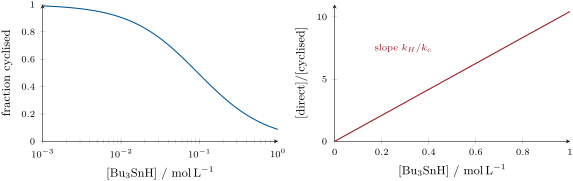
If a radical either cyclises () or is trapped by a hydride kept in excess at concentration (), the product ratio is .
Proof. At every moment the two products form at rates and . Their ratio does not depend on the radical concentration, which varies; with the hydride concentration constant, integration over time multiplies both by the same , and the ratio of the products is the ratio of the rate constants times . ∎
Method 27.7 (Designing a radical reduction or cyclisation)
- For a simple reduction, keep the hydrogen donor concentrated (about or more) so that the radical is trapped before it rearranges.
- For a cyclisation, keep the donor dilute, or add it slowly, so that the radical cyclises first: choose .
- Choose an initiator whose half-life at the reaction temperature is of the order of the reaction time (AIBN near ), and add it in portions if needed.
- Prefer a silane or another tin-free donor, and remove oxygen, which traps carbon radicals.
In the lab — Slow addition with a syringe pump
To keep a reagent dilute throughout a reaction, its solution is loaded into a gas-tight syringe and added through a septum by a syringe pump over several hours, into the refluxing solution of the substrate under nitrogen. The concentration of the reagent then stays near its low steady-state value, set by the rate of addition and the rate at which it is consumed.
27.3 Carbenes
Definition 27.8 (Singlet and triplet carbenes)
A singlet carbene has its two non-bonding electrons paired in one orbital, an hybrid, its p orbital empty; a triplet carbene has them unpaired, one in each orbital, with parallel spins.
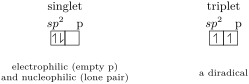
Carbenes are made by losing dinitrogen from a diazo compound (by heat, light or a metal catalyst), by -elimination (chloroform and a strong base give , which loses chloride to ), or are avoided altogether by a carbenoid.
Definition 27.9 (Carbenoids)
A carbenoid is a metal-bound species that transfers a carbene group as a free carbene would, without the free carbene being formed, such as the iodomethylzinc iodide of the Simmons–Smith reaction.
Definition 27.10 (Cyclopropanation)
Cyclopropanation is the formation of a cyclopropane by addition of a carbene or carbenoid to a C=C double bond.
Proposition 27.11 (The Skell test)
A singlet carbene adds to a cis or trans alkene stereospecifically, keeping the relative configuration; a triplet carbene gives both cyclopropane stereoisomers.
Argued. The singlet makes both new bonds in one concerted step, with no time for rotation. The triplet makes one bond first, giving a triplet 1,3-diradical; its two unpaired electrons cannot form the second bond until a spin flips, which is slow compared with rotation about the remaining C–C single bond: the configuration is scrambled. ∎

Singlet carbenes also insert into C–H bonds. Rhodium(II) carboxylates decompose diazo esters into rhodium carbenoids that cyclopropanate alkenes and insert into C–H bonds selectively, and, with chiral ligands, enantioselectively.
Definition 27.12 (Nitrenes)
A nitrene is the nitrogen analogue of a carbene, a neutral nitrogen atom with only six electrons, formed for example by loss of dinitrogen from an azide.
27.4 Rearrangements to electron-deficient carbon
Definition 27.13 (1,2-Shift)
A 1,2-shift is the migration of a group, with its bonding pair, from one atom to the neighbouring electron-deficient atom.
In a Wagner–Meerwein shift an alkyl group or a hydride moves to a neighbouring carbocation, giving a more stable one: the carbocation rearrangements of the Year 1 volume, now with their mechanism named. Terpene skeletons are reshaped in nature by cascades of such shifts.
Definition 27.14 (Pinacol rearrangement)
The pinacol rearrangement turns a 1,2-diol, in acid, into a ketone or an aldehyde: one hydroxy group leaves as water, a group on the neighbouring carbon shifts to the cation, and the cation formed, stabilised by the remaining oxygen, loses a proton.
Definition 27.15 (Migratory aptitude)
The migratory aptitude of a group is its relative tendency to move in a 1,2-shift to an electron-deficient centre.
Groups that carry positive charge well during the shift migrate best: hydride, aryl and tertiary alkyl before secondary, primary and methyl. Pinacol, , gives pinacolone, 3,3-dimethylbutan-2-one.
Method 27.16 (Predicting the product of a rearrangement)
- Find the electron-deficient atom formed (cation, nitrenium, oxygen of an activated peroxide, carbene or nitrene) and the leaving group that makes it.
- List the groups on the neighbouring atom that could move; when the geometry is fixed (oximes), only the group anti to the leaving group can.
- Otherwise choose by migratory aptitude, or by which group forms the more stable cation where it leaves.
- Move the group with retention of its configuration, then complete the mechanism (loss of a proton, addition of water).
27.5 Rearrangements to electron-deficient nitrogen and oxygen
Definition 27.17 (Beckmann rearrangement)
The Beckmann rearrangement turns an oxime, in strong acid, into an amide: the hydroxy group, activated as a leaving group, departs while the group anti to it migrates from carbon to nitrogen; water adds to the nitrilium ion formed, and tautomerisation gives the amide.
Proposition 27.18 (Anti migration)
In the Beckmann rearrangement the group that migrates is the one anti to the leaving group on nitrogen.
Argued. The migrating bond pair attacks nitrogen from the back of the N–O bond, as in an displacement; only the group anti to the oxygen has its bond aligned with the N–O orbital. The step is concerted with the departure of the leaving group, so no free nitrenium ion forms that could choose otherwise. ∎
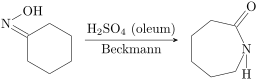
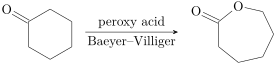
Definition 27.19 (Baeyer–Villiger oxidation)
The Baeyer–Villiger oxidation turns a ketone into an ester, or a cyclic ketone into a lactone, with a peroxy acid: the peroxy acid adds to the carbonyl group, then a group on the carbonyl carbon migrates to the nearer peroxide oxygen as a carboxylate leaves.
Proposition 27.20 (Baeyer–Villiger regiochemistry)
In the Baeyer–Villiger oxidation the group that migrates keeps its configuration, and the order of migratory aptitude is tertiary alkyl > secondary alkyl aryl > primary alkyl > methyl (established experimentally).
Argued. The group moves with its bonding pair across the face of the carbon it leaves and lands on oxygen from the same side, so its configuration is kept. In the transition state the migrating group carries partial positive charge, which alkyl substitution and aryl conjugation stabilise. ∎
Definition 27.21 (Isocyanates, Curtius and Hofmann rearrangements)
An isocyanate is a compound . In the Curtius rearrangement an acyl azide loses dinitrogen on heating while the R group moves from carbon to nitrogen, giving an isocyanate; in the Hofmann rearrangement a primary amide treated with bromine and base gives the same isocyanate through an N-bromoamide. With water the isocyanate gives the amine and carbon dioxide; with an alcohol, a carbamate.
Definition 27.22 (Ketenes and the Wolff rearrangement)
A ketene is a compound . In the Wolff rearrangement an -diazoketone loses dinitrogen while the group on the carbonyl carbon migrates, giving a ketene, which adds water, an alcohol or an amine.
The Wolff rearrangement is the key step of the Arndt–Eistert homologation, which lengthens a carboxylic acid by one carbon: acid chloride, then diazoketone, then ketene, then the homologous acid.
Safety


Tributyltin hydride: toxic if swallowed, harmful on skin, damages organs on repeated exposure, very toxic to aquatic life; tin residues are collected separately. Diazomethane is a toxic, carcinogenic and explosive gas; it is named here for its chemistry only and is replaced in practice by safer reagents such as trimethylsilyldiazomethane. AIBN is self-reactive on heating.
History — A radical that should not exist, and a nylon
In 1900 Moses Gomberg, trying to make hexaphenylethane, obtained a yellow solution that took up oxygen and iodine: the triphenylmethyl radical, the first persistent carbon radical. Half a century later, the Beckmann rearrangement of cyclohexanone oxime became the industrial route to caprolactam, polymerised by ring opening into nylon-6, a fibre and engineering plastic made on a very large scale.
27.6 Exercises
Exercise 27.1 ★
At the relative reactivities per hydrogen of primary, secondary and tertiary C–H bonds are towards chlorine atoms and towards bromine atoms (data of the exercise). Compute the proportions of 1- and 2-halopropane formed from propane in each case.
Solution
Solution of Exercise 27.1.
Propane has six primary and two secondary hydrogens. Chlorination: , that is 43 % 1-chloropropane and 57 % 2-chloropropane. Bromination: , 4 % and 96 %.
Exercise 27.2 ★
Which is the ground state of , and of ? Which adds stereospecifically to trans-but-2-ene, and what does it give?
Solution
Solution of Exercise 27.2.
: triplet; : singlet (the chlorine lone pairs raise the empty p orbital). Dichlorocarbene adds stereospecifically: trans-1,1-dichloro-2,3-dimethylcyclopropane.
Exercise 27.3 ★
Give the product of the Simmons–Smith reaction of (Z)-hex-3-ene.
Solution
Solution of Exercise 27.3.
cis-1,2-Diethylcyclopropane: the carbenoid adds in one step to one face.
Exercise 27.4 ★
Give the products of the Baeyer–Villiger oxidation of cyclohexanone and of acetophenone.
Solution
Solution of Exercise 27.4.
Cyclohexanone: -caprolactone (oxepan-2-one). Acetophenone: phenyl acetate, ; phenyl migrates in preference to methyl.
Exercise 27.5 ★★
With the data of Exercise 27.1, compute the proportions of the two monochlorides and of the two monobromides of 2-methylpropane.
Solution
Solution of Exercise 27.5.
Nine primary and one tertiary hydrogen. Chlorination: , 64 % 1-chloro-2-methylpropane and 36 % 2-chloro-2-methylpropane. Bromination: , 0.6 % and 99.4 %.
Exercise 27.6 ★★
A new radical clock, reduced with , gives three times as much rearranged as unrearranged product. With , find its rate constant.
Solution
Solution of Exercise 27.6.
.
Exercise 27.7 ★★
Classify by Baldwin’s rules the attack of a hex-5-enyl radical on C5 and on C6, then say whether each of these closures is favoured: 4-exo-tet, 5-endo-trig, 5-exo-dig, 3-exo-dig, 5-endo-dig.
Solution
Solution of Exercise 27.7.
Attack on C5: 5-exo-trig, favoured; on C6: 6-endo-trig, favoured by the rules but slower here. 4-exo-tet: favoured. 5-endo-trig: disfavoured. 5-exo-dig: favoured. 3-exo-dig: disfavoured. 5-endo-dig: favoured.
Exercise 27.8 ★★
Give the product of the pinacol rearrangement of 2,3-diphenylbutane-2,3-diol, and explain the choice of the migrating group.
Solution
Solution of Exercise 27.8.
Loss of water gives a tertiary, benzylic cation; on the neighbouring carbon a phenyl and a methyl group could move, and phenyl, of higher aptitude, migrates. The oxygen-stabilised cation loses a proton: 3,3-diphenylbutan-2-one.
Exercise 27.9 ★★
Benzoyl azide is heated in toluene, then water is added; in a second experiment, ethanol. Give the products.
Solution
Solution of Exercise 27.9.
Curtius: . With water, the carbamic acid loses : aniline (some diphenylurea forms as aniline meets more isocyanate). With ethanol: ethyl N-phenylcarbamate, .
Exercise 27.10 ★★★
With and (data of the exercise) and the C–H values of the chapter’s figure, compute for abstraction of a primary and of a tertiary hydrogen by each halogen atom, and use the Hammond postulate to explain the selectivities of Exercise 27.1.
Solution
Solution of Exercise 27.10.
Chlorine: primary , tertiary ; bromine: and . Both chlorine abstractions are exothermic, with early transition states that feel little of the difference; both bromine abstractions are endothermic, with late transition states whose activation energies differ by most of it: , the order of the observed ratio.
Exercise 27.11 ★★★
Give the Beckmann products of the two oximes, E and Z, of 2-methylcyclohexanone, and explain why they differ, while the Baeyer–Villiger oxidation of the ketone gives one main lactone.
Solution
Solution of Exercise 27.11.
E oxime (OH anti to C2, which bears the methyl group): C2 migrates, nitrogen enters next to it: 7-methylazepan-2-one. Z oxime: C6 migrates: 3-methylazepan-2-one. In the Beckmann rearrangement the oxime geometry decides; in the Baeyer–Villiger oxidation the migratory aptitude does, and the secondary carbon moves: 7-methyloxepan-2-one.
Exercise 27.12 ★★★
With the model clock of the chapter, compute the fraction cyclised at , 0.10 and . What hydride concentration gives 95 % of cyclised product, and how can it be maintained?
Solution
Solution of Exercise 27.12.
Fraction cyclised : 0.91, 0.49 and 0.09. For 95 %: , so . It is maintained by adding the hydride slowly with a syringe pump, or by using a catalytic amount of tin halide with a reducing agent that regenerates the hydride.
27.7 Problem: Two Rings from Cyclohexanone
Problem 27.1
Weekend problem — two rings from cyclohexanone: the oxime, the Beckmann rearrangement to caprolactam, the Baeyer–Villiger oxidation to caprolactone, and the regiochemistry of both with 2-methylcyclohexanone
Data of the problem: one tonne of cyclohexanone is converted into its oxime with 98 % yield, and the oxime into caprolactam with 98 % yield; the rearrangement uses 1.3 mol of sulfuric acid (as oleum) per mole of oxime, neutralised at the end with ammonia to ammonium sulfate.
Part I — The oxime.
- Write the formation of cyclohexanone oxime from hydroxylamine.
- Why is it run near pH 4 to 5?
- Does cyclohexanone oxime have E and Z isomers? Why?
- Draw the E and Z oximes of 2-methylcyclohexanone.
- Why do these two oximes interconvert only slowly?
Part II — The Beckmann rearrangement.
- What does the acid do to the oxime?
- Which bond migrates, and why does it make the ring larger?
- What intermediate does water attack?
- Write the overall equation, oxime to caprolactam.
- Name and draw the product, and the polymer made from it.
- Compute the molar masses of cyclohexanone and caprolactam.
- Compute the mass of caprolactam from one tonne of cyclohexanone.
- Compute the mass of ammonium sulfate made with it.
Part III — The Baeyer–Villiger oxidation.
- Write the oxidation of cyclohexanone by a peroxy acid .
- Give the intermediate formed by addition of the peroxy acid.
- Which group migrates, and what is the leaving group?
- Name the lactone and the polymer it gives.
- Why can hydrogen peroxide with a catalyst replace the peroxy acid in a cleaner process?
Part IV — 2-Methylcyclohexanone.
- Which carbon migrates in its Baeyer–Villiger oxidation, and what lactone forms?
- Is the configuration of that carbon kept?
- Which lactam does the E oxime give (OH anti to the methyl-bearing carbon)?
- Which lactam does the Z oxime give?
- What decides the regiochemistry in each reaction?
- Why is cyclohexanone itself free of these problems?
- State the result: the mass of caprolactam from one tonne of cyclohexanone.
Solution
Solution of Problem 27.1.
1. .
2. Acid is needed to remove the hydroxy group of the addition intermediate as water, but too much acid protonates hydroxylamine, which then no longer adds.
3. No: the two carbons attached to the C=N carbon are equivalent by the symmetry of the ring.
4. In the E oxime the OH points away from the methyl-bearing carbon C2 (anti to it), in the Z oxime towards it.
5. Inversion at an oxime nitrogen bearing an electronegative oxygen has a high barrier.
6. It protonates (or sulfonates) the hydroxy group, making it a good leaving group, water.
7. The ring C–C bond anti to the leaving group moves from carbon to nitrogen, which is thereby inserted into the ring: six atoms become seven.
8. A cyclic nitrilium ion.
9. : an isomerisation, oxime to lactam.
10. Caprolactam, azepan-2-one, the seven-membered cyclic amide of 6-aminohexanoic acid; its ring-opening polymerisation gives nylon-6.
11. and .
12. ; ; , .
13. Oxime: ; : , giving as many moles of : , more than the caprolactam.
14. .
15. The tetrahedral adduct of the peroxy acid on the carbonyl carbon (the Criegee intermediate), a peroxy hemiketal.
16. A ring group (the two are equivalent) moves to the nearer peroxide oxygen; the carboxylate leaves.
17. -Caprolactone, oxepan-2-one; its ring-opening polymerisation gives poly(-caprolactone), a biodegradable polyester.
18. Its only by-product is water, where a peroxy acid leaves a mole of carboxylic acid per mole of lactone and is itself hazardous to store.
19. The secondary carbon C2 migrates: 7-methyloxepan-2-one.
20. Yes: the migrating carbon keeps its configuration.
21. 7-Methylazepan-2-one (C2 anti, migrates).
22. 3-Methylazepan-2-one (C6 migrates).
23. Beckmann: the geometry of the oxime (the anti group moves). Baeyer–Villiger: the migratory aptitude (the more substituted carbon moves).
24. Its two carbons are equivalent: one oxime, one lactam, one lactone.
25. One tonne of cyclohexanone gives about of caprolactam.