
All books

Professional

Apps About Coach Log in Start reading

Chemistry · Glossary

What is Saddle point, minimum energy path?

Also known as: saddle point · minimum energy path

Definition 12.3 University Chemistry — Year 3 · Chapter 12 — Theories of Reaction Rates

A saddle point of a potential energy surface is a point where the gradient vanishes, the energy is a maximum along one direction and a minimum along all others. The minimum energy path is the path of steepest descent from the saddle point to the reactant and product valleys; its length measured along it is the reaction coordinate, and the saddle point is the transition state.
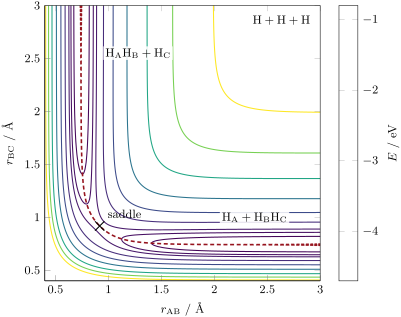
A model potential energy surface for collinear H + H2 (LEPS form built from the Morse curve of H2, with a Sato parameter of 0.17 chosen as a model constant). Contours from -4.65\, eV to -0.8\, eV, energy zero for three separate atoms; the valleys lie at -4.75\, eV, the depth of the H2 well. Dashed: the minimum energy path, which crosses the symmetric saddle at r_ AB = r_ BC = 0.92\, Å, 0.27\, eV above the valleys in this model.
A model potential energy surface for collinear H+HX2\ce{H + H2} (LEPS form built from the Morse curve of HX2\ce{H2}, with a Sato parameter of 0.17 chosen as a model constant). Contours from −4.65 eV-4.65\,\mathrm{eV} to −0.8 eV-0.8\,\mathrm{eV}, energy zero for three separate atoms; the valleys lie at −4.75 eV-4.75\,\mathrm{eV}, the depth of the HX2\ce{H2} well. Dashed: the minimum energy path, which crosses the symmetric saddle at rAB=rBC=0.92 A˚r_{\mathrm{AB}} = r_{\mathrm{BC}} = 0.92\,\text{Å}, 0.27 eV0.27\,\mathrm{eV} above the valleys in this model.
Read in context →