All books

Professional

Apps About Coach Log in Start reading

Chemistry · Glossary

What is Potential energy surface, stationary point, geometry optimisation?

Also known as: potential energy surface · stationary point · equilibrium geometry · geometry optimisation

Definition 3.2 University Chemistry — Year 3 · Chapter 3 — Computational Chemistry: Hartree–Fock and DFT

The potential energy surface (PES) of a molecule is the function U(R)=Eel(R)+Vnn(R)U(\mathbf R) = E_{\mathrm{el}}(\mathbf R) + V_{\mathrm{nn}}(\mathbf R) of its nuclear coordinates. A stationary point is a point where all first derivatives of UU vanish; a minimum is an equilibrium geometry. Searching for one from a starting structure, by following the forces −∇U-\nabla U, is a geometry optimisation.

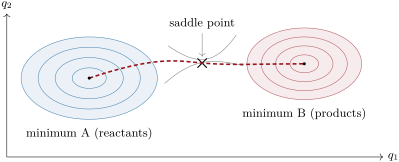
A potential energy surface seen from above, as a contour map over two nuclear coordinates (schematic). Two minima are joined, through a saddle point (cross), by the path of lowest energy (dashed): the minimum energy path studied in .
A potential energy surface seen from above, as a contour map over two nuclear coordinates (schematic). Two minima are joined, through a saddle point (cross), by the path of lowest energy (dashed): the minimum energy path studied in Chapter 12.
Read in context →