All books

Professional

Apps About Coach Log in Start reading

Chemistry · Glossary

What is Standard addition?

Also known as: standard-addition method

Definition 34.13 University Chemistry — Year 2 · Chapter 34 — Statistics of Chemical Measurement

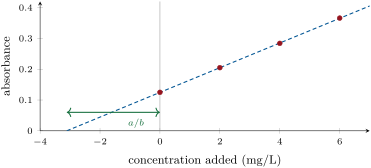
In the standard-addition method, known amounts of analyte are added to equal portions of the sample itself; the signal is plotted against the concentration added, and the concentration of the analyte in the sample is the distance from the origin to the point where the line extrapolated to zero signal crosses the axis, a/ba/b.

Standard addition (exercise data): absorbance of a sample spiked with 0, 2, 4 and 6\, mg/ L of analyte. The line meets zero signal at -3.11\, mg/ L: the measured solution contained 3.11\, mg/ L.
Standard addition (exercise data): absorbance of a sample spiked with 0, 2, 4 and 6 mg/L6\,\mathrm{mg}/\mathrm{L} of analyte. The line meets zero signal at −3.11 mg/L-3.11\,\mathrm{mg}/\mathrm{L}: the measured solution contained 3.11 mg/L3.11\,\mathrm{mg}/\mathrm{L}.
Read in context →