全部书籍

专业

应用 关于 Coach 登录 开始阅读

书籍暂未推出简体中文版——当前显示英文版。

Chemistry · 术语表

什么是 Standard addition?

又称: standard-addition method

Definition 34.13 University Chemistry — Year 2 · 第 34 章 — Statistics of Chemical Measurement

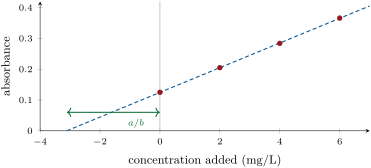
In the standard-addition method, known amounts of analyte are added to equal portions of the sample itself; the signal is plotted against the concentration added, and the concentration of the analyte in the sample is the distance from the origin to the point where the line extrapolated to zero signal crosses the axis, a/ba/b.

Standard addition (exercise data): absorbance of a sample spiked with 0, 2, 4 and 6\, mg/ L of analyte. The line meets zero signal at -3.11\, mg/ L: the measured solution contained 3.11\, mg/ L.
Standard addition (exercise data): absorbance of a sample spiked with 0, 2, 4 and 6 mg/L6\,\mathrm{mg}/\mathrm{L} of analyte. The line meets zero signal at −3.11 mg/L-3.11\,\mathrm{mg}/\mathrm{L}: the measured solution contained 3.11 mg/L3.11\,\mathrm{mg}/\mathrm{L}.
在原文中阅读 →