All books

Professional

Apps About Coach Log in Start reading

Earth and Space Sciences · Glossary

What is Blueschist; eclogite?

Also known as: blueschist · eclogite

Definition 15.9 High School Earth and Space Sciences · Chapter 15 — Subduction Zones

Blueschist is a metamorphic rock made from basalt of the oceanic crust buried to high pressure while it stays relatively cold; it is coloured blue by the mineral glaucophane. Eclogite is the dense metamorphic rock that basalt and gabbro become at mantle depths along subduction zones: it has the same chemical composition, but is made of red garnet and green pyroxene.
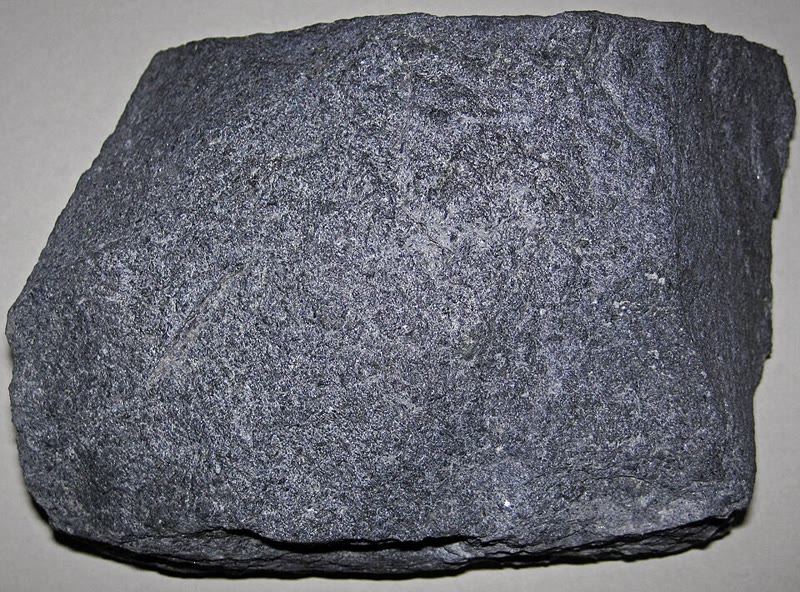
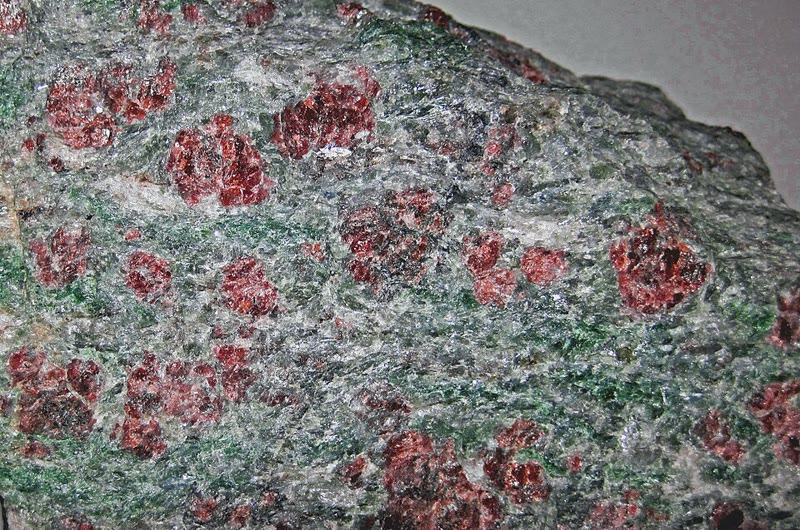
Left: blueschist from Santa Catalina Island, California, once oceanic crust buried in a subduction zone. Right: eclogite from Norway, with red garnets in green pyroxene. Photographs James St. John (CC BY 2.0). Left: blueschist from Santa Catalina Island, California, once oceanic crust buried in a subduction zone. Right: eclogite from Norway, with red garnets in green pyroxene. Photographs James St. John (CC BY 2.0).
Left: blueschist from Santa Catalina Island, California, once oceanic crust buried in a subduction zone. Right: eclogite from Norway, with red garnets in green pyroxene. Photographs James St. John (CC BY 2.0).
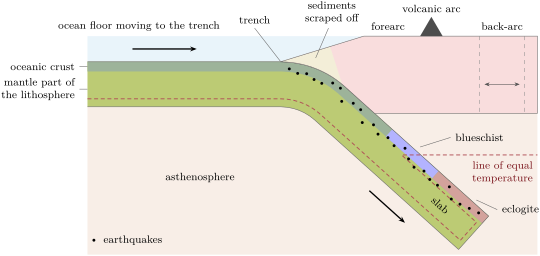
A subduction zone (a drawing, not to scale). Old oceanic lithosphere bends down at the trench and sinks beneath the overriding plate. Sediments scraped off its surface pile up against the edge of the overriding plate; the earthquakes follow the sinking slab; its crust turns into blueschist, then into eclogite. The slab stays colder than the mantle around it: the lines of equal temperature are dragged down along it. A line of volcanoes, the volcanic arc, stands above the slab.
Read in context →