
সব বই

পেশাদার

1 Markets I: The Ecosystem and Exchange-Traded Marketsবাজার অনলাইন 2 Markets II: Rates, FX and Creditবাজার অনলাইন 3 Markets III: Commodities, Energy and Cryptoবাজার অনলাইন 4 Quantitative Methodsপদ্ধতি অনলাইন 5 Derivatives and Volatilityডেরিভেটিভস অনলাইন 6 Rates, Credit, XVA and Riskসুদহার, ঋণ ও ঝুঁকি অনলাইন 7 Research Craft: Predictors, Backtests, Measurement, Portfoliosগবেষণা অনলাইন 8 Strategies I: Equities and Futuresকৌশল অনলাইন 9 Strategies II: Volatility, Relative Value, Macro and the Bank Desksকৌশল অনলাইন 10 Microstructure and Executionএক্সিকিউশন অনলাইন 11 Market Making and High-Frequency Tradingমার্কেট মেকিং অনলাইন 12 Machine Learning for Marketsমেশিন লার্নিং অনলাইন 13 Low-Latency Softwareপ্রযুক্তি অনলাইন 14 Networks, Hardware and Trading Infrastructureপ্রযুক্তি অনলাইন 15 Research, Data and Risk Platformsপ্রযুক্তি অনলাইন 16 The Desk and the Firmপ্রতিষ্ঠান অনলাইন 17 The Industry: Firms, Roles and Careersক্যারিয়ার অনলাইন 18 Interviews I: Maths, Probability and Speedক্যারিয়ার অনলাইন 19 Interviews II: Markets, Trading Games and the Final Roundক্যারিয়ার অনলাইন 20 Interviews III: Codeক্যারিয়ার অনলাইন
অ্যাপ পরিচিতি Coach সাইন ইন পড়া শুরু করো

বইগুলো এখনো বাংলা ভাষায় পাওয়া যায় না — ইংরেজি সংস্করণ দেখানো হচ্ছে।

Earth and Space Sciences · পরিভাষা

Bowen’s reaction series কী?

Definition 8.1 University Earth and Space Sciences — Year 2 · অধ্যায় 8 — Magmatic Differentiation

Bowen’s reaction series is the order in which the common silicates crystallise from a cooling basaltic magma, as two branches that meet at the end. In the discontinuous branch each mafic mineral reacts with the liquid to form a new mineral of another structure: olivine, pyroxene, amphibole, biotite. In the continuous branch plagioclase crystallises all along, its composition changing continuously from calcium-rich to sodium-rich. The last liquid crystallises potassium feldspar, muscovite and quartz.
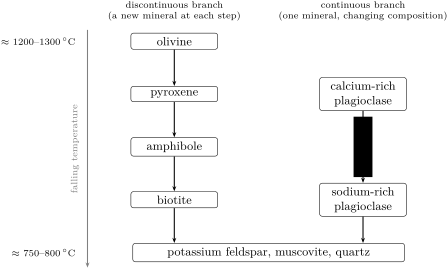
Bowen’s reaction series. Olivine and calcium-rich plagioclase crystallise first from a basaltic magma; on the left each mafic mineral reacts with the liquid to give the next, on the right the plagioclase grows ever richer in sodium; the last, silica-rich liquid gives potassium feldspar, muscovite and quartz. Temperatures are typical values for basaltic magma at low pressure.
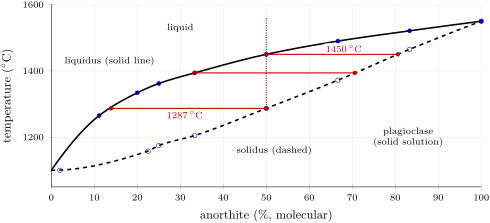
The plagioclase feldspars at atmospheric pressure, from the quenching experiments of Bowen (1913): beginning (circles) and completion (dots) of melting, with curves drawn through the measurements. In red, the equilibrium crystallisation of a liquid of 50\,\% anorthite: the first crystal, at 1450\, C, has 81\,\% anorthite; at 1394\, C crystals of 71\,\% coexist with a liquid of 33\,\%; the last liquid, at 1287\, C, has 14\,\% ().
The plagioclase feldspars at atmospheric pressure, from the quenching experiments of Bowen (1913): beginning (circles) and completion (dots) of melting, with curves drawn through the measurements. In red, the equilibrium crystallisation of a liquid of 50 %50\,\% anorthite: the first crystal, at 1450 ∘C1450\,{}^{\circ}\mathrm{C}, has 81 %81\,\% anorthite; at 1394 ∘C1394\,{}^{\circ}\mathrm{C} crystals of 71 %71\,\% coexist with a liquid of 33 %33\,\%; the last liquid, at 1287 ∘C1287\,{}^{\circ}\mathrm{C}, has 14 %14\,\% (Exercise 8.1).
প্রসঙ্গসহ পড়ো →