বইগুলো এখনো বাংলা ভাষায় পাওয়া যায় না — ইংরেজি সংস্করণ দেখানো হচ্ছে।
University Earth and Space Sciences — Year 2 · স্নাতক দ্বিতীয় বর্ষ
8Magmatic Differentiation
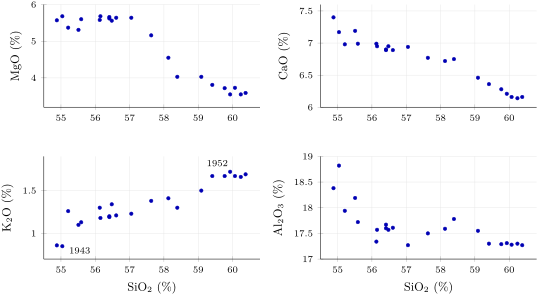
On 20 February 1943 a volcano began to erupt in the west of Mexico, and it went on for nine years. Its first lavas were basaltic andesites with silica; its last, in February 1952, were andesites with slightly over . The volcano, Parícutin, did not move to another source in the meantime, and its lavas were analysed one after the other as they came out. The magma beneath it changed itself: it grew crystals and left them behind, and it ate some of the granitic rock around it. A magma that leaves the mantle as a basalt can end as a rhyolite, and the rocks it leaves behind on the way record how it did so. This chapter follows a magma as it cools: the order in which minerals crystallise, the laws that tell how major and trace elements change when crystals are removed, the rocks built from those crystals, and what happens when the magma takes in another magma or the crust.
You already know
From the high-school volume: igneous rocks and their textures; the order in which minerals crystallise from a basaltic magma, olivine first and quartz last, found by Bowen’s experiments. From the chemistry books’ Year 2 volume: binary phase diagrams, solid solutions and the lever rule. From the Year 1 volume: plagioclase, a solid solution between anorthite and albite , and the other rock-forming silicates; thin sections between crossed polars. From Chapter 3: the mineral–melt and bulk partition coefficients, , compatible and incompatible elements, normalised diagrams and the europium anomaly. From Chapter 4: isotope ratios as tracers and the mixing hyperbola. From Chapter 7: the diopside–anorthite eutectic, incongruent melting, ternary diagrams and primary magmas.
8.1 Crystallisation sequences
A basaltic magma does not crystallise all its minerals at once. Bowen found by experiment that olivine normally crystallises first, at between 1200 and ; that the calcium-rich plagioclase begins about where pyroxene does; and that the last, silica-rich liquid gives potassium feldspar, quartz and perhaps muscovite at around 750 to . Between the two, the mafic minerals do not simply pile up: each reacts with the liquid to give the next.
Definition 8.1 (Bowen’s reaction series)
Bowen’s reaction series is the order in which the common silicates crystallise from a cooling basaltic magma, as two branches that meet at the end. In the discontinuous branch each mafic mineral reacts with the liquid to form a new mineral of another structure: olivine, pyroxene, amphibole, biotite. In the continuous branch plagioclase crystallises all along, its composition changing continuously from calcium-rich to sodium-rich. The last liquid crystallises potassium feldspar, muscovite and quartz.
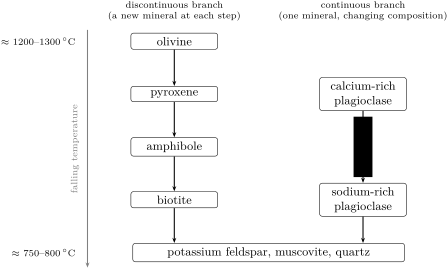
The two branches correspond to the two kinds of phase diagram of Chapter 7. A discontinuous reaction is the incongruent melting of enstatite run backwards: forsterite crystals react with a liquid richer in silica to give enstatite. The continuous branch is a solid solution. Bowen measured it in 1913 on synthetic plagioclases, holding each composition at a known temperature and looking for glass and crystals: anorthite melts at , albite at about , and every intermediate plagioclase melts over an interval between a lower curve, the solidus, and an upper one, the liquidus (the figure below).
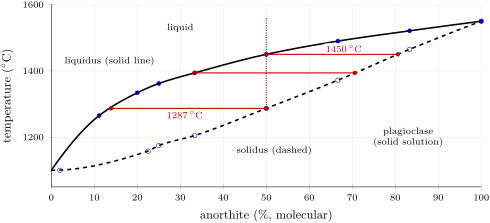
A liquid that crystallises a solid solution is enriched in the component that melts at the lower temperature: the first plagioclase from a liquid of anorthite has , and the liquid moves towards albite. What happens next depends on whether the crystals keep talking to the liquid.
Definition 8.2 (Equilibrium and fractional crystallisation)
In equilibrium crystallisation the crystals remain in chemical equilibrium with the whole of the liquid until the end, re-equilibrating as the liquid changes; the system ends with the composition it started with. In fractional crystallisation each crystal, once formed, is removed from reaction with the liquid, by settling, by being plastered on the walls of the chamber, or by being armoured by later growth; the liquid then evolves as if the crystals had been taken out of the system.
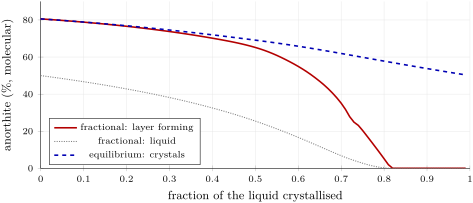
In equilibrium crystallisation the plagioclase of the figure above changes from to anorthite as it grows, every crystal re-equilibrating by diffusion with the liquid, and the last liquid disappears at the solidus, . Diffusion in feldspar is slow, and natural crystals seldom keep up: the inside of each crystal is cut off from the liquid, which then behaves as in fractional crystallisation and can go on to compositions near albite. The figure in the last section of this chapter computes both paths.
Definition 8.3 (Liquid line of descent)
The liquid line of descent of a magma is the sequence of compositions taken by its liquid as it crystallises, plotted on a variation diagram or a phase diagram.
A liquid line of descent is a property of the liquid only. Lavas erupted with crystals in them do not lie on it exactly, and Wilcox, studying the lavas of Parícutin, used both their whole-rock analyses and the compositions of their groundmass, the liquid part, calculated by removing the crystals.
8.2 Fractional crystallisation of the major elements
Removing crystals changes the composition of the liquid in a simple, linear way, and the oldest tool for reading it is a plot of each oxide against silica.
Definition 8.4 (Harker diagram)
A Harker diagram (silica-variation diagram) plots the mass percentage of each oxide of a suite of related rocks against their mass percentage of , one panel per oxide.
The lavas of Parícutin show such trends (the Harker diagrams after the next proposition): as silica rises, magnesia, lime and alumina fall and potash rises. This is what removing olivine and plagioclase would do: olivine takes away magnesia and iron, plagioclase lime and alumina, and both leave the liquid richer in silica and alkalis. Whether the removal of known minerals can account for the trends quantitatively is a question of mass balance.
Proposition 8.5 (Mass balance of crystal removal)
Let a parent magma of composition (a vector of oxide mass fractions) crystallise minerals of compositions in masses per unit mass of parent, and let be the composition of the remaining liquid. Then
For one mineral, the parent lies on the straight segment joining the liquid and the mineral on every variation diagram, and the mass fraction removed is for any oxide : the lever rule.
Proof. Every oxide is conserved: the mass of oxide in a unit mass of parent ends either in the liquid, of mass and concentration , or in the minerals. Writing this for each gives the vector equation. With one mineral it reads , a point of the segment from to dividing it in the ratio , on any pair of axes; solving one component gives . ∎
With several minerals the masses are found by solving the conservation equations of as many oxides. Wilcox did this graphically in 1954; today it is a small linear system.
Method 8.6 (Least-squares mass balance)
To test whether a daughter liquid derives from a parent by removing minerals (and adding, if needed, an assimilated rock, entered with a negative mass): (1) for each oxide , write the conservation of the proposition rearranged as a linear equation in the masses removed per of parent,
(2) with exactly oxides, chosen among those the minerals change most, solve the system; with more oxides, solve it by least squares (minimise the sum of the squared differences between both sides); (3) recompute the daughter from the masses found and compare it with the analysis, oxide by oxide: residuals larger than the analytical errors, or a negative mass for a mineral, reject the model.
Wilcox chose silica, alumina and magnesia as his three controls, and three materials: olivine of composition Fo, plagioclase An, and the average of four granitic xenoliths ( , ) found in the lavas. He showed that no combination of olivine and plagioclase alone fits the series, and that adding of xenolith and removing of olivine and of plagioclase from of the groundmass of the first lava gives of a material close to the groundmass of the 1950 lava. Solving his three equations exactly gives , and ; least squares over seven oxides gives a different answer, , and , a reminder that such results depend on the chosen controls. Either way the magma took in more granite than it crystallised. The lavas of Parícutin record an open system, the subject of the last section.
8.3 Trace elements
A trace element does not change the minerals that crystallise; it follows them, with its bulk partition coefficient (Chapter 3), here written , between the crystals forming at each moment and the liquid.
Theorem 8.7 (Rayleigh fractionation law)
In perfect fractional crystallisation with a constant bulk partition coefficient , the concentration of a trace element in the liquid is
where is its concentration in the initial liquid and the mass fraction of liquid remaining. This is the Rayleigh fractionation law.
Proof. Let be the mass of liquid. When a small mass of crystals forms, in equilibrium with the liquid only at that moment, it carries the element at concentration . The mass of element in the liquid, , therefore changes by . Expanding, , so . Integrating from , where , gives , and . ∎
Proposition 8.8 (Equilibrium crystallisation of a trace element)
If the crystals remain in equilibrium with the liquid, .
Proof. The whole crystal mass (per unit initial mass) holds , so mass conservation of the element reads . ∎
Corollary 8.9 (Ratios of incompatible elements)
For two elements of partition coefficients and , the ratio of their concentrations in the liquid changes by the factor in fractional crystallisation. If both are strongly incompatible () the ratio barely changes: it keeps the value of the parent magma, and so of its source.
Proof. Divide the two Rayleigh laws: ; for and the factor is . ∎
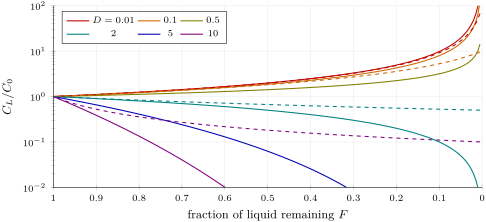
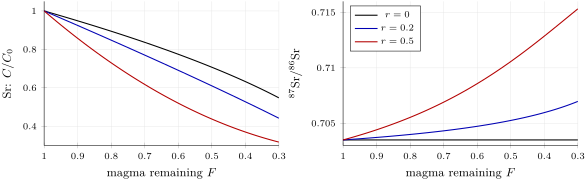
The figure above reads in two directions. Incompatible elements () behave almost alike: their concentration rises nearly as , so that a liquid enriched tenfold in zirconium has crystallised about nine-tenths of its mass. Compatible elements are far more sensitive. Nickel enters olivine with a partition coefficient of about 5 in hot magnesian liquids: measured at 3.8 at and 5.0 at , it rises by about 0.8 for every of cooling; strontium enters plagioclase with about 2.7; a basalt that crystallises a fifth of its mass as olivine loses more than half of its nickel (Exercise 8.5). Nickel is therefore the most sensitive record of olivine fractionation, and a basalt rich in nickel is close to a primary magma (Chapter 7).
Two remarks fix the scope of these laws. First, is not a constant: it changes when a new mineral joins the crystallising assemblage, and the law is then applied in stages (Exercise 8.12). Secondly, the same equations, with the roles of solid and liquid exchanged, describe the melting of a source; how batch and fractional melting fractionate the trace elements is treated in the Year 3 volume.
8.4 Cumulates and layered intrusions
Where do the crystals removed from a magma go? In a magma chamber that cools slowly, they settle on its floor, grow on its walls and roof, and build rocks of a particular kind.
Definition 8.10 (Cumulate; layered intrusion)
A cumulate is an igneous rock formed by the accumulation of crystals (the cumulus crystals) from a magma, together with the minerals later grown from the liquid trapped between them (the intercumulus material); its composition is that of crystals plus a little liquid, not that of any magma. A layered intrusion is a large, slowly cooled body of mafic or ultramafic cumulates arranged in layers, recording the fractional crystallisation of the magma that filled it.
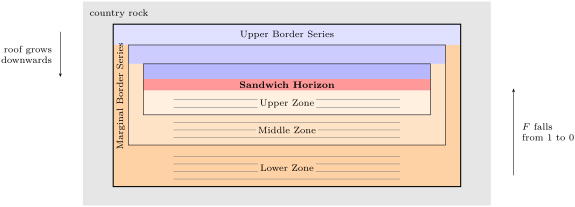
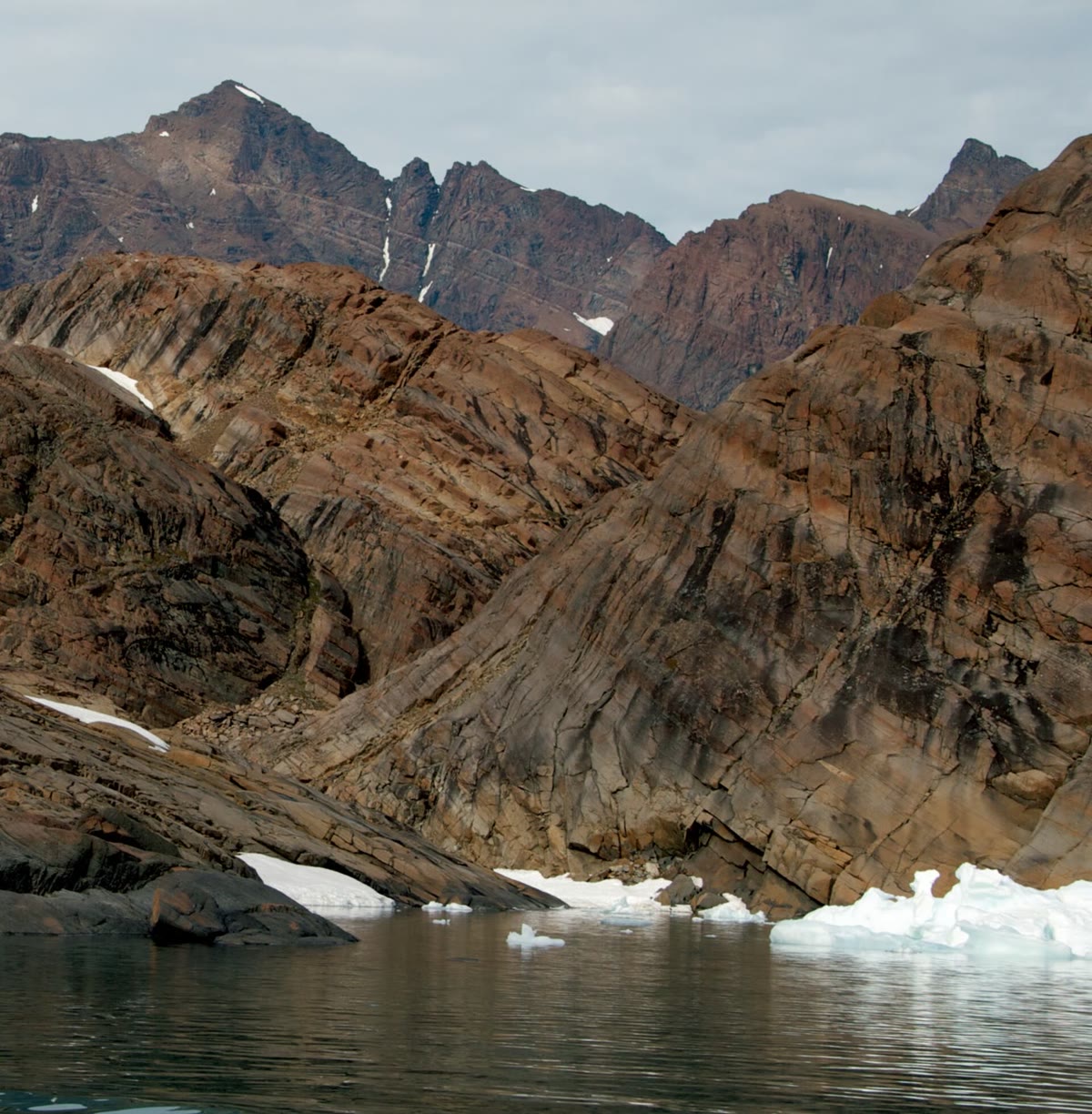
The Skaergaard intrusion of East Greenland, about old, is the reference. Its layered gabbros crop out over some 11 by , and record the uninterrupted differentiation of a tholeiitic basalt: a Layered Series grew on the floor, Border Series on the walls and roof, and the two met at the Sandwich Horizon, where the last, most evolved liquid crystallised in the interior (the figure below). The floor cumulates are divided, from the base up, into a Hidden Zone, not exposed, and the exposed Lower, Middle and Upper Zones. Its students estimated the mass fraction of liquid left when each level crystallised, fitted along the reference section of the Layered Series by
( in metres above the base of the Lower Zone). A quarter of the magma had already crystallised, in the walls, the roof and a hidden zone, when the exposed floor sequence began; the Sandwich Horizon, , lies some up (Exercise 8.7).
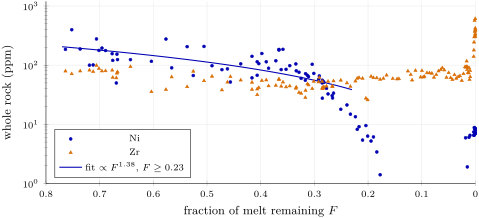
Whole-rock analyses of 134 samples along this section show the laws of the previous section at work (the figure below). Nickel, compatible, falls from about in the Lower Zone cumulates to in the Middle Zone and in the Upper Zone. A cumulate holds times the nickel of the liquid it grew from, so on logarithmic axes : the slope over the Lower and Middle Zones, 1.38, gives an apparent . Zirconium, incompatible, hardly varies in the cumulates: it stays in the liquid, and enters a cumulate only through the trapped liquid, until the last rocks of the Upper Zone, crystallised from a liquid where it had piled up.
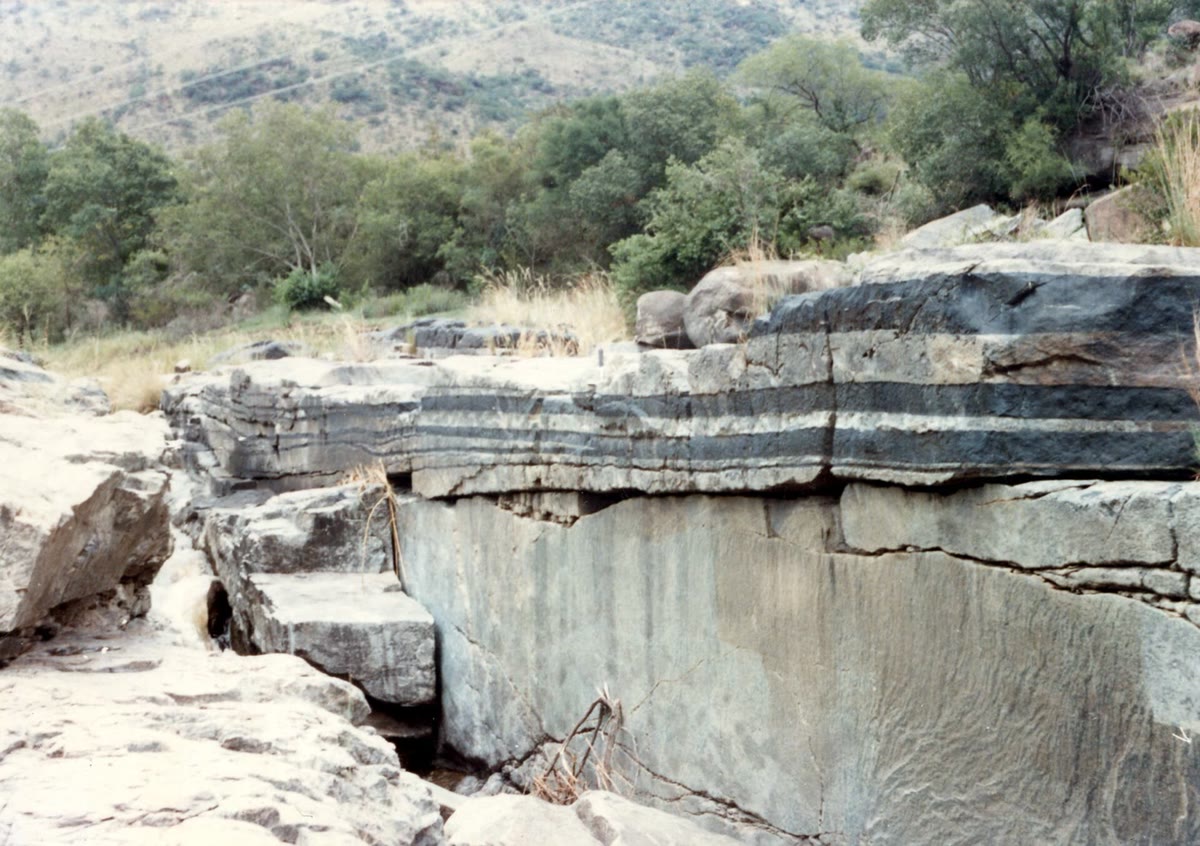
Thicker intrusions hold ore: the layered intrusions that host chromitite are on average at least thick. The Bushveld Complex of South Africa, old, covers , and its layered suite is about thick, up to in places. Its Critical Zone, 1500 to thick, repeats cycles of pyroxenite, norite and anorthosite and holds layers of chromitite, a rock of more than chromite; one of them, the LG6 layer, is 0.5 to thick. Thermal models give the emplacement of its magmas about years and their crystallisation . How layers so thin and so regular form, by settling of crystals, by crystallisation in place on the floor, by influxes of new magma, is still debated.
8.5 Open systems
A magma chamber is seldom closed. New magma arrives from below, and the walls of the chamber are rocks that the magma can heat, melt and dissolve.
Definition 8.11 (Magma mixing; crustal assimilation; AFC)
Magma mixing is the blending of two magmas of different compositions into one. Crustal assimilation is the incorporation of crustal rock into a magma, by melting and dissolution of the wall rock or of blocks fallen into it. Assimilation–fractional crystallisation (AFC) is their combination in one chamber: the magma crystallises, and the latent heat released melts and assimilates the wall rock.
Proposition 8.12 (Mixing is linear in concentrations)
A mixture of a mass fraction of magma A and of magma B has every concentration : on any diagram of one concentration against another, mixtures lie on the straight segment from A to B, and the lever rule gives .
Proof. Each element is conserved: ; divide by . ∎
Mixing and crystal removal both draw straight lines on Harker diagrams; isotope ratios tell them apart. Crystallisation does not change an isotope ratio, while mixing with a rock of different ratio does, along the hyperbola of Chapter 4. A rise of Sr/Sr with silica in a volcanic suite is therefore the mark of assimilation.
Proposition 8.13 (Assimilation with fractional crystallisation)
A magma crystallises crystals with bulk partition coefficient for an element and assimilates wall rock of concentration at a rate times the rate of crystallisation (). With the mass of magma relative to its initial mass and ,
For this is the Rayleigh law. The isotope ratio of the element in the magma is the mean of that of the initial magma and that of the wall rock, weighted by the two terms of this sum.
Proof. Per unit initial mass, when a mass crystallises, a mass is assimilated and the magma mass changes by . The element balance is . Expanding the left side and replacing by ,
So , and is proportional to ; with at , , which is the formula. For , and . The atoms that come from the initial magma obey the same equation with , so their concentration is ; the rest come from the wall: hence the weighting of the isotope ratios. ∎
DePaolo gave these equations in 1981, and they are the standard model of a magma contaminated on its way through the crust. They hide a thermal constraint. The heat to assimilate rock comes from the latent heat of the crystals: heating crust from 150 to takes about , melting it , while crystallising magma gives about ; so some of magma must crystallise for each gram of rock assimilated, and is well below 1. Wilcox made the same calculation for Parícutin: his of quartz monzonite, taken at about , needed some to be heated to and melted, the heat of crystallising about of plagioclase, far more than the of crystals his mass balance removed. The erupted magma could not have paid for its own assimilation: the heat must have come from a larger body of magma than the one that erupted, crystallising out of sight (Exercise 8.11).
8.6 Reading zoned crystals
Definition 8.14 (Compositional zoning)
A crystal of a solid solution shows compositional zoning when its composition varies from core to rim, recording the changing liquid from which successive layers grew. Zoning is normal when the rim is richer in the low-temperature component (sodium in plagioclase), reverse when it is richer in the high-temperature one, and oscillatory when it alternates.
A zoned crystal is fractional crystallisation caught in the act: its core did not re-equilibrate with the later liquid. The figure below computes, on Bowen’s loop, the plagioclase growing from a liquid of anorthite. In equilibrium the crystals stay homogeneous and end at ; in perfect fractional crystallisation each new layer is in equilibrium with an ever more sodic liquid, and the rim of the last crystals is nearly pure albite. Normal zoning, from calcic core to sodic rim, is what Bowen’s series predicts for a cooling magma. A reverse zone, a calcic band outside a sodic one, says that the crystal was suddenly bathed in a hotter or more calcic liquid: often the arrival of new magma, mixing in the chamber.
In the lab — Reading zoned crystals
Petrologists read zoning first between crossed polars, where the zones of a plagioclase go extinct at slightly different angles and appear as concentric bands. They then measure it: an electron microprobe (Chapter 31) analyses spots a few micrometres across along a traverse from core to rim, and maps of calcium and sodium show the zones directly. From such a profile they compute the composition of the liquid each zone grew from, with the loop of the figure above or with partition coefficients, and they count the reverse zones as the number of recharges of the chamber. Trace elements measured along the same traverse by laser ablation, and isotope ratios measured zone by zone, separate crystallisation, mixing and assimilation in the history of a single crystal.
8.7 Exercises
Exercise 8.1 ★
Use Bowen’s measurements on the plagioclases (solidus / liquidus, ): An 1550 / 1550; An 1465 / 1521; An 1372 / 1490; An 1287 / 1450; An 1205 / 1394; An liquidus 1334; An liquidus 1265, and interpolate linearly between neighbouring points. A liquid of anorthite cools in equilibrium. (a) At what temperature does it begin to crystallise, and what is the composition of the first crystal? (b) At , what are the compositions of the liquid and of the crystals, and what mass fraction has crystallised (use mole fractions as if they were mass fractions)? (c) What is the composition of the last drop of liquid?
Solution
Solution of Exercise 8.1.
(a) The liquidus of An is . The first crystal lies on the solidus at that temperature, between An (1372) and An (1465): anorthite. (b) At the liquid is on the liquidus, An; the crystals on the solidus, . By the lever rule, the crystallised fraction is . (c) The last liquid disappears when the crystals reach An, at the solidus temperature ; the liquidus there lies between An (1265) and An (1334): anorthite.
Exercise 8.2 ★
A gabbroic cumulate contains plagioclase, clinopyroxene and olivine. With the partition coefficients (olivine / clinopyroxene / plagioclase) Sr 0.000063 / 0.157 / 2.7, Zr 0.00068 / 0.195 / 0.001 and Rb 0.000044 / 0.0033 / 0.025, compute the bulk partition coefficient of each element, and say which is compatible.
Solution
Solution of Exercise 8.2.
; ; . Only strontium, held by the plagioclase, is compatible (); zirconium and rubidium are incompatible, rubidium the more so.
Exercise 8.3 ★
The cumulate of Exercise 8.2 crystallises from a basalt, by fractional crystallisation, until half of the liquid is left. (a) By what factor has each of Sr, Zr and Rb changed in the liquid (take the bulk coefficients 1.40, 0.069 and 0.014)? (b) By what factor has the ratio Zr/Rb changed? Comment with the corollary on ratios.
Solution
Solution of Exercise 8.3.
(a) : Sr (it falls); Zr ; Rb , close to the limit 2. (b) Zr/Rb changes by , less than while each element nearly doubled: as the corollary says, the ratio of two incompatible elements keeps the value of the parent magma, and so tells about the source, not about crystallisation.
Exercise 8.4 ★
The first lava of Parícutin (February 1943) had , and ; the last (February 1952), 60.07, 3.73 and . (a) Compute the change of each oxide. (b) Potash enters none of the crystallising minerals. If it had been concentrated by fractional crystallisation alone, what fraction of the liquid would have been left? (c) Wilcox’s mass balance removes only about of crystals per of magma. What does the comparison suggest?
Solution
Solution of Exercise 8.4.
(a) , , (per cent), potash multiplied by . (b) For a perfectly incompatible element , so : half of the magma would have had to crystallise. (c) Removing per leaves and would raise potash only by about : crystallisation alone cannot explain the rise. The potash came from outside, from the granitic xenoliths, rich in potash (), that the magma assimilated.
Exercise 8.5 ★★
Compare fractional and equilibrium crystallisation: compute by both laws (a) for nickel, , when of the liquid has crystallised; (b) for an incompatible element, , when has crystallised. (c) What are the limits of both laws as ? Which law can strip a liquid of a compatible element completely?
Solution
Solution of Exercise 8.5.
(a) , . Fractional: ; equilibrium: . (b) , . Fractional: ; equilibrium: . (c) As , the Rayleigh law tends to for and to infinity for , while the equilibrium law tends to (the last liquid in equilibrium with crystals of the bulk composition). Only fractional crystallisation can strip a liquid of a compatible element completely.
Exercise 8.6 ★★
(a) Compute the mass percentages of , and in olivine Fo, ( = 40.30, 71.84 and ). (b) A basalt with and crystallises only this olivine until its liquid has . What mass fraction of olivine was removed? (c) What is the silica content of the liquid then?
Solution
Solution of Exercise 8.6.
(a) One formula unit holds 1.6 , 0.4 and one : , , 60.08, total . Mass percentages , , . (b) Lever rule on : , about of olivine. (c) Silica of the liquid: . Removing olivine, poorer in silica than basalt, raises the silica of the liquid, but only slowly.
Exercise 8.7 ★★
For the Skaergaard intrusion, . (a) Compute at , 1000 and . (b) At what height is ? (c) What fraction of the magma had crystallised before the base of the exposed floor sequence formed, and where could it be?
Solution
Solution of Exercise 8.7.
(a) ; ; . (b) The discriminant is , of square root ; the smaller root is , the Sandwich Horizon. (c) : nearly a quarter of the magma had crystallised before the base of the exposed Lower Zone formed, in the Hidden Zone beneath it and in the Border Series along the walls and the roof.
Exercise 8.8 ★★
Along the Skaergaard section, the median cumulate holds Ni at (Lower Zone a), at (Middle Zone) and at (Upper Zone a). (a) Assuming that the cumulates hold times the nickel of their liquid and that the liquid follows the Rayleigh law, compute the apparent between the first two levels. (b) Do the same between the last two. (c) What can make the apparent change?
Solution
Solution of Exercise 8.8.
The cumulate holds , so between two levels . (a) , so (the regression over the 66 cumulates with gives 2.38). (b) , so . (c) The bulk changes when the crystallising assemblage changes (a new mineral that takes up nickel, or one that leaves), and mineral–melt coefficients themselves rise as the liquid cools and changes composition, as measured for olivine; trapped liquid in the cumulates blurs the estimate.
Exercise 8.9 ★★
Check Wilcox’s answer: of groundmass of the first lava ( 55.53, 4.66, ) plus of average xenolith (72.48, 0.77, 3.64) minus of olivine Fo (39.19, 42.06, 0) minus of plagioclase An (50.54, 0, 0). (a) What mass remains? (b) Compute its , and and compare with the groundmass of lava 19 (60.16, 3.19 and ). (c) Which oxide fits worst?
Solution
Solution of Exercise 8.9.
(a) . (b) Grams of : , so against 60.16. : , against 3.19. : , against 1.75. (c) Silica and magnesia, two of the three controls, fit to within 0.03; potash, not used as a control, is low by 0.15, nearly a tenth of its value: the assimilated material had more potash than the average xenolith, or a potash-rich melt of it was taken preferentially.
Exercise 8.10 ★★★
A magma assimilates wall rock at while crystallising, with , , initial Sr/Sr = 0.7035 and wall rock 0.7200. (a) Compute , and at . (b) Compare with pure fractional crystallisation at the same , and explain the difference with the mass of crystals formed in each case. (c) Compute the Sr/Sr of the magma.
Solution
Solution of Exercise 8.10.
(a) ; ; , so . (b) Rayleigh: . The AFC magma has less strontium for two reasons: to lose of its mass while gaining times what it crystallises it must crystallise instead of 0.30, and the strontium it gains comes from a rock half as rich. (c) : the ratio has risen by 0.0008 while crystallisation alone would have left it at 0.7035.
Exercise 8.11 ★★★
Follow Wilcox’s heat budget for Parícutin. (a) How much heat does a gram of quartz monzonite need to go from 200 to (heat capacity ) and then to melt ()? (b) How much for ? (c) What mass of plagioclase An (latent heat ) must crystallise to supply it? (d) Compare with the of crystals of the mass balance, compute the ratio of assimilation to crystallisation, and say what this implies.
Solution
Solution of Exercise 8.11.
(a) per gram. (b) , close to Wilcox’s . (c) of plagioclase. (d) The mass balance removed only of crystals, whose latent heat (about ) covers less than a sixth of the need; , twice as much rock assimilated as crystals formed, while the heat budget allows well below 1. The erupted magma cannot have supplied the heat itself: a larger mass of magma must have crystallised and cooled at depth, out of sight.
Exercise 8.12 ★★★
A basalt with Ni first crystallises olivine alone () until , then olivine with plagioclase and clinopyroxene (bulk ). (a) Compute the factor by which nickel changes in each stage, and the nickel content of the liquid at . (b) What would a single law with have predicted? (c) Explain why the Rayleigh law must be applied in stages.
Solution
Solution of Exercise 8.12.
(a) Stage 1, from 1 to 0.8 with : factor . Stage 2, from 0.8 to 0.5 with : the law applies to the liquid remaining, so the factor is . Nickel: . (b) , five times too low. (c) The Rayleigh law assumes a constant ; when the crystallising assemblage changes, jumps, and the law must be restarted from the liquid composition reached at the change, with measured relative to that liquid.
8.8 Problem: The intrusion that wrote its own history
Problem 8.1
Weekend problem — from the layers of a gabbro to the fraction of its magma that was still liquid at the end
An (invented) layered gabbro sill crystallised from a basalt whose chilled margin gives the parent composition: 49.5, 16.0, 10.0, 9.0, 11.5, 2.5, ; Ni and Zr. The lower zone cumulates are made of olivine, plagioclase and clinopyroxene; above the level where olivine disappears, of plagioclase and clinopyroxene. Take the partition coefficients (olivine / plagioclase / clinopyroxene) Ni 5.0 / 0 / 2.0 and Zr 0.0007 / 0.001 / 0.195. Mineral compositions (): olivine 42.06, 0, 0, 39.19; plagioclase 0, 14.36, 31.70, 50.54; clinopyroxene 16.0, 20.5, 3.0, 51.5. A dyke of fine-grained rock fed from the chamber when the uppermost layer crystallised has 50.0, 14.1, 16.7, 4.9, 7.3, 3.4, and Zr.
Part I — The partition coefficients of the layers.
- Compute the bulk partition coefficient of nickel in the lower zone.
- Compute that of zirconium in the lower zone.
- Compute both in the upper zone.
- Which element is compatible in each zone? Does nickel stay compatible when olivine disappears?
- Which mineral holds most of the zirconium of the cumulates, and why?
- By what factor does Ni/Zr in the liquid change per halving of in the lower zone?
Part II — Rayleigh curves up the section.
- What nickel content do you expect in the lowest cumulate, crystallised at ?
- A lower-zone cumulate higher up holds Ni. At what did it form?
- What was then the zirconium content of the liquid?
- At that , compare the nickel of the liquid given by the fractional and the equilibrium laws.
- Olivine disappears at . Compute the nickel content of the liquid there.
- Compute the nickel of the cumulates formed just below and just above that level. What feature would a geologist see in the profile?
- Compute the nickel of the liquid and of the cumulate at . Explain the trend.
Part III — The mass balance of the last liquid.
- Write the conservation equation of the method for one oxide, with the masses removed per of parent and the dyke as daughter.
- Write it for , and .
- Solve the system.
- What fraction of the parent is left as liquid?
- Check the answer with : recompute the silica of the liquid from the masses found.
- Compare the proportions of the minerals removed with the modes of the two zones.
- Potash enters none of the minerals: what fraction of liquid does it give?
Part IV — The fraction of liquid at the top.
- By what factor had zirconium risen in the liquid when olivine disappeared at ? Give the zirconium content then.
- From the zirconium of the dyke, compute the fraction of liquid remaining when it formed, applying the upper-zone law from .
- Redo the calculation with a single from the start. Is the answer sensitive to the details of ?
- Iron rose from 10.0 to in the liquid while silica barely changed. Which minerals are responsible, and which kind of magmatic series does this foreshadow (Chapter 9)?
- The uppermost cumulates hold Zr. Cumulus crystals alone would hold times the zirconium of the liquid; what mass fraction of trapped liquid (of the dyke’s composition) explains the analysis?
- State the fraction of the original magma still liquid when the uppermost layer crystallised, the key number of this problem, and compare the three estimates (major elements, potash, zirconium).
Solution
Solution of Problem 8.1.
Part I.
1. .
2. .
3. Upper zone: ; .
4. Nickel is compatible in the lower zone (1.60) and becomes slightly incompatible (0.90) when olivine disappears; zirconium is incompatible in both.
5. Clinopyroxene: it supplies of the lower-zone , nearly all, because it is the only mineral with a coefficient far from zero.
6. changes by ; per halving, .
Part II.
7. .
8. The liquid had ; .
9. .
10. Fractional: ; equilibrium: . The difference is only after a third of the magma has crystallised: for a moderately compatible element the two laws stay close early on.
11. .
12. Just below: ; just above: . The nickel profile of the cumulates drops abruptly by at the level where olivine disappears from the layers: a step, not a smooth curve.
13. Liquid: ; cumulate . With nickel now rises slowly in the liquid and in the cumulates: the profile, after its step, climbs gently.
Part III.
14. .
15. : ; : ; : .
16. Solving (by elimination or Cramer’s rule): , , grams per .
17. Crystals ; liquid : .
18. , as in the dyke: the oxide not used as a control is reproduced.
19. The crystals removed are olivine, plagioclase and clinopyroxene, between the modes of the two zones. They match the lower assemblage crystallising from to 0.55 (, , ) followed by the upper one from 0.55 to 0.40 (, ): 9.0, 30.75 and 20.25 grams.
20. .
Part IV.
21. ; .
22. , so .
23. . For incompatible elements whatever the small : the answer hardly depends on the details of , which makes incompatible elements the best gauges of .
24. Plagioclase, which holds no iron, makes half of the crystals, and the pyroxene and olivine together hold less iron than they hold magnesia: the liquid grows richer in iron and poorer in magnesia without gaining silica. This iron enrichment at nearly constant silica is the mark of the tholeiitic series of the next chapter.
25. Pure cumulus crystals would hold . With a mass fraction of trapped liquid, , so : about trapped liquid.
26. The three estimates, major elements (0.398), potash (0.40) and zirconium (0.399), agree: when the uppermost layer crystallised, of the original magma was still liquid.