全部书籍

专业

应用 关于 Coach 登录 开始阅读

书籍暂未推出简体中文版——当前显示英文版。

Earth and Space Sciences · 术语表

什么是 Buoyancy frequency?

Definition 19.11 University Earth and Space Sciences — Year 3 · 第 19 章 — Geophysical Fluid Dynamics

The buoyancy frequency NN of a fluid at rest is defined by

N2=gθdθdz (air),N2=−gρ0dρθdz (seawater),N^2 = \frac{g}{\theta}\frac{\mathrm d\theta}{\mathrm dz}\ \text{(air)}, \qquad N^2 = -\frac{g}{\rho_0}\frac{\mathrm d\rho_\theta}{\mathrm dz}\ \text{(seawater)},

where θ\theta is the potential temperature of the air and ρθ\rho_\theta the potential density of the water, the density it would have if brought adiabatically to a reference pressure.
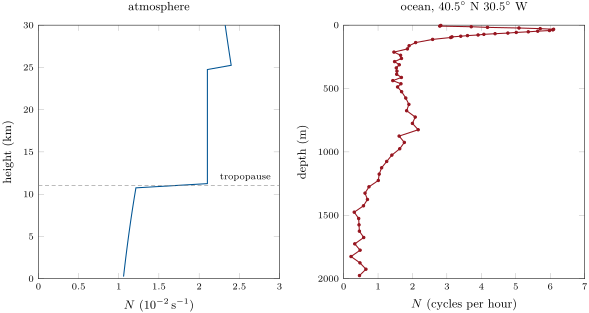

Buoyancy frequency. Left, the standard atmosphere: nearly uniform in the troposphere, twice as large in the isothermal lower stratosphere, larger still above 25\, km where the temperature rises. Right, an annual-mean column of the North Atlantic (temperature and salinity from the World Ocean Atlas 2023, potential density from EOS-80): a sharp maximum in the seasonal pycnocline, weak stratification below.
Buoyancy frequency. Left, the standard atmosphere: nearly uniform in the troposphere, twice as large in the isothermal lower stratosphere, larger still above 25 km25\,\mathrm{km} where the temperature rises. Right, an annual-mean column of the North Atlantic (temperature and salinity from the World Ocean Atlas 2023, potential density from EOS-80): a sharp maximum in the seasonal pycnocline, weak stratification below.
在原文中阅读 →