 Coach
A chondrite is a stony meteorite that never melted after it was assembled, and whose composition, apart from the most volatile elements, is close to that of the Sun. Most of it is made of chondrules, rounded droplets, a tenth of a millimetre to about a centimetre across, of silicate rock that solidified from a melt, set in a fine-grained matrix with grains of iron–nickel metal and iron sulfide. Some chondrites hold calcium–aluminium-rich inclusions (CAIs), irregular white grains of the minerals of calcium, aluminium and titanium that are the first condensates of the nebula. A carbonaceous chondrite is a chondrite rich in carbon, water-bearing minerals and matrix, whose content of the volatile elements comes closest to the Sun’s.
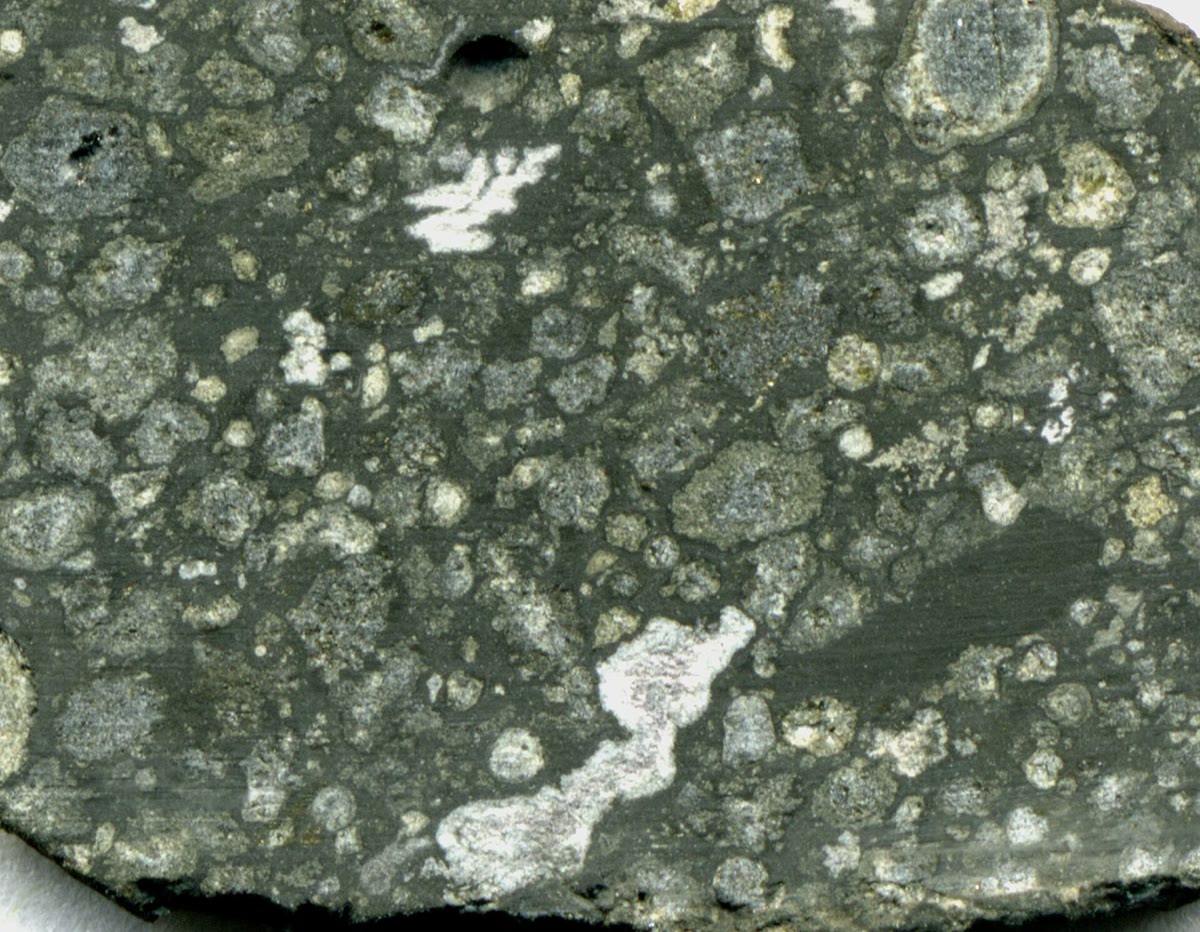
| H | L | LL | CI | CM | CV | |
|---|---|---|---|---|---|---|
| chondrules (vol. %) | 60–80 | 60–80 | 60–80 | 20 | 45 | |
| mean chondrule diameter (mm) | 0.3 | 0.7 | 0.9 | — | 0.3 | 1.0 |
| CAIs (vol. %) | 0.1–1 | 0.1–1 | 0.1–1 | 5 | 10 | |
| matrix (vol. %) | 10–15 | 10–15 | 10–15 | 70 | 40 | |
| iron–nickel metal (vol. %) | 10 | 5 | 2 | 0 | 0.1 | 0–5 |
| fayalite in olivine (mol %) | 16–20 | 23–26 | 27–32 | |||
| petrologic types | 3–6 | 3–6 | 3–6 | 1 | 2 | 3 |
| highest temperature (K) | 1220 | 1220 | 1220 | 430 | 670 | 870 |