
All books

Professional

Apps About Coach Log in Start reading

Earth and Space Sciences · Glossary

What is Closure temperature, cooling age?

Also known as: closure temperature · cooling age

Definition 25.12 University Earth and Space Sciences — Year 1 · Chapter 25 — Radiometric Dating Methods

The closure temperature of a mineral for a decay system is the temperature below which the parent and daughter atoms no longer diffuse in or out of its lattice fast enough to matter, so that the mineral behaves as a closed system. A cooling age is an age measured in a mineral that formed above its closure temperature: it dates the moment the mineral cooled through that temperature, not the moment it formed.
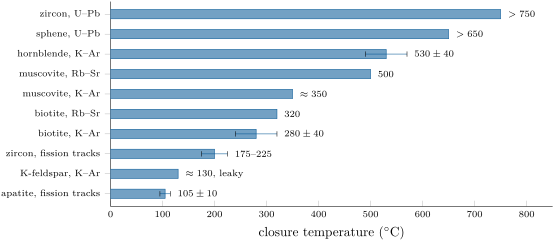
Closure temperatures of the main mineral clocks, from one published table. U–Pb is uranium–lead, K–Ar potassium–argon (and argon–argon), Rb–Sr rubidium–strontium. For fission tracks the value is the temperature at which the tracks heal.
Read in context →